

There’s a version of this story that happens in a lot of households.
One parent does the dishes. The other parent notices the dishwasher needs rinse aid, remembers the pediatrician appointment needs rescheduling, realizes the school forms are due Friday, and mentally files that the babysitter hasn’t been paid yet.
The one who did the dishes gets credit for helping. The one who held all of that in their head — tracking, planning, anticipating, remembering — is just called “organized.”
That second job is the mental load of motherhood. And if you’ve been feeling exhausted in a way that doesn’t quite match how much you’ve actually done, this is probably why.
Table of Contents
What the Mental Load of Motherhood Actually Is
The mental load of motherhood is not a to-do list. It’s the invisible cognitive work of running a household and a family — the constant mental monitoring, planning, and decision-making that happens before any task is even started.
It’s knowing the doctor appointment needs to happen before you make the call. It’s tracking that the formula is running low before you run out. It’s holding in your head that your child has a birthday party next Saturday, which means a gift needs to be bought, wrapped, and remembered — and that it conflicts with the dentist, which means that needs to be moved.
None of those things appear on anyone’s task list. They live in your head, constantly running in the background, draining cognitive resources even when you’re sitting still.
In 1989, sociologist Arlie Hochschild documented this in her landmark book The Second Shift, showing that women who worked full-time still performed the majority of domestic labour at home. More recently, French cartoonist Emma’s viral comic “You Should’ve Asked” brought the concept into mainstream conversation: the problem isn’t who does the tasks. It’s who has to think of them in the first place.
Research from the American Psychological Association confirms that women report significantly higher levels of stress related to family responsibilities than men — even in households that consider themselves egalitarian.
What the Mental Load of Motherhood Looks Like in Real Life
Let me make the mental load of motherhood concrete, because most descriptions stay too abstract to land.
Right now, in my head, at any given moment, I am tracking:
There is one carton of milk left. Butter is almost gone. The dried fruits are done. I need to write a supermarket list before Wednesday or we won’t have the basics for the rest of the week. The supermarket list itself requires mental capacity — remembering what we have, what we used, what my nutritionist said to prioritize, what the kids will eat this week.
There are boxes that need a home. Somewhere in this apartment there is a logical place for them and I need to find it — but finding it requires a mental audit of every storage space we have and a decision about what gets moved where. The whole task sits undone in my head, taking up space, because it requires a level of cognitive engagement I haven’t had available.
The winter clothes are still in the summer wardrobe. The seasonal switch needs to happen — pull everything out, sort by size, pack what the kids have grown out of, identify gaps, put the summer things front. It’s a half-day project minimum and I am the one who knows what size everyone is, what fits, what needs replacing.
The curtain rail needs fixing. The frame in my toddler’s room fell off the wall and needs reattaching. The window security locks — the ones you install to prevent a toddler from opening a window wide enough to fall out — are still in a bag somewhere because they haven’t been installed. I know all of this. I know who needs to do each thing. I know which ones have been waiting for weeks.
The baby needs to sleep in approximately two hours. I know this because I track his wake windows. I know what he’s eating today and in what sequence. I know when his next pediatrician check is and which vaccines he needs. I know which development milestones we’re watching for this month.
And I know all of this simultaneously, passively, without being asked, without a system that holds it — just my brain, running it as background process, all day, every day.
This is the mental load of motherhood. Not any one item on the list. The fact that the entire list lives in one person’s head while the rest of the household operates without holding any of it.
The one exception I’ve made: finances. I was managing the household finances for years. I tracked accounts, payments, subscriptions, savings, everything. This year I transferred full ownership of finances to my husband. Not the tasks — the whole domain. He now knows what we have, what goes where, what needs attention. I no longer carry it at all.
That transfer of one domain reduced my cognitive load measurably. Not because the work went away. Because someone else is now thinking about it.
The Numbers Behind the Feeling
The mental load of motherhood is not anecdote. It is documented, measurable, and consistent across cultures and income levels.
- Women perform an average of 4 hours more unpaid domestic work per day than men globally, according to UN Women
- 80% of mothers report being the primary “household manager” — the one who tracks, delegates, and follows up on family logistics
- In a Harvard Business Review study, 58% of working mothers identified cognitive overload — not physical exhaustion — as their primary source of burnout
The mental load of motherhood is not a feeling. It is a structural imbalance with numbers attached.
Why the Mental Load of Motherhood Hits Moms Abroad Harder
For mothers living far from their home country, the mental load of motherhood has an extra layer that rarely gets acknowledged.
There’s no family nearby to call when childcare falls through. No grandmother who knows the pediatrician. No sister who can pick up the kids if you’re sick. Every logistical safety net that other families take for granted — the informal village of people who absorb small tasks and provide backup — has to be rebuilt from scratch in a country that isn’t yours.
You are navigating a healthcare system in a different language. Figuring out school enrollment where the system works differently from the one you grew up in. Managing the emotional labour of homesickness, cultural adjustment, and identity shift — on top of the regular mental load of running a household and a career.
I moved from the Dominican Republic to Madrid, and then from Madrid to Valencia. The practical implications of that for the mental load of motherhood are real: I have no family backup. Every appointment, every emergency, every logistical gap is mine to manage or to coordinate. There is no “my mother can take the kids” option. There is no informal support structure absorbing the overflow.
This is not weakness. This is an objectively harder situation — and it’s worth naming, because the mental load of motherhood research rarely accounts for the expat layer.
Why the Mental Load of Motherhood Is Invisible
The mental load of motherhood is hard to see — and that invisibility is part of what makes it so exhausting.
Physical labor is visible. Dirty dishes, an unmopped floor, a pile of laundry — these can be seen and evaluated. Cognitive labor is not. The hours spent tracking, anticipating, planning, and remembering leave no visible trace. They don’t show up in any ledger. They don’t get acknowledged in any conversation about who does what.
This is why “I do half the tasks” doesn’t solve the mental load of motherhood. If one partner does half the tasks but the other partner still has to know which tasks need doing, when, and how — the cognitive load remains entirely unshared.
The labor of noticing is different from the labor of doing. And for most mothers, the labor of noticing is entirely theirs.
The Symptoms Nobody Connects to the Mental Load
If you’re carrying a heavy mental load of motherhood, it shows up in specific ways that are easy to misattribute:
You can’t relax even when you have time to. When you finally sit down, your brain is still running — reviewing the list, catching things you might have missed. Rest doesn’t feel restful because your cognitive background process never actually switched off.
You feel resentful in ways you can’t fully explain. Your partner isn’t doing anything obviously wrong, but something feels deeply unfair. That feeling is usually correct — it is unfair, and the mental load research documents exactly why.
You snap at small things. Not because the small thing matters, but because your cognitive bandwidth is completely full and one more thing tips the balance. The snap isn’t about the thing. It’s about everything that came before it.
You’re the one who wakes up mentally at midnight. You’re the one who thinks “did I lock the door.” You’re the one who remembers the permission slip at 11pm. The mental load of motherhood doesn’t observe sleep hours.
You feel like you can never fully hand anything off. Because handing off a task without handing off the tracking of that task isn’t actually handing off at all. You still know it needs to happen. You’re still watching to make sure it does.
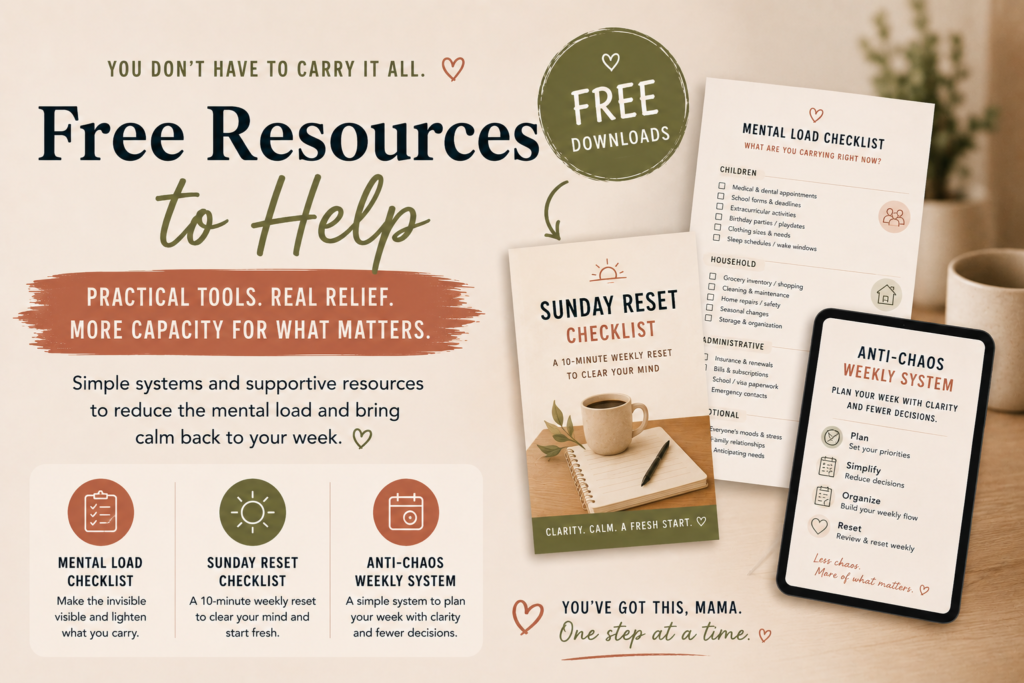
Mental Load Checklist: What Are You Carrying Right Now?
Use this to make the mental load of motherhood visible. Check everything you’re currently responsible for tracking or managing — not doing, tracking.
Children
- Medical and dental appointments
- Vaccine schedule and upcoming boosters
- School forms and deadlines
- Extracurricular activities and logistics
- Playdates and birthday parties
- Clothing sizes and what needs replacing
- Developmental milestones to watch for
- Sleep schedules and wake windows
Household
- Grocery inventory and shopping list
- Seasonal wardrobe changes
- Storage organization and what needs a home
- Cleaning schedule and maintenance tasks
- Home repairs that are waiting to happen
- Safety items that need installing
- Bills, subscriptions, and renewal dates
Administrative
- Insurance documents and renewals
- School enrollment and paperwork
- Visa and residency requirements (especially relevant abroad)
- Family finances (if this is yours)
- Emergency contacts and protocols
Emotional
- Monitoring everyone’s mood and stress levels
- Managing family relationships and dynamics
- Anticipating what each child needs before they ask
Count your checks. If it’s more than 15, you’re carrying a heavy mental load. If it’s more than 20, the cognitive overload you feel is entirely proportional to what you’re actually managing.
Why “Just Ask for Help” Doesn’t Fix the Mental Load
The most common advice for the mental load of motherhood is to ask your partner to do more. It misses the core problem entirely.
The cognitive labor of knowing what needs to happen is different from the physical labor of doing it. If you still have to tell your partner what to do — you still carry the mental load of motherhood. You’ve delegated a task. You haven’t transferred ownership.
“Can you book the dentist” means you still tracked that it needed booking, you still decided it was time, and you’ll probably still follow up to make sure it happened. The mental load stayed with you.
“You’re in charge of all the kids’ medical appointments — finding the clinic, booking, tracking the schedule, following up” means someone else now holds that domain in their head. The mental load transferred.
The difference sounds subtle. The impact on your cognitive capacity is not.
What Actually Helps Reduce the Mental Load of Motherhood
There is no complete solution to the mental load of motherhood within the current structures most families operate in. But these three approaches meaningfully reduce the weight.
1. Make the invisible visible
Get everything out of your head and onto paper — or a shared document, or a whiteboard on the fridge. When the mental load of motherhood becomes visible, two things happen: your partner can see what you’re actually carrying, and your brain gets partial relief from not having to hold it all simultaneously.
The mental load checklist above is a starting point. Go through it together.
2. Transfer domains, not tasks
Instead of splitting individual tasks, assign each person full ownership of specific areas of household life. When you own a domain — truly own it, tracking included — you think about it, manage it, and deal with the consequences. The other person never has to hold it.
I transferred the finances domain to my husband this year. Not “help with the finances.” Complete ownership. He now knows everything about our financial situation and I don’t have to carry any of it. That single transfer had an outsized effect on my cognitive load.
Pick the domain that costs you the most. Start there.
3. Reduce the decision volume systematically
Many items on the mental load of motherhood list generate recurring decisions — what’s for dinner, when to do the grocery run, which tasks happen this week. Systems that automate recurring decisions reduce the cognitive load without requiring anyone to do more.
A weekly meal template. A standard grocery list baseline. A recurring calendar reminder for household tasks. These don’t eliminate the mental load of motherhood — but they meaningfully reduce the decision volume it generates day to day.
This is the core logic behind the Anti-Chaos Weekly System — not more planning, but fewer decisions made in real time. When the decisions are made in advance, the week runs on structure rather than on your depleted cognitive reserves.
The Mental Load and Your Body
One thing that rarely gets connected in mental load conversations: the mental load of motherhood has a measurable physiological cost.
Chronic cognitive overload activates the same stress response as physical threat. Cortisol rises. Sleep quality degrades — even when you’re physically exhausted, a brain running too many background processes doesn’t fully switch off at night. Decision fatigue accumulates. Emotional regulation becomes harder.
If you’ve noticed that your body feels the mental load of motherhood even when you’re resting — elevated tension, difficulty sleeping despite exhaustion, that feeling of being permanently slightly wired — this is the mechanism. It’s not weakness. It’s physiology.
I recently got blood work done and found measurable hormonal markers of sustained stress — low DHEA, low Vitamin D, improvable B12 — all consistent with years of chronic cognitive and physiological demand. The mental load of motherhood leaves biological traces. That post goes into the full picture: Why Moms Are Always Exhausted: What My Blood Work Revealed.
A Practical Summary
- The mental load of motherhood is the invisible cognitive work of tracking, anticipating, and managing household and family life — not the tasks themselves, but the mental overhead of knowing they need doing
- It’s documented and measurable — not a feeling, not a complaint, a structural imbalance with research behind it
- Moms abroad carry more — without the informal village of nearby family, every logistical gap falls on you
- It shows up physically — as restlessness, resentment, snapping, and inability to relax even during downtime
- “Ask for help” doesn’t fix it — transferring tasks without transferring ownership leaves the cognitive load in place
- What actually helps: making it visible, transferring full domain ownership, and reducing recurring decision volume through systems
Frequently Asked Questions
What is the mental load in motherhood?
The mental load of motherhood refers to the invisible cognitive work of managing a household and family — the planning, tracking, anticipating, and decision-making that happens before any visible task begins. It’s not the dishes; it’s knowing the dishes need to be done, that the soap is running out, and that someone needs to order more.
Why are moms mentally exhausted even when they’re resting?
Because the mental load of motherhood doesn’t switch off. Even when you’re physically still, your brain is running a background process — reviewing the list, catching what might get missed, anticipating tomorrow. That background cognitive activity is genuinely tiring, even without visible output.
What are examples of mental load?
Examples of the mental load of motherhood include: tracking that milk is running low before you run out, knowing your child needs a seasonal wardrobe change and what sizes they’re in now, remembering which home repairs are pending and who needs to do them, monitoring vaccine schedules, managing grocery inventory, and anticipating everyone’s needs before they’re expressed.
Why does the mental load fall on moms?
Research consistently shows the mental load of motherhood falls disproportionately on women due to deeply ingrained social expectations about who manages domestic and family life. This happens even in households where partners consider themselves egalitarian — the default assumption that the mother tracks and manages persists regardless of stated values.
How do couples share the mental load fairly?
The most effective approach is domain ownership, not task splitting. Assign each partner full responsibility for specific areas of household life — so each person thinks about, tracks, and manages their domains without needing to be told. This requires a deliberate conversation to set up but dramatically reduces the cognitive load on both partners over time.
Is the mental load making me physically unwell?
It can. Chronic cognitive overload activates the stress response, raises cortisol, degrades sleep quality, and contributes to the kind of hormonal depletion that shows up in blood work. The mental load of motherhood has measurable physiological consequences — it’s not just emotional.
How do I explain the mental load to my partner?
The checklist in this post is a starting point — go through it together so your partner can see what you’re actually tracking. The key is making the invisible load visible before having the conversation about how to redistribute it. Emma’s comic “You Should’ve Asked” is also an accessible starting point for partners who are genuinely willing to understand.
Can reducing the mental load actually reduce my exhaustion?
Yes — but only if you transfer ownership of domains rather than individual tasks. When someone else truly holds a domain — tracking it, managing it, following up on it — the cognitive load genuinely reduces. Partial solutions, where you still have to monitor whether tasks are being done, don’t meaningfully reduce the mental load of motherhood.
If you want to reduce the decision volume the mental load generates, the Anti-Chaos Weekly System helps you build a weekly structure where fewer decisions need to be made in real time. And the free Sunday Reset Checklist is a 10-minute weekly process that gets the most pressing items out of your head and into a plan.





2 Comments on “The Mental Load of Motherhood: 7 Brutal Truths Nobody Talks About”