
The first week I tried to work from home with a baby, I sent an email to the wrong person, forgot a meeting, and cried in the bathroom while my son slept on the baby monitor.
I am not telling you this to bond over shared trauma. I’m telling you because I want to be honest about what the early days of trying to work from home with a baby actually look like — before you find the version that works.
And there is a version that works. I promise. But it looks nothing like the productivity advice you’ll find if you search for it.
Table of Contents
Why Most Work From Home With a Baby Advice Doesn’t Apply
The standard work-from-home advice assumes a few things: dedicated work hours, a door you can close, manageable interruptions, and calendar blocks that hold.
None of those apply when the person you’re home with is a baby.
Babies don’t respect calendar blocks. They don’t understand “I’m on a call.” And if you’re breastfeeding, you can’t even fully hand off physical caregiving — your body is part of the job.
Most work from home with a baby advice also assumes a fairly standard job — one where you can be largely invisible for hours and nobody notices. That assumption breaks down completely if you’re in a leadership role, managing a team, running campaigns with real deadlines, or expected to be available and responsive during core hours.
I am a Marketing Director. My role has meetings, direct reports, stakeholder communication, and deliverables that require sustained strategic thinking. Work from home with a baby as a Marketing Director is a specific kind of challenge — not just “being available” but being sharp, present, and decisive during unpredictable windows of cognitive capacity.
The solution I eventually landed on wasn’t a better morning routine. It was a structural decision: I talked to the company and hired someone in-office to manage the team operationally and handle day-to-day tasks directly. That freed me to focus on the strategic work that actually requires my full attention — and to do it in the windows when I actually have that attention available.
Not everyone can make that specific call. But the principle behind it applies to everyone trying to work from home with a baby: the goal is not to compress a full-time job into nap windows. The goal is to identify which parts of your job require your best cognitive presence and protect those ruthlessly.
What Working From Home With a Baby Actually Looks Like
Let me give you a real day rather than an ideal one.
This morning: I woke up, made coffee, and drank it while playing with both kids. Not at my desk — on the floor, present, because that’s what the morning requires. My toddler went to school with my husband. I put the baby down for his morning nap. While he slept, I did a quick tidy of the house — not deep cleaning, just the baseline that keeps the visual environment calm enough for my brain to function.
When the baby woke up, I got him ready and took him to my mother-in-law’s house, where he stays until 5pm. I came home, sat down with breakfast, and started working. Today that meant working on this project — something that requires creative and strategic thinking — and that’s exactly the kind of work I protect my morning window for.
My afternoons have meetings. That’s intentional — I schedule anything that requires real-time presence and communication in the afternoon, when the baby is reliably out of the house and I can give my full attention without the ambient anxiety of someone needing something from me.
At 5pm the kids come home and work stops, unless there’s something genuinely urgent. The evening is family time — dinner, bath, bedtime routines. Sometimes I return to work after 8:30pm if I need to finish something. Sometimes I don’t.
This is not a perfect system. Some days the baby doesn’t go to my mother-in-law’s. Some days my toddler is sick and doesn’t go to school. Some days I work in my pyjamas because I don’t have the energy to change before the first call starts. Some weeks everything collapses and I’m functioning on bare minimum.
But this is the shape of work from home with a baby when it’s actually working — not productivity influencer working, but real, sustainable, mostly functional working.
The Structural Shift That Changes Everything
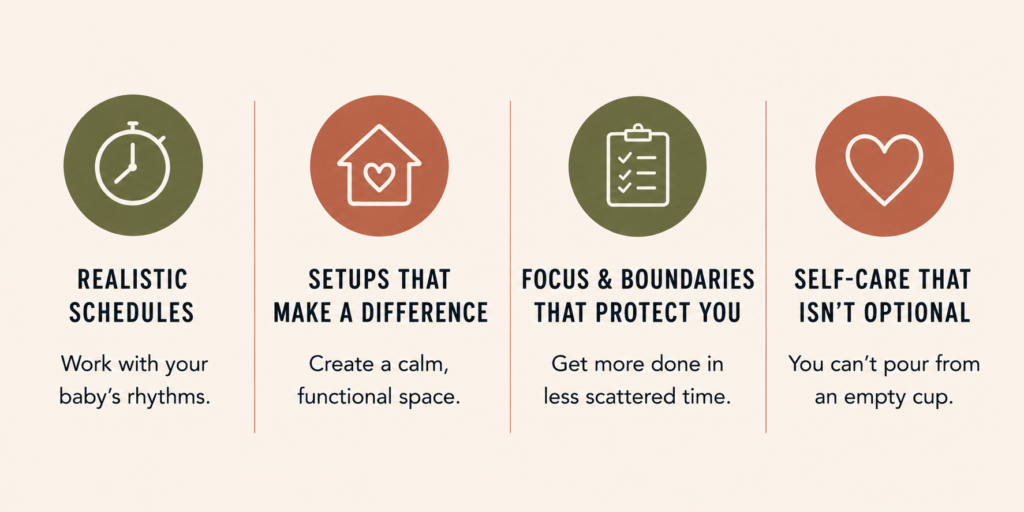
Most advice about how to work from home with a baby focuses on tactics — the right schedule, the right nap routine, the right tools. Tactics help. But the most important shift is structural, and it’s the one nobody talks about.
You cannot work from home with a baby the same way you worked before the baby. The cognitive fragmentation, the unpredictability, the constant ambient awareness of another person’s needs — these change what’s actually possible during any given hour. The question is not how to get the old version of yourself back. It’s how to design work around the person you actually are now, in the conditions you actually have.
That structural shift looks different for everyone. For me it meant:
Identifying which parts of my job require my best thinking — strategic decisions, creative work, complex communication — and protecting those for my sharpest window.
Being honest with my employer about what I needed — which led to the hire that changed my working situation more than any scheduling trick.
Accepting that some days are maintenance days — low cognitive load tasks, meetings, admin — and some days are deep work days. Not every day can be both.
Building a weekly structure rather than a daily schedule — because daily schedules collapse when the baby doesn’t cooperate. A weekly structure is more resilient. If Monday is a disaster, Tuesday can recover it.
According to Harvard Business Review, working mothers who set explicit boundaries around their highest-value work — protecting specific blocks for deep work rather than staying broadly available throughout the day — report significantly higher productivity and lower burnout than those who try to maintain constant availability.
What Working From Home With a Baby Actually Requires
Before strategies, a clear-eyed assessment of what makes this sustainable at all:
Some form of childcare, even limited. The mothers who work from home with a baby without any childcare are in survival mode. Two to three hours of reliable support — a partner who takes a morning shift, a family member, a childminder for part of the day — changes the mathematics entirely. It’s not a luxury. It’s infrastructure.
A job with some flexibility in how work happens. If your role requires you to be available and responsive 9 to 5 with back-to-back meetings, work from home with a baby is genuinely very hard without additional full-time childcare. Jobs with high autonomy, async communication, and output-based evaluation are significantly more compatible with the reality of working with a baby at home.
A different definition of productive. Two focused hours of real work can equal five fragmented hours of trying to work while half your attention is on a baby. Output matters more than time at desk. This sounds obvious. It takes most remote working moms a surprisingly long time to actually internalize it.
Permission to have bad weeks. Work from home with a baby means some weeks are genuinely not productive. The baby is in a regression. You haven’t slept. Your cognitive reserves are gone. Having a minimum viable work week defined in advance — the three things that absolutely must happen regardless of circumstances — means bad weeks don’t cascade into lost months.
A Realistic Work From Home With a Baby Schedule
This is not a perfect schedule — it’s a realistic one, built around a baby who naps twice a day, with partial external childcare in the afternoon.
| Time | Baby | You |
|---|---|---|
| 6:00–7:00am | Baby asleep or early wake | Optional early window — highest focus work if you have it |
| 7:00–9:00am | Both kids awake — morning routine | Minimum screen time, full presence with kids |
| 9:00–10:30am | Baby nap 1 | First work window — deep work, strategic tasks |
| 10:30am–12:00pm | Baby awake | Lighter tasks, baby on play mat nearby if no childcare |
| 12:00–5:00pm | Baby at childcare | Core work window — meetings, focused work, deliverables |
| 5:00–8:00pm | Kids home — family time | Work stops unless genuinely urgent |
| 8:30pm+ | Kids asleep | Optional evening window for overflow |
The key insight in this schedule: the most cognitively demanding work goes in the morning window before meetings start. Meetings are grouped in the afternoon. Nothing important gets scheduled at the unpredictable edges.
The Specific Challenges Nobody Prepares You For
The guilt runs in both directions. When you’re working you feel guilty for not being present with the baby. When you’re with the baby you feel guilty for not working. The guilt doesn’t fully resolve — but it gets quieter when you have a structure you trust, because the structure tells you that this time is for this thing, and both things are getting their time.
The cognitive fragmentation is real and cumulative. Working from home with a baby means your brain is running two tracks simultaneously — the work track and the parent track — even when you’re supposed to be fully on one of them. A sound on the baby monitor mid-presentation. The awareness that the nap window is closing. The peripheral visibility of everything that needs doing at home. This fragmentation is not a personal failing. It is a feature of the environment.
The loneliness compounds. Working from home, with a baby, in a country that isn’t yours, without family nearby — the isolation is its own kind of exhaustion. The social contact that an office provides, the ambient human presence of colleagues, the simple act of talking to someone who isn’t a baby — all of that disappears. Finding a community of mothers in similar situations, even online, changes something real.
The identity blur is disorienting. When you’re at home, you’re never fully at work, and never fully just a mother. The feeling of failing at both is a symptom of the structure, not your competence. It’s what happens when two roles share the same physical space without clear transitions between them.
The unpredictability is structural, not temporary. Some days you get everything done. Some days the baby is in a developmental leap and nothing holds. Building a system that absorbs bad days without collapsing — rather than building a system that requires good days to function — is the whole game.
The Practical Toolkit for Working From Home With a Baby
A weekly planning session — 20 minutes, every Sunday. Before the week starts, decide your three work priorities, your minimum viable work week, and your non-negotiables. When Monday morning arrives in chaos, the decisions are already made.
A minimum viable workday definition. What does a day need to contain to count as okay? For me it’s: one strategic task completed, no missed meetings, inbox processed once. Everything else is bonus.
Async-first communication where possible. Every time you can replace a meeting with a message, you recover a protected work window. If your role allows it, push for fewer real-time meetings and more output-based accountability.
The right structure for your specific role. Generic work from home with a baby advice doesn’t account for what kind of work you actually do. A freelance writer needs different strategies than a Marketing Director. A part-time remote worker needs different strategies than someone with a full team to manage. Start from your actual role, not a generic template.
External childcare as infrastructure, not luxury. Even two or three hours a day of reliable external support is not indulgent — it’s the foundation that makes sustainable remote work with a baby possible. If family can provide it, that’s the starting point. If not, it’s worth treating childcare as a work expense rather than a personal one.
The Anti-Chaos Weekly System was built for exactly this situation — remote work, motherhood, unpredictable weeks, not enough cognitive bandwidth for a standard planning system. It’s the planning tool I use to make sure my work priorities don’t get swallowed by the week before I’ve had a chance to act on them.
What Nobody Tells You About Work From Home With a Baby Long-Term
There is a version of this that gets easier. Not immediately — but it does shift.
The baby becomes a toddler. Sleep stabilizes somewhat. Childcare becomes more consistent. The cognitive load of the baby’s immediate physical needs reduces as they become more independent. The job that felt impossible to manage from home starts to feel, if not easy, at least sustainable.
What you build in this early season matters. The habits of working in focused blocks rather than scattered availability, the structural decisions about your role and what it requires from you, the weekly planning practice that keeps your priorities from getting lost — these don’t just help now. They become the foundation of how you work long after the baby stage is over.
Work from home with a baby teaches you, by necessity, to protect your best cognitive hours and to be ruthless about what actually requires your attention. Those are skills worth having.
A Practical Summary
- Work from home with a baby requires structural adaptation, not just scheduling tactics
- Identify your highest-value work and protect it for your sharpest window — everything else fits around it
- Some form of childcare — even a few hours — is infrastructure, not luxury
- Cognitive fragmentation is real — two tracks running simultaneously drains more than the individual tasks would suggest
- Batch your meetings — group real-time communication so your deep work windows stay protected
- Define your minimum viable workday before the week starts, not in the middle of a bad day
- The identity blur is structural — not failing at both roles, navigating two roles sharing one space
- It does get easier — what you build now becomes how you work long-term
FAQ
Can you realistically work from home with a baby?
Yes — but with adjusted expectations and usually some form of childcare support. Two to three focused work windows per day, built around nap times and any external childcare, can add up to a productive and sustainable workday. The key is defining what “productive” means in your specific role, not comparing to a pre-baby standard.
How many hours can you realistically work with a baby at home?
Most mothers working from home with a baby manage three to five focused hours per day, spread across nap windows and childcare time. This is enough for flexible or part-time roles and many full-time roles with high autonomy. Roles requiring constant real-time availability are harder without additional childcare.
What is the best schedule for working from home with a baby?
The most effective schedule puts the highest-focus work in the morning window before meetings, groups meetings in the afternoon, and treats nap times as protected work time rather than household time. The exact timing depends on your baby’s sleep pattern and your role’s requirements — the principle matters more than the specific hours.
How do you handle video calls when working from home with a baby?
Whenever possible, group calls into predictable windows when you have reliable childcare or a reliable nap window. For unavoidable calls during uncertain times, a bouncer or safe play space nearby buys short windows. Most employers are increasingly understanding about brief baby appearances — transparency with your manager about your situation is usually more effective than trying to hide it perfectly.
What types of jobs work best when working from home with a baby?
Roles with high autonomy, async communication, and output-based evaluation work best. Writing, marketing strategy, design, consulting, virtual assistance, and content creation are all compatible with working in focused blocks. Leadership roles are manageable with the right structural adaptations — like delegating operational tasks to someone with more consistent in-office presence.
How do you maintain focus when working from home with a baby?
The most effective approach is to decide your single most important task before the work window starts — not during it. Cognitive bandwidth is too limited when you’re tired and interrupted to make good priority decisions in real time. Pre-decided priorities reduce the decision load at the moment when it’s hardest to make good decisions.
What do you do when work from home with a baby becomes unsustainable?
The honest answer: something structural needs to change. More childcare. A conversation with your employer about role adjustments. A change in how work is distributed. Tactical improvements — better schedules, different apps — don’t fix structural mismatches. If every week feels impossible, it’s worth asking what the actual constraint is and addressing that directly.
How does remote work with a baby affect your career long-term?
This depends heavily on how you manage it and what your employer’s culture is. Moms who are explicit about their constraints, proactive about their output, and strategic about their role adjustments tend to maintain career momentum better than those who try to pretend nothing has changed. The transition is real — being honest about it with the right people usually produces better outcomes than trying to match a pre-baby performance standard indefinitely.
If you’re trying to get your week organized enough to protect your work windows, the Anti-Chaos Weekly System is the planning tool I built for this specific situation. And the free Sunday Reset Checklist is the 10-minute weekly reset that keeps the work priorities from getting buried under everything else.