
Meal planning for exhausted moms is not what the food blogs make it look like.
It is not a color-coded weekly spread with prepped containers stacked neatly in the fridge. It is not an elaborate Sunday cooking session. It is not homemade granola and smoothie bowls and forty minutes of morning prep.
It is: what can I make with the energy I actually have, that will not make me feel worse, that my kids will eat, and that takes as little decision-making as possible.
That’s the bar. And it’s a completely legitimate one.
I’ve been working with a nutritionist to address the measurable hormonal depletion that three years of motherhood produced — high cortisol, low DHEA, low Vitamin D, improvable B12. The protocol she gave me is built around food that supports cortisol regulation, energy production, and nervous system recovery. High protein, whole foods, no processed flour or sugar, dinner two hours before bed.
What I’ve learned in the process of trying to follow it while exhausted, breastfeeding, and managing two small children is that meal planning for exhausted moms has to be built around one principle above all others: reduce decisions, not just time.
Índice
Why Meal Planning Matters More When You’re Depleted
Most people think about meal planning as a time-saving strategy. For exhausted moms it’s something more fundamental than that.
When you’re chronically sleep-deprived, running low on cortisol reserves, and making decisions from a depleted cognitive state, the question of “what’s for dinner” at 6pm is genuinely harder than it looks. Decision fatigue is cumulative — and by evening, after a full day of work decisions, childcare decisions, household decisions, and the constant low-level management of everything that needs tracking, your brain has very little left for nutritional choices.
The result: takeout, cereal, whatever requires the least thought. Not because you’re lazy or don’t care about nutrition. Because your cognitive bandwidth is genuinely exhausted.
Research from the American Journal of Clinical Nutrition consistently shows that dietary choices deteriorate under cognitive load and stress — people default to higher-calorie, lower-nutrient options when decision capacity is low. For moms already dealing with the biological consequences of chronic stress, this creates a compounding problem: the stress depletes the nutritional reserves, and the depletion makes it harder to make the food decisions that would support recovery.
Meal planning for exhausted moms breaks that cycle. Not by requiring more effort — by front-loading the decisions so they don’t have to be made in real time.
The Honest Breakfast Problem
Let me tell you what my breakfast actually looks like on most mornings.
I pour oats into a bowl. I add milk, a spoonful of peanut butter, half a banana, and a drizzle of honey. I make coffee. Sometimes I add a yogurt on the side. I drink water.
That’s it. Not eggs. Not a hot meal. Not anything that requires me to touch the stove before I’ve had coffee and before both children have been managed.
The reason is simple: I have no energy to cook in the morning. I need to see a completely clear and organized kitchen before I have the mental capacity to do anything in it. And on most mornings, the kitchen is not clear and organized. So the breakfast that happens is the one that requires the least possible activation energy.
My nutritionist’s meal plan includes cooked breakfasts — eggs with spinach, savory toast with avocado and Iberian ham, almond pancakes. These are better nutritionally. They are also not happening before 9am in my current life.
What I’ve learned to do instead is optimize the breakfast I can actually make. Oats with peanut butter, banana, and a protein source — Greek yogurt on the side — is genuinely solid nutrition. High in protein, slow-releasing carbs, healthy fats. It takes three minutes. It requires zero cooking. And it happens.
The first rule of meal planning for exhausted moms: the meal you can actually make is infinitely better than the meal you can’t.
The Nutritionist Protocol Behind This System
I’m sharing the actual weekly plan my nutritionist built for me — because I think it’s one of the most realistic and sustainable eating frameworks I’ve seen for a postpartum, breastfeeding, chronically sleep-deprived woman.
The principles behind it:
High protein at every meal — protein supports cortisol regulation, muscle recovery, and sustained energy. For breastfeeding moms, protein needs are significantly higher than average. Most exhausted moms are chronically under-eating protein.
No processed flour or sugar — both spike blood sugar and contribute to the energy crashes that make afternoon exhaustion worse. This doesn’t mean no carbs — it means whole food carbs: sweet potato, quinoa, brown rice, legumes.
Dinner at least 1.5-2 hours before bed — eating too close to sleep affects sleep quality, which exhausted moms cannot afford to lose.
Vegetables at every meal, especially dinner — cooked vegetables at dinner specifically, because they’re easier to digest in the evening.
Snacks only when genuinely hungry — especially relevant for breastfeeding, where hunger is real and frequent.
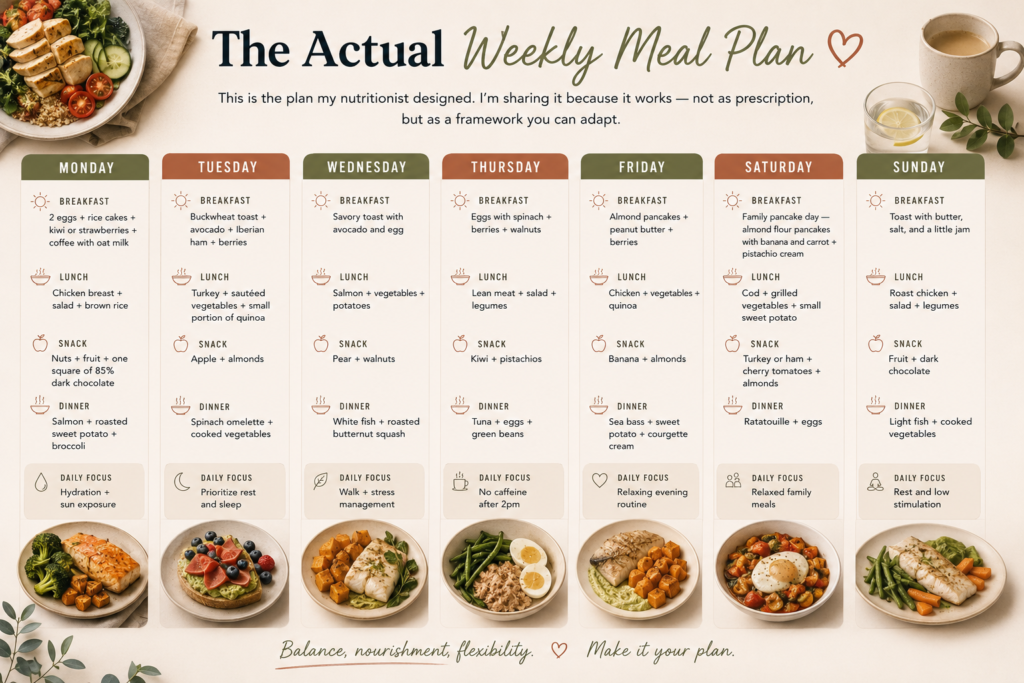
The Actual Weekly Meal Plan
This is the plan my nutritionist designed. I’m sharing it because it works — not as prescription, but as a framework you can adapt.
Monday
Breakfast: 2 eggs + rice cakes + kiwi or strawberries + coffee with oat milk Lunch: Chicken breast + salad + brown rice Snack: Nuts + fruit + one square of 85% dark chocolate Dinner: Salmon + roasted sweet potato + broccoli Daily focus: Hydration + sun exposure
Tuesday
Breakfast: Buckwheat toast + avocado + Iberian ham + berries Lunch: Turkey + sautéed vegetables + small portion of quinoa Snack: Apple + almonds Dinner: Spinach omelette + cooked vegetables Daily focus: Prioritize rest and sleep
Wednesday
Breakfast: Savory toast with avocado and egg Lunch: Salmon + vegetables + potatoes Snack: Pear + walnuts Dinner: White fish + roasted butternut squash Daily focus: Walk + stress management
Thursday
Breakfast: Eggs with spinach + berries + walnuts Lunch: Lean meat + salad + legumes Snack: Kiwi + pistachios Dinner: Tuna + eggs + green beans Daily focus: No caffeine after 2pm
Friday
Breakfast: Almond pancakes + peanut butter + berries Lunch: Chicken + vegetables + quinoa Snack: Banana + almonds Dinner: Sea bass + sweet potato + courgette cream Daily focus: Relaxing evening routine
Saturday
Breakfast: Family pancake day — almond flour pancakes with banana and carrot + pistachio cream Lunch: Cod + grilled vegetables + small sweet potato Snack: Turkey or ham + cherry tomatoes + almonds Dinner: Ratatouille + eggs Daily focus: Relaxed family meals
Sunday
Breakfast: Toast with butter, salt, and a little jam Lunch: Roast chicken + salad + legumes Snack: Fruit + dark chocolate Dinner: Light fish + cooked vegetables Daily focus: Rest and low stimulation
The Snack System
Snacks only when genuinely hungry — especially important during breastfeeding when hunger is real and frequent.
Sweet options:
- Small handful of nuts (20-25g)
- One piece of fruit — apple, pear, kiwi, small banana
- One square of 85% dark chocolate
Savory options:
- Iberian ham or turkey
- Cherry tomatoes
- Almonds
The rule: real hunger, not boredom or stress eating. The distinction matters because stress eating is one of the ways cortisol dysregulation shows up behaviorally — and feeding it with sugar creates the spike-and-crash cycle that makes afternoon energy worse.
The Supplements That Support the Food
Nutrition alone doesn’t address deficiencies that are already established. The supplements my nutritionist prescribed work alongside the food:
| Supplement | When |
|---|---|
| Omega 3 | With meals |
| Active B complex | Morning |
| Vitamin D3 + K2 | Morning with food |
| Magnesium | Night |
| Glycine / L-theanine | Before sleep |
The magnesium and glycine before sleep specifically support sleep quality — important for moms who are exhausted but whose sleep architecture is disrupted by stress hormones. Glycine has been shown in research published in Sleep and Biological Rhythms to improve sleep quality and reduce daytime sleepiness.
These are what I take under my nutritionist’s supervision for my specific results. Always discuss supplements with your own healthcare provider.
The Airfryer Changes Everything
Here is the single most practical piece of meal planning for exhausted moms advice I can give you: if you don’t have an airfryer, get one.
We use ours for almost every meal. The reason it works for exhausted moms is not that it’s faster — it’s that it requires almost no active attention. You put the food in, you set the temperature and time, and you walk away. You can breastfeed, respond to a work message, manage a toddler meltdown, or simply stand still for seven minutes while dinner makes itself.
What we make in the airfryer constantly:
Salmon + sweet potato — this is my anchor meal, the one that happens even on the worst weeks. Cut sweet potato into chunks, toss with olive oil and salt, airfryer at 200°C for 15 minutes. Add salmon fillets for the last 8 minutes. That’s dinner. High protein, complex carbs, omega-3s, minimal effort, minimal washing up.
Chicken breast — season with whatever you have, airfryer at 180°C for 18-20 minutes. Slice over a salad with whatever vegetables are in the fridge. Lunch sorted.
White fish — any white fish fillet, 180°C, 10-12 minutes. Add a side of pre-washed salad leaves from a bag. Dinner in 12 minutes.
Roasted vegetables — any combination of courgette, pepper, onion, sweet potato, broccoli — 200°C for 12-15 minutes. Goes with everything.
Eggs — you can cook eggs in the airfryer in a small oven-safe dish. 160°C for 10-12 minutes for a baked egg. Takes zero active attention.
The airfryer is the meal planning for exhausted moms tool that nobody talks about enough. Not because it’s revolutionary — because it removes the one thing that makes cooking impossible when you’re depleted: the need to stand over the stove and actively manage something.
How to Actually Implement Meal Planning When You’re Exhausted
The gap between having a meal plan and actually following it when you’re depleted is real. Here’s how to close it.
Step 1 — Reduce the decision to one question per day
Instead of planning every meal in detail, ask one question on Sunday: what are the three dinners this week? Not every dinner — three. The others can be flexible or repeat.
Write them down. Put them in the shared grocery list. That’s the meal plan.
Step 2 — Build your grocery list around anchors
Every week should have the same core items regardless of which specific meals you’re making. Mine are:
- Protein: salmon fillets, chicken breast, eggs, canned tuna, turkey slices
- Vegetables: sweet potato, broccoli, courgette, spinach, cherry tomatoes, salad leaves
- Breakfast: oats, Greek yogurt, bananas, peanut butter, berries
- Snacks: nuts, dark chocolate, fruit
- Pantry: olive oil, quinoa, brown rice, legumes
When these are always in the house, most meals can be assembled without a specific plan. The decision fatigue of “what’s for dinner” becomes “which protein + which vegetables + which carb” — three simple variables rather than an open question.
Step 3 — Batch cook one thing per week
Not a full Sunday meal prep. One thing. The thing that creates the most friction during the week.
For me it’s often hard-boiled eggs — eight at a time, in the airfryer (180°C, 15 minutes), stored in the fridge. Ready for breakfast, lunch additions, or snacks. One decision, made once, available all week.
Other options: a batch of quinoa or brown rice that goes with anything. A pot of legumes. Roasted vegetables for the next two days.
Step 4 — Keep the kitchen reset as a Sunday task
This is the one that unlocks everything else. I cannot cook in a messy kitchen — I need to see clear surfaces before I have the activation energy to start anything.
Five minutes on Sunday evening clearing the counters, emptying the dishwasher, and resetting the kitchen means Monday morning breakfast actually happens. It’s not about cleanliness. It’s about lowering the activation cost of cooking by removing visual friction.
Step 5 — Accept the tier system
Like everything in exhausted mom life, meals exist on a tier system:
Level 1 — Survival meals: Oats with peanut butter. Eggs on rice cakes. Canned tuna with salad leaves from a bag. These are nutritionally decent and require almost nothing. They are valid meals.
Level 2 — Standard meals: Airfryer salmon + sweet potato. Chicken breast + bag salad + quinoa from the batch cook. Omelette with whatever vegetables are in the fridge. These are the meals that happen most days when things are functioning normally.
Level 3 — Good days: The full nutritionist protocol meals — proper breakfasts, cooked lunches, varied dinners. These happen when energy is available. They are not the baseline expectation.
Meal planning for exhausted moms works when you plan for Level 2 most days, have Level 1 ready for the hard days, and let Level 3 happen when it does without building it into the weekly requirement.
Daily Habits That Support the Food System
The meal plan is one piece. These daily habits are what make it work:
- 2.5 litres of water daily — dehydration compounds cognitive blur and fatigue faster than almost any other variable. Especially important when breastfeeding.
- Sun exposure daily — even five minutes outside supports Vitamin D synthesis and circadian rhythm regulation
- Walk every day — movement that lowers cortisol without requiring a gym
- No caffeine after 2pm — caffeine after mid-afternoon disrupts sleep architecture even when you feel like you fall asleep fine
- Screens off 20 minutes before bed — blue light suppresses melatonin
- Dinner 1.5-2 hours before sleep — eating too close to sleep affects quality
None of these are new ideas. The challenge is implementing them consistently when you’re depleted. The system that helps is the same one that helps with any habit in this season: attach it to something that already happens, make it as frictionless as possible, and accept imperfect consistency over perfect inconsistency.
The Connection Between Food and Everything Else
Meal planning for exhausted moms is not separate from the mental load, the organization systems, or the sleep content on this blog. It’s foundational to all of it.
Cortisol regulation depends on protein intake, blood sugar stability, and sleep quality. Decision fatigue is worse when blood sugar is unstable. Sleep quality is affected by what and when you eat. The organizational capacity to function — to plan a week, to maintain a system, to show up for work — is directly affected by how well you’re feeding your body.
I wrote about the measurable biological cost of three years of motherhood on my cortisol and DHEA levels in Why Moms Are Always Exhausted: What My Blood Work Revealed. Food is one of the primary levers for addressing what that blood work showed. Not a supplement, not a morning routine — food, consistently, built around what your body actually needs in this season.
The Anti-Chaos Weekly System includes a weekly meal planning slot — because getting the food piece into the weekly structure is the difference between it happening and it not happening. And the Sunday Reset Checklist includes a kitchen reset as one of the weekly tasks, for exactly the reason described above.
Un resumen práctico
- Meal planning for exhausted moms is about reducing decisions, not adding structure
- The meal you can actually make is better than the perfect meal you can’t
- High protein at every meal is the single highest-impact nutritional change for depleted moms
- The airfryer removes the active attention cooking usually requires — making real meals possible even on depleted days
- Three dinners planned per week is enough. The rest can flex.
- A standard grocery list means most meals can be assembled without a specific plan
- One batch cook item per week — not a full Sunday session, just one thing
- The kitchen reset on Sunday is what makes Monday breakfast actually happen
- Level 1, 2, and 3 meals — plan for Level 2, have Level 1 ready, let Level 3 happen when it does
FAQ
How do exhausted moms find time to meal plan?
The goal is not more time — it’s fewer decisions. A five-minute Sunday session to decide three dinners and check the grocery staples is enough. The meal plan doesn’t need to be elaborate to be effective.
What should exhausted moms eat for energy?
High protein foods at every meal — eggs, chicken, salmon, legumes, Greek yogurt — stabilize blood sugar and support cortisol regulation. Complex carbohydrates from whole foods provide sustained energy without the spike-and-crash cycle of processed carbs and sugar.
Is meal planning realistic for moms with babies and toddlers?
Yes — with the right system. The key is reducing the decision to its simplest form: three dinners, a standard grocery list, one batch-cooked item. That’s the whole system. Everything else adapts around it.
What is the easiest healthy meal for an exhausted mom?
Airfryer salmon with sweet potato and any green vegetable. Fifteen to twenty minutes total, almost no active cooking, genuinely nutritious. This is the meal that holds even on the worst weeks.
How does nutrition affect mom exhaustion?
Directly and measurably. Chronic stress depletes Vitamin D, B12, and adrenal hormones like DHEA. Poor nutrition — especially low protein and unstable blood sugar — compounds that depletion. Eating to support cortisol regulation and nervous system recovery is one of the most effective things a depleted mom can do for her energy and cognitive function.
What should moms eat for postpartum recovery?
High protein to support tissue repair and hormone production, complex carbohydrates for sustained energy, omega-3 rich foods for inflammation and mood, and Vitamin D and B12 rich foods to address the deficiencies common in postpartum and breastfeeding. A nutritionist can order blood work to identify specific deficiencies and build a protocol around them.
How do I meal plan when I have no energy to cook?
Start with your anchor meal — the one thing you can always make regardless of energy. For me it’s salmon and sweet potato in the airfryer. Build the week around that anchor and one or two other low-effort meals. Accept that some meals will be survival-level simple. That’s not failure — that’s sustainable.
What is the best breakfast for an exhausted mom?
The best breakfast is the one you can actually make. Oats with peanut butter, banana, and Greek yogurt on the side is genuinely solid nutrition — high protein, healthy fats, slow-releasing carbs — and requires zero cooking. If you can manage eggs, even better. But don’t skip breakfast waiting for the energy to make the perfect one.
This post contains my personal experience with a nutritionist-designed protocol. It is not medical or nutritional advice. If you’re dealing with persistent exhaustion, hormonal symptoms, or postpartum depletion, speak with your doctor about getting blood work done — the specific numbers are far more useful than general wellness advice.
For the organizational piece — getting meal planning into your weekly structure consistently — the Anti-Chaos Weekly System includes a weekly planning framework that treats meal decisions like any other non-negotiable. And the free Sunday Reset Checklist has the kitchen reset built in.
Related: Why Your Baby Won’t Sleep (7 Real Reasons + What Actually Worked)





One comment on “Meal Planning for Exhausted Moms: 7 Powerful Strategies That Finally Work”