If you’ve been searching gentle sleep training for the last hour, I want to save you some time.
There are a lot of approaches out there. Some involve leaving your baby to cry. Some promise results in three days. Most require you to be a perfectly consistent robot at 3am when you’ve had four hours of broken sleep and your nervous system is running on empty.
The gentle sleep training method I’m going to walk you through is different. It’s called fading — sometimes called the chair method or gradual retreat — and it doesn’t require you to leave your baby alone or listen to them cry without responding.
But I also want to be honest about something before we start: the method itself is only half of what actually worked.
The other half was the daytime routine. And that’s the part almost nobody talks about.
Table of Contents
What Gentle Sleep Training Is — and What It Isn’t
Gentle sleep training doesn’t mean painless. Your baby will still fuss. You will still have hard nights. Progress will sometimes feel invisible.
What gentle sleep training means is that you never fully withdraw your presence. You don’t leave them to figure it out alone in a dark room. You stay — and you gradually, slowly, do a little less each night until they can fall asleep without you doing anything at all.
It’s harder than cry-based approaches in some ways, because it requires more patience and more nights. But for many moms — especially those of us who genuinely cannot leave our baby to cry — gentle sleep training is the only method that feels sustainable.
It also works alongside whatever feeding situation you’re in. Gentle sleep training doesn’t mean eliminating night feeds. It means teaching your baby to fall asleep independently — which is a different skill from sleeping through the night without hunger.
My Experience With Sleep Training — Including What Failed
I tried before I succeeded. And the first attempt failed completely.
My first son was what people call a high needs baby. The phrase is generous. What it means in practice is that everything that works for other babies — white noise, swaddles, putting down drowsy, Ferber — worked for us for approximately none of the nights we tried it. Twelve nights of Ferber went nowhere. He was not going to cry it out. His nervous system simply didn’t respond to it the way the method assumes a baby will.
I stopped trying. I moved him into my bed. And that’s where he slept until it was no longer working for any of us.
With my second son, I approached it differently. And what I discovered — the thing that changed everything — was not a better nighttime method. It was that the nighttime method only worked once I had built a solid daytime routine first.
Not a rigid schedule. A predictable daily rhythm — consistent wake times, consistent nap windows, consistent pre-sleep cues — that signaled to my son’s nervous system what was coming next. Once that rhythm was established, the fading method worked. Before it, nothing did.
If gentle sleep training has failed for you before, ask yourself this before you try again: is the daytime structure solid? Because the nighttime method sits on top of daytime foundations. Without those foundations, even the gentlest method struggles to hold.
Before You Start: The Daytime Foundation
This is the step most gentle sleep training guides skip entirely. Before night 1, spend one week building these three things.
Consistent Wake Times
Wake your baby at the same time every morning — within 30 minutes, even on weekends, even after a terrible night. Consistent wake times are the anchor of the circadian rhythm. Without a consistent start to the day, nothing that follows is predictable for your baby’s nervous system.
Age-Appropriate Wake Windows
Overtiredness is one of the most common reasons gentle sleep training stalls. When a baby is overtired, cortisol spikes — making it harder, not easier, to settle. Keeping to wake windows removes overtiredness as a variable before you start.
Wake windows by age:
- 4-5 months: 1.5-2 hours
- 5-6 months: 2-2.5 hours
- 6-8 months: 2.5-3 hours
- 8-10 months: 3-4 hours
- 10-12 months: 3.5-4.5 hours
A Consistent Pre-Sleep Routine
The same sequence of events before every nap and every bedtime — bath, feed, book, sleep sack, white noise, lights off, song — trains the nervous system to anticipate sleep. Over time this becomes a biological cue. The routine itself starts producing melatonin.
This doesn’t need to be long. Fifteen minutes for bedtime, five minutes for naps. It needs to be the same, in the same order, every time.
Once these three elements are consistent for at least five to seven days, you are ready to start the 21-night method.
Who Gentle Sleep Training Works For
This method works best for:
- Babies over 4 months with a clear sleep association (rocking, feeding, motion, being held)
- Babies who wake frequently overnight to re-establish that association
- Babies who are otherwise healthy and feeding well during the day
- Moms who need to stay present — shared room, another child nearby, or simply not able to leave them to cry
It works less reliably for high needs babies whose nervous systems respond intensely to any transition — in which case a slower version of the method, extended over more nights with smaller increments, is worth trying before abandoning it.
According to the American Academy of Pediatrics, parent-present sleep training methods — where the caregiver remains in the room — are an effective and appropriate approach for families who prefer not to use extinction-based methods.
Week 1 — Shift the Drowsy Point (Days 1–7)
The first week of gentle sleep training has one goal: changing where in the falling-asleep process your baby goes into the crib.
Most of us rock or feed to full sleep and then transfer. The problem is what happens at 2am: your baby wakes between sleep cycles, finds themselves alone in the crib instead of in your arms, and cries to recreate the condition they fell asleep in. This is not manipulation. It is the baby’s nervous system doing exactly what it was trained to do.
This week, you put them down slightly less drowsy each night. Still rocking, still holding — but into the crib with eyes a little more open than the night before.
The pick-up-put-down method: When they fuss in the crib, pick them up and calm them to drowsy — not to full sleep. Put them back down. Repeat as many times as needed. There is no maximum. There is no failure point in this method.
Night by night progression — Week 1:
- Night 1-2: Rock to very drowsy, almost asleep. Transfer.
- Night 3-4: Rock to drowsy, eyes still fluttering. Transfer.
- Night 5-6: Rock until calm and sleepy, but eyes open. Transfer.
- Night 7: Brief rock, into crib awake and calm.
Night 1 may take 60 minutes and 15-20 rounds of pick-up-put-down. Night 7 may take 20 minutes and 4 rounds. That is what gentle sleep training progress looks like — not dramatic, and completely invisible if you’re not tracking it.
Track this week: Minutes to settle, number of pick-up-put-down rounds, time of first night waking.
Week 2 — Fade the Motion (Days 8–14)
Week 2 of gentle sleep training shifts focus from drowsy-ness to the motion itself.
You are no longer rocking to sleep. You are reducing the rocking until stillness — and your presence — becomes enough.
Night by night progression — Week 2:
- Day 8-9: Rock for 2 minutes maximum, then hold still standing
- Day 10-11: Begin with gentle swaying — no full rocking
- Day 12-13: Hold still from the beginning, sitting in a chair
- Day 14: Brief hold, then into crib with your hand on their chest
Your baby is learning that your presence — not the motion — is the source of safety. The rocking was never the point. You were. The method is just making that visible.
Watch for: Babies often accept the reduced motion more easily at this stage than parents expect. If yours resists, slow down and spend more nights at each step. Gentle sleep training has no fixed timeline — 21 nights is a guide, not a deadline.
Track this week: Whether you needed pick-up-put-down or just patting, minutes to settle, any spontaneous resettling between night cycles without intervention.
Week 3 — The Chair Shift (Days 15–21)
This is the week gentle sleep training comes together — and the week that feels hardest because you are doing less and less while your instinct is to do more.
The chair method: each night, your physical presence moves slightly further from the crib. Not dramatically. A few inches, or a position change. Enough that the distance becomes the new normal before you add more distance.
Night by night progression — Week 3:
- Day 15-16: Sitting beside the crib, hand on chest
- Day 17: Hand nearby but not touching. Chair stays beside crib.
- Day 18: Chair moves 6 inches back. Minimal verbal reassurance only.
- Day 19: Chair in the middle of the room. No physical contact.
- Day 20: Chair near the door.
- Day 21: Outside the door. Baby falls asleep independently.
You haven’t left. You’ve just slowly stepped back until they no longer need you to step in.
Track this week: Longest independent stretch at night, whether they resettle alone between sleep cycles, total number of interventions per night.
Why Tracking Is Non-Negotiable in Gentle Sleep Training
Here is something nobody prepares you for: exhaustion makes progress invisible.
On night 12, I was ready to stop. Every night felt the same level of hard. Nothing felt like it was improving.
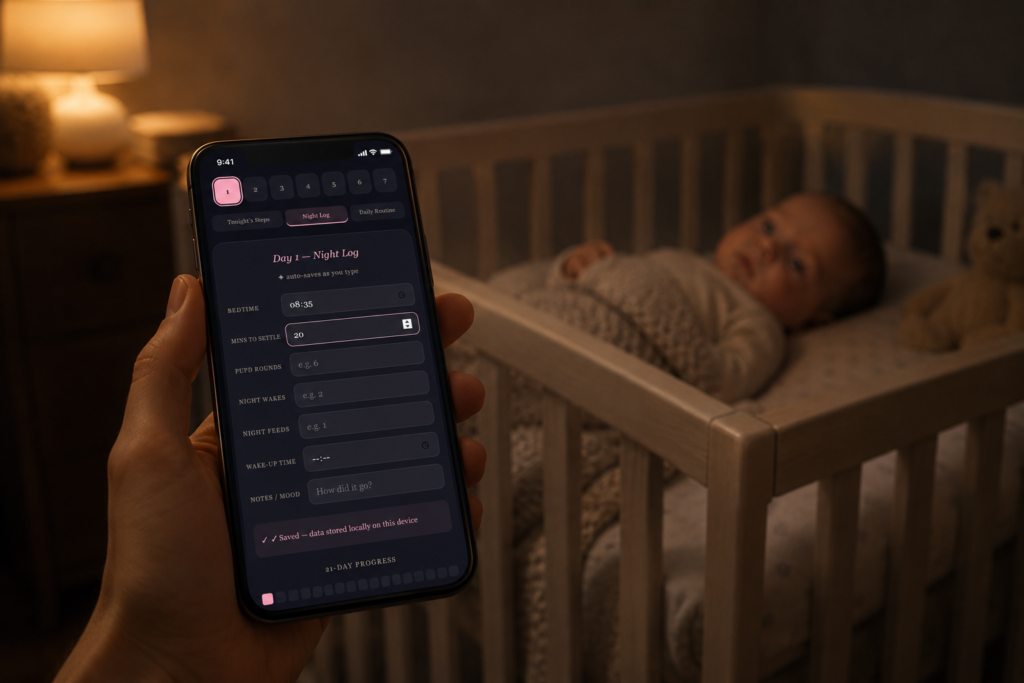
Then I looked at my log. Night 1: 58 minutes, 19 pick-up-put-down rounds. Night 12: 22 minutes, 4 rounds.
I could not feel that progress with my sleep-deprived brain. But the data showed it clearly — and it’s the only reason I kept going.
Research on behavioral sleep interventions consistently shows that progress in gentle sleep training is gradual and often imperceptible night-to-night, even when the cumulative trend is clearly positive. This is why The Sleep Foundation recommends keeping sleep logs during any sleep training period — to maintain perspective when subjective exhaustion distorts perception of progress.
This is exactly why I built the free Baby Sleep Tracker — a 21-day tool with the full gentle method built in, day-by-day instructions, a nightly log, and a progress chart. Access it free through the Free Resources page. No account needed, works on any phone.
What to Do When Gentle Sleep Training Stalls
Setbacks are part of the process. A night where you break the method because you’re too exhausted to hold the line is not failure. Pick back up the next night.
If you’ve been consistent for a full week and see no improvement at all, check these four things before changing the method:
1. Wake windows — Is overtiredness a factor? An overtired baby produces cortisol that actively fights the ability to settle. Adjust nap timing if needed.
2. Environment — Is the room dark enough? Is white noise consistent and loud enough to mask household sounds? Research published in Archives of Disease in Childhood shows white noise significantly reduces infant settling time.
3. Developmental timing — Is there a leap happening? Teething, crawling, pulling to stand? These temporarily disrupt sleep regardless of method. Maintain the routine but lower expectations for the leap period.
4. Daytime structure — Has the daytime routine slipped? Inconsistent nap timing or wake times destabilize the nighttime even when the bedtime method is consistent.
If all four are addressed and progress remains flat after two full weeks of consistency, going back one step in the method — not all the way to the beginning, just one step — is the right move.
Gentle Sleep Training and Night Feeds
Gentle sleep training does not mean eliminating night feeds. These are separate goals.
If your baby wakes at their usual feed time, feed them. Then use the method to resettle. The goal of gentle sleep training is independent sleep onset — teaching your baby to fall asleep without requiring a specific parental action. Hunger is a legitimate need, not a sleep problem, and the two should not be conflated.
My second son’s pediatrician confirmed at several months that he still needed a night feed — and we kept it, working the method around it rather than against it. The gentle sleep training still worked. We just had one scheduled feed built into the night.
When your pediatrician indicates your baby is ready to night wean, that is a separate process — and a gentler one when the independent sleep skill is already in place, because your baby can resettle without the feed rather than depending on it.
Common Gentle Sleep Training Mistakes
Starting too early in the process. Before the daytime routine is solid, the nighttime method is working against the current. Build the foundation first.
Expecting linear progress. Night 8 will sometimes be harder than night 5. This is normal. Look at the weekly trend, not the nightly variation.
Stopping too soon. Most families abandon gentle sleep training between nights 10-14 — just before the method consolidates. If you’ve been consistent, the hardest nights are usually behind you by week 2.
Rushing the chair movement. Moving the chair too far, too fast undoes the gradual desensitization that makes the method work. Smaller steps over more nights produce more durable results than big jumps.
Inconsistency between caregivers. If one caregiver uses the method and another doesn’t, the baby receives conflicting signals. Both caregivers need to follow the same approach — or alternate nights so each one is internally consistent.
A Practical Summary
- Gentle sleep training works by gradually reducing your active role in your baby’s falling-asleep process — while remaining present throughout
- The daytime foundation — consistent wake times, age-appropriate wake windows, predictable pre-sleep routine — is what makes the nighttime method work
- Week 1 shifts the drowsy point — less asleep before going into the crib
- Week 2 fades the motion — presence replaces rocking as the source of safety
- Week 3 moves the chair — physical distance increases gradually until independent sleep is established
- Tracking is essential — progress is real but invisible to an exhausted brain without data
- Night feeds are separate — keep them if your baby needs them, work the method around them
- Stalls are normal — check wake windows, environment, daytime routine, and developmental timing before changing the method
FAQ
What age can you start gentle sleep training?
Most pediatric sleep specialists recommend waiting until at least 4 months — when sleep cycles mature and the baby can begin to learn self-settling skills. Before 4 months, sleep is more biologically driven and responsive approaches are more appropriate.
How is gentle sleep training different from cry-it-out?
Cry-it-out (extinction) methods involve leaving the baby to fall asleep without parental intervention. Gentle sleep training methods keep the parent present throughout, gradually reducing their active involvement rather than withdrawing entirely.
Does gentle sleep training cause emotional harm?
Current research does not support the idea that evidence-based sleep training methods — including parent-present methods — cause emotional harm or attachment disruption. A 2020 review published in Sleep Medicine Reviews found no negative effects on infant emotional development, stress hormones, or parent-child attachment from behavioral sleep interventions.
What if my baby cries during gentle sleep training?
Some crying is normal and expected — even in the gentlest methods. The difference is that in fading methods you respond to and comfort your baby throughout, rather than leaving them to cry alone. The crying during gentle sleep training is typically protest crying rather than distress crying, and it decreases significantly over the first week.
How long does gentle sleep training take?
The 21-night method is a guide. Some babies show significant improvement in 10-14 nights. Others take longer, especially high needs babies or those with strong sleep associations. Consistency matters more than speed.
Can you do gentle sleep training in a shared room?
Yes — the chair method is specifically well-suited to shared rooms because you remain in the room throughout. You may need to be especially consistent with darkness and white noise to minimize environmental disruptions.
What if gentle sleep training doesn’t work?
If you’ve completed a full 21 nights with consistent implementation and see no improvement, consult your pediatrician to rule out underlying issues — reflux, allergies, or a developmental concern affecting sleep. A certified pediatric sleep consultant can also help identify whether a modified approach might work better for your specific baby.
Does the daytime routine really matter that much for nighttime sleep?
Yes — more than most sleep training guides acknowledge. Consistent daytime wake times anchor the circadian rhythm. Age-appropriate wake windows prevent overtiredness. Predictable pre-sleep cues signal the nervous system that sleep is coming. The nighttime method sits on top of these foundations. Without them, even the gentlest method struggles to hold consistently.
The information in this post is based on personal experience and general research. It is not medical advice. Always consult your pediatrician before beginning any sleep training approach, especially if your baby has health concerns.
The free Baby Sleep Tracker has the complete 21-night gentle sleep training plan built in — day-by-day instructions, a nightly log, and a progress chart. Access it free on the Free Resources page.