

If your baby won’t sleep, I want to say something before anything else: you are not failing.
I know that’s easy to say and hard to believe at 3am when you’ve been up since midnight and nothing is working. But I’ve been there — twice, with two very different babies — and the one thing both experiences taught me is that when a baby won’t sleep, it’s almost never about what the parent is or isn’t doing.
It’s about finding the right system for your specific baby, in your specific life.
My second son slept beautifully for the first four months. I thought I had figured it out. Then we removed the swaddle — because he was starting to roll — and everything changed overnight. Suddenly the only place he would sleep was on top of me. Not next to me, not in the crib with a hand on his chest. On top of me, with full body contact, all night.
I was breastfeeding, managing a remote job, running a household, and doing all of this without family nearby. The contact napping was the only thing that worked. Until it wasn’t sustainable anymore.
That’s when I got serious about understanding why baby won’t sleep — and what actually helps when you’re past the point of just surviving it.
Table of Contents
Why Baby Won’t Sleep: The 7 Real Reasons
Understanding why your baby won’t sleep is the first step toward actually fixing it. Most sleep problems come down to one of these seven causes — and knowing which one you’re dealing with completely changes your approach.
Reason 1 — Sleep Associations
This is the most common reason baby won’t sleep independently, and the one that caught me completely off guard with my second son.
A sleep association is whatever your baby needs to be present in order to fall asleep — rocking, feeding, being held, a dummy, motion, or in our case, full body contact after we removed the swaddle. The problem isn’t the association itself. The problem is what happens at 2am when your baby wakes between sleep cycles — which all humans do, every 45-90 minutes — and looks for that same condition to fall back asleep.
If they fell asleep on top of you and wake up in a still crib, the crib feels wrong. They cry. You come in. The cycle repeats all night. Not because they’re manipulative or poorly attached — but because the condition they associate with sleep is no longer present.
According to the American Academy of Pediatrics, helping babies learn to fall asleep independently — without requiring a specific parental action each time — is one of the most effective ways to improve night sleep duration and reduce overnight wakings.
The fix: Gradually shift where in the falling-asleep process your baby goes into the crib. This is the foundation of the gentle fading method below.
Reason 2 — Overtiredness
When a baby is overtired, their body produces cortisol — a stress hormone that makes it harder, not easier, to fall asleep. An overtired baby who won’t sleep is often a baby who needed to go down 20-30 minutes earlier.
The counterintuitive reality: the more overtired your baby gets, the harder it becomes to settle them. This is why keeping to age-appropriate wake windows matters more than waiting until your baby “seems tired.”
Wake windows by age:
- 0-2 months: 45-60 minutes
- 2-4 months: 1-1.5 hours
- 4-6 months: 1.5-2.5 hours
- 6-9 months: 2-3 hours
- 9-12 months: 3-4 hours
The fix: Watch the clock as much as you watch your baby’s cues. If your baby is rubbing their eyes and yawning, they may already be past the optimal sleep window.
Reason 3 — The 4-Month Sleep Regression
Around 4 months, babies’ sleep architecture permanently changes to resemble adult sleep — with lighter cycles, more transitions between stages, and more frequent partial wakings. A baby who was sleeping 5-hour stretches at 3 months may suddenly wake every 1.5-2 hours at 4 months.
This is developmental and permanent — not a phase that passes on its own. The Sleep Foundation notes that the 4-month regression is often the moment when previously manageable sleep associations become genuinely unsustainable, because the baby is now waking more frequently and looking for that association each time.
This was exactly what happened with my second son. The swaddle had been masking a sleep association issue that became fully visible the moment we had to remove it.
The fix: This is often the right moment to introduce a gentle sleep method. The regression itself doesn’t resolve — but your baby’s ability to self-settle can be learned with consistent, gentle guidance.
Reason 4 — Hunger
Especially in younger babies and during growth spurts, night wakings can be genuinely hunger-driven. A pediatrician can help you understand whether your baby still needs night feeds at their current age and weight.
My second son’s pediatrician confirmed he still needed one feed at around 5-6 months — so I kept it, and we worked the sleep method around it rather than trying to eliminate it. There is no shame in that. Hunger is a legitimate need, not a sleep problem.
Signs a waking is hunger vs habit:
- Hunger: baby feeds actively and fully, settles easily after
- Habit: baby feeds briefly or distractedly, wakes again shortly after
Reason 5 — Sleep Environment
A room that is too warm, too bright, or too quiet can all disrupt baby sleep in measurable ways.
Most pediatric sleep specialists recommend:
- Darkness: blackout blinds, as close to complete dark as possible. Even small amounts of light can suppress melatonin production in infants.
- Temperature: 18-20°C (65-68°F) — slightly cooler than most parents expect
- White noise: consistent background noise that masks household sounds and mimics the womb environment. Research published in Archives of Disease in Childhood found white noise helped infants fall asleep significantly faster than silence.
This is often the quickest fix when a baby won’t sleep — and the one most frequently overlooked.
Reason 6 — Inconsistency
If the bedtime routine changes every night — sometimes you rock, sometimes you feed to sleep, sometimes your partner does it differently — your baby never learns what to expect. Babies thrive on predictability because their nervous systems are still developing the capacity to regulate themselves.
A consistent bedtime routine signals to the brain that sleep is coming. Over time it becomes a biological cue, not just a behavioral one.
The fix: Same routine, same sequence, same response, every night for at least two weeks before evaluating whether something is working. Consistency feels slow. Inconsistency feels faster but sets you back further.
Reason 7 — Developmental Leaps
Growth spurts, teething, learning to crawl, pulling to stand, language development — all of these temporarily disrupt sleep as the brain processes new information and new physical abilities.
If your baby won’t sleep during what appears to be a developmental leap, it may be a short-term disruption rather than a long-term problem. The Wonder Weeks framework identifies predictable periods of developmental intensity in the first 20 months that correlate with sleep disruption.
How to tell: If the sleep disruption appeared suddenly with no change in routine or environment, and your baby is also fussier or clingy during the day, a developmental leap is likely. Increased comfort and patience during these windows — rather than attempting new sleep training — is often the most sustainable approach.
A Note on Health and Safety
The information in this post is based on personal experience and general research. It is not medical advice. Every baby is different, and sleep approaches should be discussed with your pediatrician — especially if your baby has any health concerns, reflux, allergies, or if you have questions about night feeding. Always follow safe sleep guidelines from the American Academy of Pediatrics for your baby’s sleep environment.
What Actually Worked: The 21-Day Gentle Sleep Method
After trying everything — including modified Ferber for nearly two weeks, which created more distress than progress for us — I found a method called fading, sometimes called the chair method or gradual retreat.
The core idea is this: you never fully withdraw your presence. You stay, and you slowly do a little less each night, until your baby can fall asleep without needing you to do anything at all.
This method takes longer than cry-based approaches. It is also the one I could actually sustain — because it didn’t require me to leave my baby distressed in a room alone, which was something I couldn’t do regardless of how exhausted I was.
Week 1 — Shift the Drowsy Point
The reason why baby won’t sleep independently is usually that they’re fully asleep before they reach the crib. This week, you put them down slightly less drowsy each night — still holding, still rocking — but into the crib with eyes a little more open than the night before.
When they fuss, you use the pick-up-put-down method: pick up to calm, put down to sleep. Repeat as many times as needed.
Night 1 may take 60 minutes. Night 7 may take 20. That is the progress — even when it doesn’t feel like it in the moment.
Week 2 — Fade the Motion
This week you reduce the rocking itself. Rock for two minutes, then sway. Then hold still. Then sit holding them without movement. Then sit next to the crib with a hand on their chest.
Your presence is the comfort now — not the motion. The goal is for your baby to feel safe falling asleep without the physical action, not without you.
Week 3 — Move Gradually Back
Each night, your physical presence moves slightly further from the crib.
Hand on chest → hand nearby but not touching → sitting beside the crib → chair in the middle of the room → chair near the door → outside the door.
By night 21, your baby falls asleep with you present but not actively doing anything. That independence — built gradually, with your full presence throughout — is what makes this method sustainable for both of you.
Why Tracking Makes the Difference When Your Baby Won’t Sleep
Here’s what nobody warns you about when your baby won’t sleep: exhaustion destroys your ability to see progress.
On night 12 of the method, I was ready to stop. Every night felt the same. Nothing felt like it was working.
Then I looked at my log.
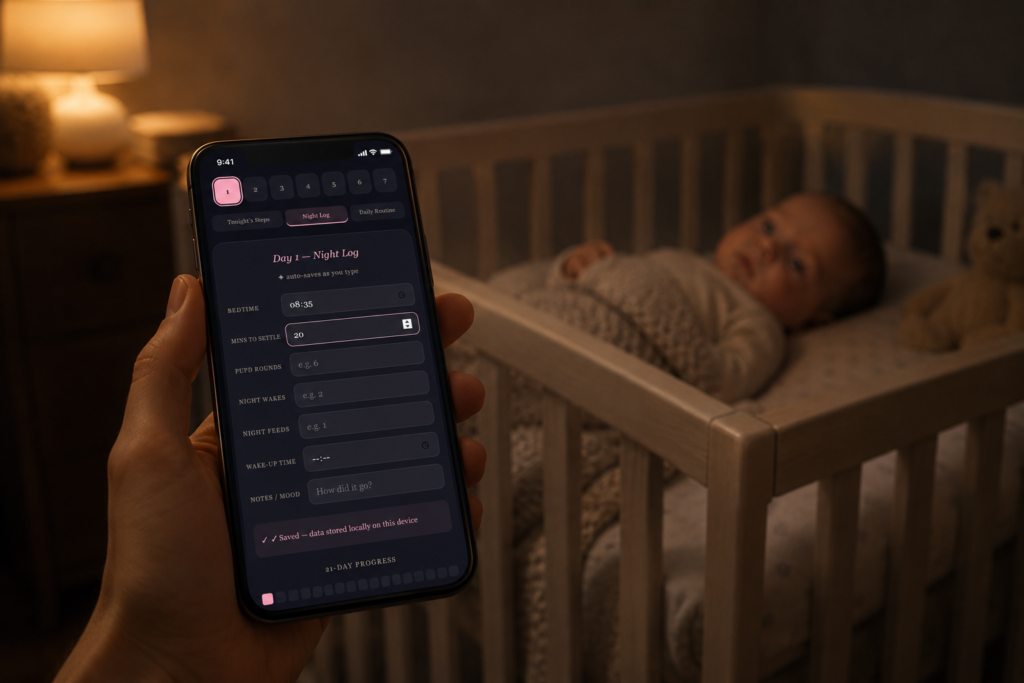
Night 1: 58 minutes, 19 pick-up-put-down rounds. Night 12: 22 minutes, 4 rounds.
I couldn’t feel the progress. But the data showed it clearly — more than half the time, more than three-quarters fewer interventions. Progress that was completely invisible to my sleep-deprived brain was sitting right there in the numbers.
Tracking does something specific when your baby won’t sleep: it gives you an objective view of a situation your emotions can no longer assess accurately. It tells you whether Tuesday was actually better than the Tuesday before — even if you were too exhausted to notice.
That’s why I built the free Baby Sleep Tracker — a 21-day tool with the full gentle method built in, day-by-day instructions, a nightly log, and a progress chart that makes the improvement visible even on the nights it doesn’t feel real.
Get access free through the form on the Free Resources page. No account, works on your phone, start tonight.
The Other Piece — Your Own System
Baby sleep problems are exhausting enough on their own. But when your baby won’t sleep and the rest of your life is also chaotic — no structure, constant decision fatigue, mental load with no outlet — it becomes significantly harder to show up consistently at bedtime.
Bedtime routines require the one thing that is most depleted at 7pm: cognitive presence. The ability to stay calm, stay consistent, and stay the version of yourself your baby needs to feel safe enough to sleep.
I’m a remote-working mom, living abroad without family nearby, managing a household, a toddler, a baby, and a full-time marketing career. The organizational system that helped me hold the rest of the week together enough to have something left at bedtime is the Anti-Chaos Weekly System — a weekly planning tool I built specifically for this season of motherhood.
If the sleep problem is the visible crisis, the mental load underneath it is often what makes it impossible to solve. Addressing both together is what actually worked for us.
You can also read more about managing the mental load of this season in the post on decision fatigue for moms — it covers exactly why 7pm feels impossible and what to do about it.
A Practical Summary
- Why baby won’t sleep usually comes down to one of seven causes — sleep associations being the most common
- The 4-month regression permanently changes sleep architecture and often makes previous associations unsustainable
- Overtiredness raises cortisol — making it harder, not easier, to fall asleep. Wake windows matter.
- Environment matters more than most parents expect — darkness, cool temperature, and white noise are high-impact, low-effort changes
- The gentle fading method works — but requires 21 nights of consistency and a way to track progress objectively
- Tracking is essential because exhaustion makes progress invisible — the data shows what your brain can’t see
- Your own system matters too — bedtime consistency requires cognitive presence, which requires the rest of your week to be held together
FAQ
Why won’t my baby sleep at night?
The most common reasons baby won’t sleep at night are sleep associations (needing a specific condition like rocking or feeding to fall back asleep between cycles), overtiredness, the 4-month sleep regression, hunger, or environment issues like a room that’s too warm or bright. Identifying which cause applies to your baby is the starting point for finding the right solution.
Why won’t my baby sleep unless held?
This is almost always a sleep association. If your baby falls asleep being held and then wakes in the crib, they’re looking for the same condition they fell asleep in. The gentle fading method gradually shifts where in the falling-asleep process they go into the crib — reducing the dependency slowly rather than all at once.
What is the 4-month sleep regression?
Around 4 months, babies’ sleep cycles permanently change to resemble adult sleep — lighter, with more wakings between cycles. A baby who slept well before 4 months may suddenly start waking every 1-2 hours. This is developmental and doesn’t resolve on its own, but babies can learn to self-settle through a consistent, gentle method.
What are wake windows for babies?
Wake windows are the age-appropriate amount of time a baby can be awake between sleeps before overtiredness sets in. For a 4-6 month old, that’s roughly 1.5-2.5 hours. Putting a baby down too late — past their optimal wake window — raises cortisol, making it harder to settle.
Does white noise help babies sleep?
Yes. Research shows white noise helps infants fall asleep faster and stay asleep longer by masking variable household sounds. Consistent white noise at a safe volume (below 50 decibels at the baby’s ear level) is recommended by most pediatric sleep specialists.
Is it okay to let my baby sleep on me?
Contact napping is safe and normal, especially in the early months. The question is sustainability — whether it works for your family long-term. If contact napping is working for you and you’re not exhausted by it, there’s no urgency to change it. If it has become unsustainable, a gradual method like fading is a gentle way to shift it.
How long does gentle sleep training take?
The 21-day gentle fading method takes three weeks of consistent effort. Most families see meaningful improvement — shorter settling times, fewer night wakings — within the first week. Tracking the data is essential because progress is often invisible to a sleep-deprived parent.
What should I do when nothing works for my baby’s sleep?
First, identify which of the seven causes applies. Then pick one intervention and give it at least two weeks of consistent implementation before evaluating. If you’ve tried multiple methods without progress, a pediatric sleep consultant or your child’s pediatrician can help identify whether there is an underlying issue — reflux, allergies, or a developmental concern — affecting sleep.
Content on this page is based on personal experience and general research. It is not medical advice. Always consult your pediatrician before making changes to your baby’s sleep routine, especially if your baby has any health concerns.
If you’re ready to try the 21-day method, the free Baby Sleep Tracker has everything you need — day-by-day instructions, a nightly log, and a 21-night progress chart. Access it free on the Free Resources page.



2 Comments on “Why Your Baby Won’t Sleep (7 Real Reasons + What Actually Worked)”