

High needs baby sleep is not “waking twice a night.” It is not “going through a regression.” It is not something a better bedtime routine will fix.
I know because I lived it for ten months with my first son — and I want to be specific about what that actually looked like, because most descriptions of high needs baby sleep are still too gentle to capture what parents in the thick of it are actually experiencing.
My son woke every twenty minutes. Not every two hours. Every twenty minutes, through the entire night, for the better part of ten months. He would stay awake for six-hour stretches during the day — no naps, no drowsiness, fully alert and fully demanding. When he finally went down, he fell asleep crying — every single time, even in my arms. The only reliable way to get him to sleep was breastfeeding, and I would sit in the rocking chair for hours. When he finally transferred, I stayed completely still, afraid to breathe wrong and wake him.
His naps, when they came, were long — two to three hours — but they came at unpredictable times, after enough exhaustion had accumulated that his body simply gave out.
I was a zombie for most of it. I functioned, technically. I worked remotely, I kept the household running, I showed up. But I was not present in any real sense. The sleep deprivation that comes with high needs baby sleep is a different category of exhaustion from ordinary new parent tiredness. It is structural. It sits in your body and affects every system — your thinking, your emotional regulation, your physical energy, your sense of who you are.
If you are reading this at 3am, I want you to know: you are not doing it wrong. Some babies are just built this way.
Table of Contents
What Is a High Needs Baby?
The term “high needs baby” was coined by pediatrician Dr. William Sears, who identified a cluster of traits that consistently appeared in babies who were more demanding, more sensitive, and more intense than typical developmental descriptions account for.
High needs babies are not a medical diagnosis. They are a temperament — and one that exists at the extreme end of normal human variation.
Dr. Sears identified 12 characteristics of high needs babies. The most relevant to high needs baby sleep include:
- Intense — their cry is more urgent, their distress more immediate, their emotional responses more extreme than other babies
- Hypertonic — higher muscle tone and physical tension, making it harder to relax into sleep
- Draining — the cumulative energy demand on parents is genuinely greater than with typical babies
- Not a self-soother — cannot reliably calm themselves or transition between sleep cycles independently
- Wants to be held constantly — physical contact is not a preference; it is a neurological need
- Frequently waking — light sleep, more transitions between sleep cycles, more difficulty resettling without parental help
Understanding that these characteristics are part of your baby’s neurological wiring — not a result of anything you did or didn’t do — is the first and most important shift in approaching high needs baby sleep.
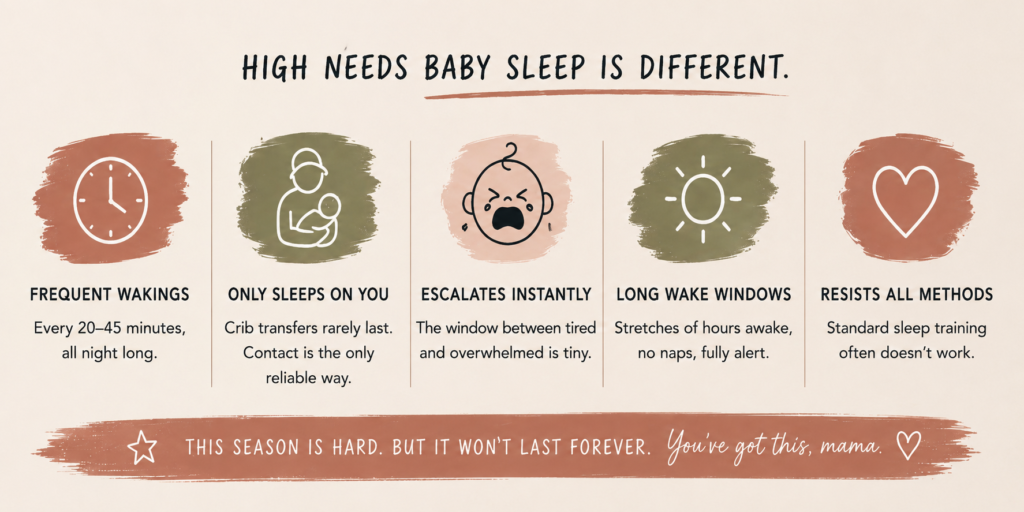
What High Needs Baby Sleep Actually Looks Like
High needs baby sleep problems exist on a spectrum, but the patterns I hear most consistently from other parents include:
Frequent overnight wakings — not the 2-3 wakings typical of young babies, but 6, 8, 10, or more. Some babies, like my son, wake on a 20-45 minute cycle through the entire night.
Only sleeping on a person — the crib works for transfers when they’re deeply asleep, but any movement, any transition, any shift in temperature or sound reactivates them. Contact napping — sleeping on a parent’s chest, in arms, or in a carrier — is often the only reliable option.
Escalating instantly — the window between drowsy and distressed is almost nonexistent. By the time you notice the tired cues, you’re already fighting an overtired baby. The sleep window is narrow and unforgiving.
Resistance to all sleep training methods — this is the part that hits hardest, because it means the standard advice is useless. Ferber doesn’t work. Cry-it-out doesn’t work — not because the method is wrong in principle, but because some high needs babies escalate indefinitely rather than settling. I tried Ferber for twelve nights. It never touched the night wakings.
Long wake windows in the day — my son had stretches of six hours awake during the day. Keeping to age-appropriate wake windows was irrelevant because his nervous system simply didn’t respond to drowsiness cues the way the books said it should.
The Early Months: What We Actually Lived
When my son was five months old, my family could see on a video call that I was not okay. They bought flights. My mother’s stated goal was simple: I would sleep. She would take the baby.
She lasted three nights before looking at me differently. Not because she didn’t want to help — because she finally understood what I had been surviving alone for five months. Three nights of high needs baby sleep nearly broke her. I had been doing it without any relief since he was born.
Those three nights gave us one real win: a stretch from 8pm to 2am, a feed, then back down until 6am. After ten months of twenty-minute wakings, six hours felt like a gift I didn’t know how to receive.
Back home, we tried everything methodically. Wake windows. Strict bedtime routines. White noise at every level. Blackout blinds. Professional sleep training support — paid, specific, personalized — that came to nothing. Ferber for twelve nights that addressed the initial bedtime but could not touch the 20-minute waking cycle.
There was one brief window — maybe two weeks — where the bottle worked. He would fall asleep with his bottle, transfer to the crib, and when he woke I could replace the pacifier and he’d go back down. Two weeks of that felt like a miracle. Then it stopped working.
Around nine months, something shifted. He started eating only once at night. By month ten, the wakings started spacing out — not reliably, not without regression, but the trajectory changed. The bone-deep desperation of those first months began to lift, slowly, into something more like ordinary exhaustion.
I want to be honest about this because I know the question every parent of a high needs baby is asking: when does it get better? The answer for us was month nine. It was not a dramatic change. It was a gradual loosening of something that had been wound too tight for too long.
High Needs Baby Sleep Training: What Works and What Doesn’t
High needs baby sleep training is one of the most searched topics in this space — and one of the most misleading, because most sleep training content is written for typical babies and applies poorly to high needs ones.
Here is what I know from experience and from talking to other parents who’ve been here:
What rarely works for high needs babies
Extinction methods (cry-it-out) — some high needs babies will escalate indefinitely. The method assumes the baby will eventually stop crying and fall asleep. Some do not. And the cortisol cost of extended distress for a highly sensitive nervous system is worth taking seriously.
Strict schedules — high needs baby sleep doesn’t conform well to rigid timing. Forcing sleep at scheduled times against the baby’s actual rhythm tends to increase resistance rather than reduce it.
Quick fix approaches — any method that promises results in 3-5 nights is almost certainly not designed for high needs baby sleep. Expect a longer timeline and build that into your expectations before you start.
What tends to work better
Gradual fading methods — the chair method, gradual retreat, pick-up-put-down. These work by slowly reducing your active role rather than withdrawing entirely. They take longer — 3-6 weeks rather than 3-5 nights — but they don’t require your baby to manage distress alone.
Daytime structure before nighttime method — this is the piece most sleep training guides miss entirely. Before any night method has a chance of working, the daytime needs to be consistent: same wake time, age-appropriate wake windows, a predictable pre-sleep routine. Without that foundation, even the gentlest night method struggles.
Survival adaptations — co-sleeping, contact napping, feeding to sleep. These are not failures. They are adaptations that get everyone through an impossible season. Many parents of high needs babies use them through the worst of it and wean off them gradually when the child’s nervous system matures.
According to the American Academy of Pediatrics, parent-present sleep training methods are an effective and appropriate alternative for families who prefer not to use extinction-based approaches — and they note that parental responsiveness during sleep training does not reduce effectiveness.
Building a High Needs Baby Sleep Routine
A high needs baby sleep routine is less about timing and more about consistency of sequence. The goal is not a rigid schedule — it is a predictable series of events that the baby’s nervous system learns to associate with sleep coming.
For high needs babies, this matters more, not less, than for typical babies. A highly sensitive nervous system responds strongly to environmental cues. The routine becomes a biological signal over time — the bath, the feed, the specific song, the white noise, the lights off — and that signal starts doing work before the baby even hits the crib.
What a high needs baby sleep routine might look like:
- Same wake time daily — even after a terrible night. Consistent wake time is the anchor of the whole system.
- Predictable nap cues — same sequence before every nap. Even if the nap timing varies, the pre-nap ritual stays the same.
- Generous pre-sleep wind-down — high needs babies need more transition time. Rushing from activity to sleep rarely works. Build in 20-30 minutes of low stimulation before any sleep attempt.
- Consistent environment — same room, same darkness level, same white noise, same temperature every time. High needs babies are more sensitive to environmental variation.
- One contact nap per day — if your baby only sleeps on you, consider protecting one nap as a contact nap while working on crib independence for the others. Going from full contact to full independence overnight is usually too much for a high needs nervous system.
The high needs baby sleep schedule that works is the one your specific baby can actually follow — not the one the books recommend.
What I Did Differently With My Second Baby
My second son was completely different from the start. He gave us four and five hour stretches for the first three months. We thought we understood sleep now.
Then the four-month regression arrived.
He’s been waking every two hours since. But the quality of those wakings is completely different from his brother’s. He wakes happy. He only cries when you try to put him back down. With him, the problem was not distress — it was a sleep association, specifically the swaddle removal at four months that left him without the containment his nervous system needed to stay asleep.
With my second, I used the fading method — gradually doing a little less each night, moving the chair back inch by inch, until he could fall asleep without me actively doing anything. It worked in three weeks.
The difference between my two sons is the difference between high needs baby sleep — a nervous system that needs something entirely different — and a typical sleep association that responds to a gentle, gradual method.
Knowing which situation you’re in changes everything about how you approach it.
5 Things I Know Now About High Needs Baby Sleep
After two very different babies, years of accumulated sleep deprivation, and more research than I ever wanted to do on this topic, here is what I actually believe:
1. Some babies are just hard — and it’s neurological, not parental. High needs baby sleep difficulty is a feature of the baby’s nervous system, not evidence of anything you did or didn’t do. The temperament research is clear on this. Some nervous systems are wired for high sensitivity and high demand. You did not cause it and you cannot discipline it away.
2. No single method works for every high needs baby. Ferber works for some and fails others completely. Fading works for some and takes too long for others to sustain. Anyone telling you there is one correct approach to high needs baby sleep is not accounting for the spectrum these babies exist on.
3. Survival mode is a valid and legitimate strategy. Co-sleeping, feeding to sleep, rocking for hours, contact napping — these are not failures. They are adaptations. They are what gets your family through a season that would break anyone who approached it with rigidity. Take what works. Leave what doesn’t. The goal is surviving this season intact.
4. Tracking helps more than you think. When your high needs baby wakes every twenty minutes, every night feels exactly as terrible as the last. You lose all perspective on whether anything is improving. Data — actual logged numbers — restores that perspective. Night 1: 58 minutes, 19 interventions. Night 21: 12 minutes, 2 interventions. The progress is real even when it’s invisible to an exhausted brain.
5. The question is not “what’s the right method” — it’s “what can we actually sustain.” The best high needs baby sleep approach is the one your family can maintain consistently over weeks without breaking down. Consistency is what produces change. And consistency requires choosing something your actual exhausted self can do at 3am, not your aspirational rested self.
When Does High Needs Baby Sleep Get Better?
This is the question every parent of a high needs baby is really asking. And I want to answer it honestly rather than optimistically.
For my son, the turning point was around month nine. He started waking once to feed instead of continuously. By month ten the wakings were spacing out. It was not sudden and it was not complete — but the trajectory changed, and that change was enough.
From what I’ve heard from other parents of high needs babies, improvement tends to come in one of three ways:
Developmental maturation — around 8-10 months, many high needs babies show natural improvement as their nervous systems mature and their ability to self-regulate increases. This is not guaranteed but it is common.
A method that finally fits — some parents find the right combination of daytime structure and gentle nighttime method that works for their specific baby. This often takes trying multiple approaches and failing several times first.
A combination of both — the method starts working because the developmental timing is finally right, not because the method changed.
The honest answer to “when does it get better” is: usually in the second half of the first year, and almost always by 18 months. That is a long time when you are in the middle of it. But it is also a finite season — even when it doesn’t feel like one.
For the Mom at 3am Right Now
You are not failing. Your baby is not broken. This is genuinely one of the hardest things a parent can experience — and if the people around you don’t understand why you’re still this exhausted, it’s because high needs baby sleep is outside the range of what most people have experienced or can imagine.
Take what works. Leave what doesn’t. Lower every expectation that doesn’t directly relate to keeping your family safe and functional.
If you want to try the gentle fading method — the one that worked with my second son — the free Baby Sleep Tracker has the full 21-night method built in with day-by-day instructions, a nightly log, and a progress chart. It’s free because exhausted parents don’t need another expensive program that might not work for their specific baby.
And if the rest of your week is falling apart around the sleep deprivation, the Anti-Chaos Weekly System was built specifically for this season — a planning tool for moms whose weeks are too unpredictable for any normal system to hold.
You don’t have to figure this out alone.
A Practical Summary
- High needs baby sleep is a neurological reality, not a parenting failure
- The term was coined by Dr. Sears to describe babies with intense, sensitive, high-demand nervous systems
- Standard sleep training often fails because it was designed for typical babies, not high needs ones
- Gradual fading methods work better than extinction approaches for most high needs babies
- Daytime structure — consistent wake times, wake windows, pre-sleep routines — is the foundation everything else sits on
- Survival adaptations — co-sleeping, contact napping, feeding to sleep — are legitimate responses to an impossible season
- Tracking restores perspective when exhaustion makes progress invisible
- It does get better — most commonly in the second half of the first year
Frequently Asked Questions
What is a high needs baby?
A A high needs baby is a baby with an intense, sensitive nervous system that requires more parental contact, more responsiveness, and more support than typical developmental descriptions account for. The term was coined by Dr. William Sears. It is a temperament, not a medical diagnosis.
Why does my high needs baby wake so often?
High needs babies have lighter sleep cycles and more difficulty transitioning between them independently. They also have stronger needs for physical contact and parental presence, which means any change in their sleep environment — like being moved from arms to crib — tends to wake them fully rather than allowing them to resettle.
Does sleep training work for high needs babies?
Some methods work for some high needs babies. Extinction methods like cry-it-out often don’t work because high needs babies escalate rather than settle. Gradual fading methods — where the parent stays present and slowly reduces their active role — tend to work better, but require more time and consistency.
What is the best high needs baby sleep schedule?
High needs babies often don’t conform well to rigid schedules. A loose rhythm — consistent wake time, age-appropriate wake windows, predictable pre-sleep routine — works better than a strict timetable. The goal is enough consistency that the nervous system learns to anticipate sleep, without the rigidity that creates resistance.
Is it okay to co-sleep with a high needs baby?
Many families of high needs babies use co-sleeping or bed-sharing as a survival strategy during the most intense period. Families who choose to co-sleep should always follow safe sleep guidelines. The choice to bed-share is personal and should be made based on what allows the whole family to function safely.
When does high needs baby sleep get better?
Most parents report meaningful improvement between 8-12 months, with more consistent stretches by 18 months. Improvement is rarely sudden — it tends to come gradually as the baby’s nervous system matures and their capacity for self-regulation increases.
How do I survive high needs baby sleep deprivation?
Simplify everything else. Share night responsibilities wherever possible. Sleep when any opportunity presents itself regardless of time of day. Lower all non-essential standards. Track progress so exhaustion doesn’t make everything feel equally impossible. And recognize that this is a season — a genuinely hard, finite season — not a permanent state.
Could my high needs baby have autism or ADHD?
High needs temperament in infancy can overlap with traits that sometimes appear in neurodivergent children, but most high needs babies are neurotypical. If you have specific developmental concerns beyond sleep and temperament, speak with your pediatrician. A high needs baby temperament alone is not a diagnostic indicator.
What high needs baby sleep routine actually works?
The most effective high needs baby sleep routine is one built around consistent sequence rather than strict timing — same pre-sleep cues in the same order, every time. Bath, feed, song, white noise, darkness. The consistency of the sequence matters more than the clock time, because it’s the sequence that becomes the biological sleep signal.
The information in this post is based on personal experience and is not medical advice. Always consult your pediatrician if you have concerns about your baby’s sleep, development, or wellbeing.
If you’re ready to try the 21-night gentle method, the free Baby Sleep Tracker has everything you need — day-by-day instructions, a nightly log, and a 21-night progress chart. Access it free on the Free Resources page.




One comment on “High Needs Baby Sleep: 10 Months of Wakings Taught Me This”