
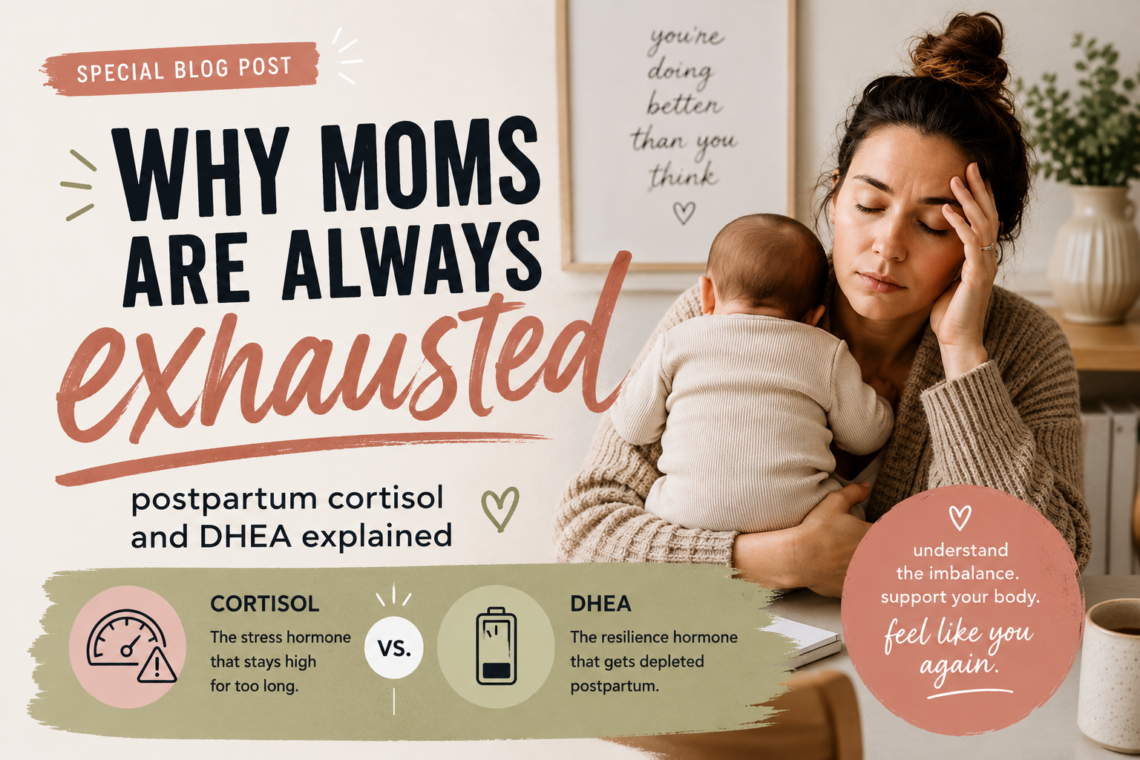
Why moms are always exhausted is a question I finally got a real answer to — not from a wellness blog or a parenting book, but from blood work that showed exactly what three years of motherhood had done to my body.
Three years into motherhood, and wondering, like so many moms, why moms are always exhausted in this specific bone-deep way. I got blood work done.
Not because I had a specific symptom to investigate. Because I was exhausted in a way that had stopped feeling temporary — a specific, bone-deep, constant exhaustion that no amount of sleep seemed to touch. And I needed a number. I needed something outside of my own experience to confirm that what I was feeling was real and not just weakness, not just poor adaptation, not just me failing to handle something other mothers were apparently managing fine.
The results gave me that number. Several of them, actually.
And for the first time in three years, I felt something unexpected: relief.
Not because everything was fine. But because now I knew exactly what we were working with.
Table of Contents
What Nobody Told Me About Why Moms Are Always Exhausted
I was a relaxed person before I became a mother. I want to say that clearly, because I think it matters.
I was not anxious. I was not a worrier. I had spent over a decade managing high-pressure marketing roles across regions and teams, navigating life in countries that weren’t mine, building a career from scratch in a second language. I handled complexity well. I did not lie awake catastrophising.
Then my first son was born.
And within weeks I found myself thinking, for the first time in my life, about all the ways something terrible could happen. Not occasionally. Constantly. Every surface, every temperature, every breath. My nervous system — which had been reliably steady for 35 years — entered a state of alert it has not fully left since.
At the time I was diagnosed with postpartum depression and treated with medication, which helped. But the underlying alert state — the hypervigilance that is, I now understand, a feature of new motherhood rather than a flaw in my wiring — never fully switched off. It adapted. It became the background frequency of my life.
My second son is now several months old. I have not slept more than two consecutive hours in three years. Most nights I get five hours total, broken into fragments. I wake before he does, breastfeeding-ready, body tense, anticipating the cry before it comes. And when I finally fall asleep, truly fall asleep, he wakes. Every night ends with that particular cruelty — the deepest exhaustion hitting at the exact moment the next demand arrives.
The sleep situation with both of my sons — and why the standard advice never worked — is something I wrote about in detail in Why Your Baby Won’t Sleep: 7 Real Reasons and What Actually Worked, because understanding the sleep piece is inseparable from understanding the exhaustion piece.
I am always tired. My mind blurs mid-task. I cannot do cognitive work consistently. I snap at things I would normally absorb without reaction. I have no physical energy reserve. Things that were automatic — cooking dinner, responding to an email, choosing what to wear — feel effortful in a way I struggle to explain to anyone who hasn’t experienced it.
This is not weakness. I now have the blood work to prove it.
What the Blood Work Actually Showed
After three years of this, my nutritionist ordered a full panel. What came back confirmed something I had suspected but hadn’t had language for: my body is showing the measurable biological cost of extended postpartum demand.
I want to be specific, because I think specificity is what’s missing from most conversations about mom exhaustion.
DHEA-S: below range
DHEA-S is a hormone produced by the adrenal glands — the same glands that produce cortisol, your primary stress hormone. DHEA is sometimes described as cortisol’s counterbalance: while cortisol mobilizes the body for stress responses, DHEA supports recovery, vitality, and resilience.
Mine was low. Not slightly low — below the reference range.
My nutritionist’s explanation was direct: this is entirely expected in a postpartum, breastfeeding woman with interrupted sleep and high physiological and emotional demand. The adrenal glands have been running hard for three years — managing the cortisol response of chronic sleep deprivation, the physiological demands of two pregnancies, the sustained hypervigilance of early motherhood. DHEA gets depleted when the system is under prolonged load.
The practical result: reduced energy, slower recovery, difficulty regulating stress responses, increased fatigue even after rest. Everything I had been attributing to “just being tired” had a hormonal mechanism underneath it.
Vitamin D: below optimal
At 26.58 ng/mL — below the optimal threshold of 30 — my Vitamin D levels were low enough to affect mood, energy, immune function, and muscle recovery. This is extremely common in postpartum and breastfeeding women, whose bodies prioritize the baby’s nutritional needs. It is also common in people who are sleep-deprived, spending little time outdoors, and under chronic stress.
Vitamin D deficiency contributes to fatigue, low mood, reduced cognitive clarity, and impaired immune function — all things I had been experiencing and attributing to simple exhaustion.
Vitamin B12: improvable
B12 is essential for energy production at the cellular level, nerve function, and cognitive clarity. Mine was described as “improvable” — not deficient, but not optimal. B12 depletion is common during breastfeeding and in people who aren’t consistently eating animal proteins.
The blur. The difficulty thinking. The tasks that require concentration feeling like lifting something too heavy. B12 was part of that picture.
What was fine
Everything else — glucose, liver function, kidney function, cholesterol, lipids — was in good range. My metabolic baseline is solid. My nutritionist was clear: this is a woman with a well-functioning body under extraordinary sustained demand. The issues are specific and addressable, not systemic.
That distinction matters. Because it means this is not about my body failing. It’s about my body doing exactly what a body does when it’s been asked to do too much for too long without adequate recovery.
The Nervous System Nobody Prepared Me For
Here is what I wish someone had told me before I became a mother.
Not the practical things — though those would have helped. The physiological things. What actually happens to your nervous system in the transition to motherhood, and why it doesn’t just resolve when the baby starts sleeping better.
Motherhood, especially in the first years, puts your nervous system into a state of chronic low-grade alert. This is not a malfunction. It is an evolutionary feature — the vigilance response that kept babies alive when the world was genuinely dangerous is still very much active in the human brain. Your nervous system does not distinguish between abstract modern risks and immediate physical ones. It responds to the perception of threat — and for a new mother, the perception of threat is constant, because something genuinely precious and vulnerable is now entirely dependent on you.
According to research from the American Psychological Association, chronic stress — the sustained activation of the stress response over weeks and months — affects every system in the body. The immune system, the endocrine system, digestion, sleep architecture, cognitive function, emotional regulation. Chronic stress is not just feeling overwhelmed. It is a physiological state with measurable consequences.
For mothers, the particular cruelty is that the stressor doesn’t resolve at the end of the workday. There is no recovery window. The alert state is maintained through the night — through the feeds, the listening for sounds, the sleep that never goes fully deep because part of the brain is always on duty. And it continues the next day, and the next.
Three years of that accumulates. In hormones. In nutrient depletion. In a nervous system that has forgotten what it feels like to not be on alert.
I wish someone had told me that was coming. Not to scare me — but because there are things you can do. Things that become much harder to build once you’re already depleted, but that are genuinely accessible if you start before or early in the journey.

What Nobody Warned Me — And What I Would Tell You Now
Not one person in my life — not one mom I knew, not one conversation I had before becoming a mother — told me the truth about what this does to your body.
They joked about sleep deprivation. They warned me about the difficulty. But nobody said: your nervous system will enter a state of sustained alert that changes how you feel, think, function, and recover. Nobody said: this has measurable physiological consequences. Nobody said: there are habits you can start building now that will help your body cope with what’s coming.
I was furious about that when my first son was born. I had to mourn a version of myself I hadn’t known I was losing — the relaxed, capable, energetic person I had been for thirty-five years — without any framework for understanding what was happening or why.
So here is what I would tell you now. Or what I would have told my pre-mother self.
Your nervous system needs training, not just rest.
Sleep is not the only tool. A depleted nervous system doesn’t fully recover with sleep alone — especially when the sleep is broken. Learning to actively downregulate your nervous system during the day matters. Slow breathing that activates the parasympathetic response. Brief moments of genuine stillness. The ability to tell your body that this moment is safe, even when the alert signal is running.
This is not meditation as a luxury. It is nervous system hygiene as a survival strategy.
Your thoughts have a physiological effect.
Catastrophic thinking — the constant anticipation of worst-case scenarios that arrives with new motherhood — is not just emotionally exhausting. It keeps the cortisol response active. Every “what if something happens to the baby” thought is a small stress signal to the body. Learning to interrupt that cycle — not to suppress the thought, but to consciously redirect it — has a measurable effect on how your body feels.
I learned this late. I wish I had started earlier.
Protein and water are not optional.
The nutritional piece sounds simple and isn’t. When you are breastfeeding, sleep-deprived, and chronically stressed, your body is running a significant nutritional deficit. Protein supports cortisol regulation, tissue repair, and energy production. Dehydration compounds cognitive blur and fatigue in ways that are dramatic and immediate. Getting enough of both — consistently, not occasionally — is one of the highest-leverage things you can do for how you function day to day.
Your beauty routine is not vanity.
Ten minutes in the morning — washing your face, doing your skincare, getting dressed in something that doesn’t feel like you’ve given up — is not about appearance. It is about signaling to yourself that you still exist as a person, not only as a function. In the seasons where I’ve skipped it entirely, I’ve felt the difference. It is a small act of self-continuity in a life that can feel like it has been completely absorbed by someone else’s needs.
Movement is medicine.
Not punishment. Not weight loss. The kind of movement that lowers cortisol, supports DHEA production, improves sleep quality, and reduces the inflammatory load that chronic stress creates. Twenty-eight minutes of pilates at 9pm on a Tuesday counts. The walk to your mother-in-law’s house with the baby counts. The goal is not athleticism. The goal is giving your body a way to process the stress load it’s been carrying.
What I’m Doing About It Now
Based on the blood work and my nutritionist’s recommendations, here is the protocol I’m working on — not as advice, but as honest documentation of what addressing this actually looks like.
Supplements: Vitamin D daily. A B-complex with active forms of B vitamins. Targeted suprarrenal support for the DHEA deficit, monitored with follow-up blood work.
Nutrition: High protein at every meal — especially breakfast, which is the meal that sets cortisol regulation for the day. Nothing processed. Whole foods only. Dinner at least two hours before bed. No sugar. Lots of water — the kind of hydration that a breastfeeding, stressed body genuinely needs, which is more than most people drink.
Movement: Training at least three times a week. Daily walking and getting outside — exposure to natural light supports both circadian rhythm and Vitamin D synthesis. Movement that feels supportive rather than punishing.
Sleep hygiene: No phone for twenty minutes before bed. Dinner timed to support sleep quality. The small ritual of the skincare routine as a transition signal between the day’s demands and sleep.
Nervous system work: Learning to actually breathe in a way that activates the parasympathetic response. Short moments of deliberate downregulation during the day. Practicing the redirection of catastrophic thoughts before they complete their loop.
I am at the beginning of this. I don’t have results yet — I have a direction and a protocol and blood work that tells me exactly what we’re targeting. I’ll update this post as we go.
The organizational piece matters more than it sounds. When your body is depleted and your cognitive capacity is genuinely reduced, having a pre-built structure for your week removes dozens of daily decisions your brain doesn’t have the resources to make. If you’re in this season, the 7 Powerful Organization Systems for Moms: An Energy-First Approach That Actually Works is where I’d start — not to add pressure, but to reduce it.
Why Moms Are Always Exhausted — And Why Nobody Addresses It Honestly
Most content about mom exhaustion offers solutions that assume the problem is behavioral. Sleep when the baby sleeps. Ask for help. Lower your standards. Practice self-care.
These are not useless suggestions. But they don’t address the physiological reality underneath the exhaustion — the hormonal depletion, the nutrient deficit, the nervous system that has been in sustained alert for years.
Mom exhaustion, in its chronic form, is not a mindset problem. It is a body problem. And it requires body-level solutions — not just mindset reframes or better planning systems.
According to research from Harvard Medical School, chronic stress depletes the body’s resources in measurable ways — affecting hormone production, immune function, cognitive capacity, and the ability to recover from subsequent stressors. For mothers navigating years of interrupted sleep, sustained vigilance, and high physiological demand, this is not a metaphor. It is a biological reality with numbers attached.
Getting blood work done was the most useful thing I did for myself in three years of motherhood. Not because the numbers told me anything I didn’t already feel. But because they gave me a starting point — something concrete to work toward, rather than a vague sense of depletion with no map.
If you have been exhausted for more than a few months, consistently, in a way that doesn’t respond to rest — talk to your doctor. Ask for a full panel. Find out what your body is actually showing, not just what you feel.
You are not weak. You are not failing. You may simply be depleted in ways that are entirely measurable and entirely addressable — if someone looks.
A Practical Starting Point
Why moms are always exhausted is rarely one thing. If you’re not ready for blood work yet — or you’re waiting for an appointment — here are the highest-leverage things you can start today that support your nervous system and energy without requiring a prescription:
Drink more water than you think you need. Especially if you’re breastfeeding. Dehydration compounds cognitive blur and fatigue faster than almost any other variable.
Add protein to breakfast. Eggs, Greek yogurt, nuts — something that stabilizes blood sugar and supports cortisol regulation from the first meal of the day.
Get outside once a day. Natural light, movement, a change of environment. Not for fitness. For your nervous system.
Build one transition ritual. Something that signals to your body the shift between demand and rest. A skincare routine. A specific tea. Five minutes without the phone. Consistency is what makes it work.
Protect the phone-free window before bed. Twenty minutes minimum. The blue light and stimulation of phone use before sleep actively disrupts melatonin production and sleep quality — things you cannot afford to lose more of.
Start one breathing practice. Box breathing, 4-7-8, or simply five slow exhales when you feel the alert state rising. The exhale specifically activates the parasympathetic nervous system. It is a biological lever, not a wellness trend.
Why moms are always exhausted now has an answer for me. None of these replace medical care. But all of them reduce the load your system is carrying while you figure out what the load actually is.
FAQ
Why are moms always so exhausted?
Understanding why moms are always exhausted starts with — broken sleep, sustained nervous system alert, hormonal changes from pregnancy and breastfeeding, nutritional depletion, and the invisible cognitive load of running a household and managing childcare simultaneously. In chronic cases, the exhaustion has measurable biological markers including low DHEA, low Vitamin D, and impaired cortisol regulation.
What causes chronic exhaustion in postpartum moms?
Postpartum exhaustion is driven by a combination of sleep deprivation, hormonal reorganization, nutritional depletion from pregnancy and breastfeeding, and the sustained stress response of early motherhood. Blood work often reveals specific deficiencies — particularly Vitamin D, B12, iron, and adrenal hormones like DHEA — that contribute directly to fatigue and cognitive impairment.
What is DHEA and why does it matter for moms?
What is DHEA and why DHEA-S is a hormone produced by the adrenal glands that supports energy, vitality, and stress recovery. It is often depleted in postpartum and breastfeeding women under sustained physical and emotional demand. Low DHEA is associated with fatigue, reduced resilience to stress, and slower recovery — all common experiences in early motherhood.does it matter for moms?
Can Vitamin D deficiency cause exhaustion in new moms?
Yes. Vitamin D plays a role in energy production, mood regulation, immune function, and muscle recovery. Deficiency — common in postpartum and breastfeeding women — contributes to fatigue, low mood, and cognitive fog. Sun exposure and supplementation, under medical guidance, are the standard approaches.
How do I know if my exhaustion is hormonal?
The clearest way is through blood work — a full panel that includes Vitamin D, B12, iron, thyroid function, and adrenal hormones like DHEA. If you’ve been chronically exhausted for more than a few months in a way that doesn’t respond to rest, speak to your doctor about ordering a panel rather than attributing everything to normal motherhood tiredness.
What helps with nervous system dysregulation in moms?
A combination of physiological and behavioral approaches: consistent movement (not punishing exercise, but regular activity), protein-sufficient nutrition, adequate hydration, reduced processed food and sugar, sleep hygiene practices, and deliberate nervous system downregulation through breathing practices. Medical support — supplements, hormonal support if indicated — addresses the underlying deficiencies.
Is it normal to feel hypervigilant all the time as a new mom?
Yes — to a degree. The vigilance response is a biological feature of new parenthood, not a malfunction. However, when it persists at a chronic level without recovery, it becomes a sustained stress state with physiological consequences. Recognizing it as a system rather than a character trait is the first step toward addressing it.
What should I ask my doctor if I think I’m chronically exhausted?
Ask for a full blood panel including: complete blood count, Vitamin D (25-OH), B12, iron and ferritin, thyroid function (TSH, T3, T4), and hormonal markers including DHEA-S. If you’re postpartum or breastfeeding, mention this explicitly as it affects reference ranges. Come with a list of your specific symptoms — cognitive, physical, and emotional — so the full picture is visible.
This post is based on personal experience and is not medical advice. Blood work results and supplement recommendations should always be discussed with and supervised by a qualified healthcare professional. What applies to my situation may not apply to yours.



2 Comments on “Why Moms Are Always Exhausted: What My Blood Work Revealed”