

There’s a particular kind of tired that doesn’t come from doing too much.
It comes from being the only person whose eyes see what needs doing.
The laundry that needs washing. The thing that needs fixing. The surface that needs wiping. The item that needs ordering before it runs out. The appointment that needs booking before it gets forgotten. The seasonal clothes that need switching. The safety lock that still hasn’t been installed.
Nobody put these things on a list. Nobody assigned them to you. You simply notice them — constantly, involuntarily, in the background of everything else you’re doing — and then you either do them or you carry the cognitive weight of knowing they’re undone.
This is the invisible work at home. And the reason it’s exhausting in a way that doesn’t fully respond to sleep or rest is that it never switches off. It runs continuously, underneath everything, like a background process your brain never closes.
Table of Contents
Truth 1: The Invisible Work at Home Is Invisible Because It Works
The invisible work at home has a structural reason for its invisibility: it’s anticipatory.
You buy the nappies before you run out. You schedule the appointment before the child gets sicker. You notice the permission slip before the deadline passes. You switch the winter clothes to summer storage before anyone is standing in front of the wardrobe with nothing to wear.
Because you did it, nothing went wrong. No visible crisis. No evidence the work happened at all.
The work only becomes visible when it doesn’t happen. When the nappies run out. When the appointment gets missed. When the permission slip is lost. Then the absence of the invisible work becomes extremely visible — and usually, so does the person who was supposed to be doing it.
This is why so many mothers feel unseen. Not because their partners are malicious. Because the system is structured to make management work disappear the moment it’s done well.
Let me give you a real inventory from this morning before 9am:
I noticed we were almost out of butter and added it to the grocery list. I remembered the seasonal wardrobe switch still hasn’t happened — the winter clothes are still out and the summer things are buried. I made a mental note that the curtain rail needs fixing. I tracked that the window security locks are still in a bag somewhere, uninstalled. I noticed the baby needed more formula. I thought about what the kids would eat for dinner. I checked whether the cleaning help was confirmed for Wednesday.
None of that appeared on any to-do list. None of it would count if someone asked what I did this morning. All of it took real cognitive energy that I will not get back.
Truth 2: It Shows Up as a Tiredness Sleep Doesn’t Fix
The invisible work at home produces a specific kind of exhaustion — not physical tiredness from doing too much, but cognitive depletion from tracking too much.
When your brain is constantly running a background process of household management — noticing, anticipating, planning, remembering — it consumes cognitive resources even when you’re physically resting. You sit down and your brain keeps running. You try to sleep and your brain reviews the list. You have a free hour and instead of resting you find yourself reorganizing the pantry because you finally have the bandwidth to act on something you’ve been noticing for weeks.
This is why “rest more” doesn’t solve the invisible work problem. The depletion isn’t from output. It’s from the unceasing input of noticing.
Research from the American Psychological Association shows that chronic cognitive load — sustained mental processing without adequate recovery — produces measurable stress responses in the body including elevated cortisol, disrupted sleep architecture, and reduced capacity for emotional regulation. For mothers carrying the invisible work at home, this is not metaphor. It is physiology.
The tiredness that doesn’t respond to sleep is the body’s signal that the cognitive load hasn’t been addressed — only the physical one.
Truth 3: The Numbers Are Real and Documented
The invisible work at home is not a feeling or a complaint. It is a documented, measured, structural imbalance that exists across cultures, income levels, and employment statuses.
- Women perform an average of 4 hours more unpaid domestic work per day than men globally, according to UN Women
- Cognitive labour — the planning and management layer of household work — is performed primarily by women in over 80% of heterosexual households regardless of employment status
- In sociologist Arlie Hochschild’s landmark research, working women effectively worked a “second shift” at home — an extra month of 24-hour days per year compared to their partners
- A study published in the journal Sociological Methods and Research found that even in households where partners reported equal sharing of household tasks, women still performed the majority of the planning and management work
The invisible work at home is not about one partner being lazy or uncaring. It is a structural feature of how domestic labour is organised in most households — and it defaults to mothers regardless of what both partners believe about equality.
Truth 4: Cognitive Labour Is the Part Nobody Counts
There are two layers to the invisible work at home.
The first layer is the physical tasks themselves — the washing, the cooking, the cleaning, the fixing. These are at least partially visible. They can be listed, divided, tracked.
The second layer is the cognitive labour that sits above the tasks: noticing what needs doing, deciding when and how it should happen, delegating and following up, holding the entire household system in your head so nothing falls through the cracks.
This second layer is the one nobody counts. And it is the heavier one.
You can give your partner half the tasks on the list. But if you’re still the one who made the list — if you’re still the one who notices what goes on the list, tracks whether it got done, and follows up when it didn’t — you haven’t shared the invisible work at home. You’ve shared the execution. The management stayed with you.
This distinction matters more than any task-splitting conversation. The goal is not equal tasks. It is equal ownership — of whole domains, not individual items.
I transferred the finances to my husband this year. Not “help with the finances” — full ownership. He now tracks accounts, payments, subscriptions, everything. I no longer carry any of it. That one transfer of one domain had a disproportionate effect on my cognitive load because it genuinely removed a category of invisible work at home from my mental inventory entirely.
Truth 5: “Just Ask for Help” Doesn’t Fix It
The most common advice given to mothers overwhelmed by the invisible work at home is: ask for help. Communicate what you need. Tell your partner what to do.
This advice misses the entire point.
If you have to ask — if you have to notice the problem, decide what needs doing, and then request that someone else do it — you have not shared the invisible work at home. You have delegated a task while retaining the management overhead. The cognitive labour of knowing it needed doing stayed with you.
“Can you fix the curtain rail” is a task delegation. You noticed it needed fixing. You decided it was time. You made the request. You will probably follow up.
“You’re in charge of all home repairs and maintenance — noticing them, scheduling them, getting them done” is domain ownership. Someone else now holds that category in their head. The invisible work at home genuinely transferred.
The difference between these two is the difference between feeling helped and actually being helped. And it requires a different kind of conversation — not “can you do this thing” but “can you own this whole area.”
Truth 6: Making It Visible Is the Only Way to Share It
The invisible work at home cannot be shared until it can be seen. And it cannot be seen until it leaves the one head it currently lives in and enters a shared space.
This is not a complaint session. It is a mapping exercise.
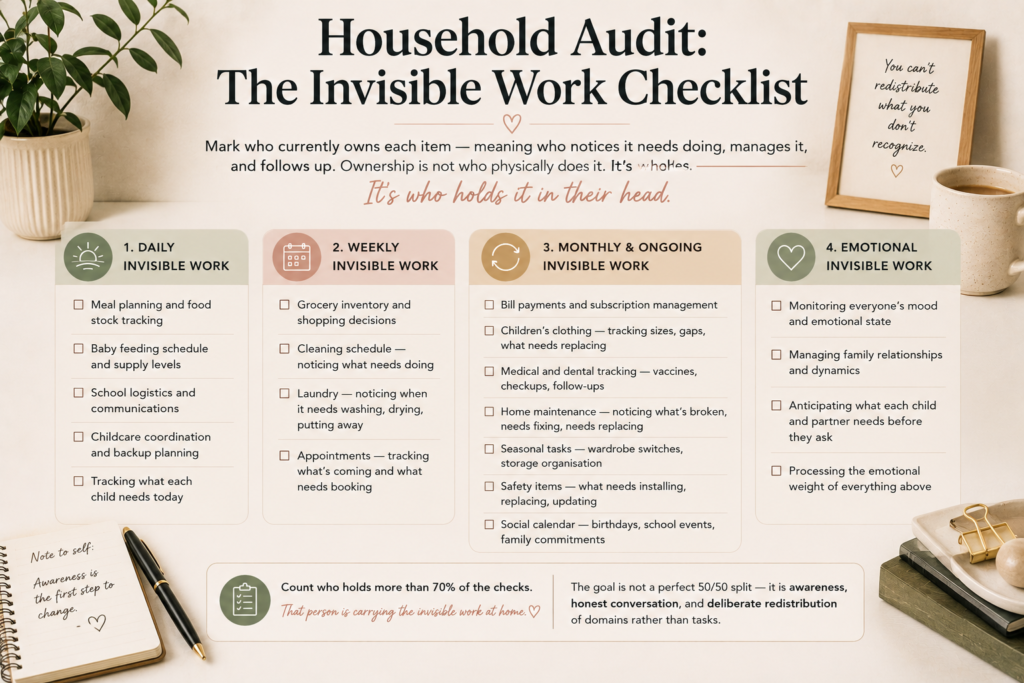
The household audit below is a starting point. Go through it together — not to assign blame, but to make the full picture visible. Most partners who do this exercise are genuinely surprised by what they see. That surprise is useful. It opens a conversation the invisible nature of the work was preventing.
Household Audit: The Invisible Work Checklist
Mark who currently owns each item — meaning who notices it needs doing, manages it, and follows up. Ownership is not who physically does it. It’s who holds it in their head.
Daily invisible work
- Meal planning and food stock tracking
- Baby feeding schedule and supply levels
- School logistics and communications
- Childcare coordination and backup planning
- Tracking what each child needs today
Weekly invisible work
- Grocery inventory and shopping decisions
- Cleaning schedule — noticing what needs doing
- Laundry — noticing when it needs washing, drying, putting away
- Appointments — tracking what’s coming and what needs booking
Monthly and ongoing invisible work
- Bill payments and subscription management
- Children’s clothing — tracking sizes, gaps, what needs replacing
- Medical and dental tracking — vaccines, checkups, follow-ups
- Home maintenance — noticing what’s broken, needs fixing, needs replacing
- Seasonal tasks — wardrobe switches, storage organisation
- Safety items — what needs installing, replacing, updating
- Social calendar — birthdays, school events, family commitments
Emotional invisible work
- Monitoring everyone’s mood and emotional state
- Managing family relationships and dynamics
- Anticipating what each child and partner needs before they ask
- Processing the emotional weight of everything above
Count who holds more than 70% of the checks. That person is carrying the invisible work at home. The goal is not a perfect 50/50 split — it is awareness, honest conversation, and deliberate redistribution of domains rather than tasks.
What Actually Helps Reduce the Invisible Work at Home
None of these are complete solutions. The invisible work at home is a structural problem that requires structural responses. But these three approaches meaningfully reduce the weight.
Transfer domains, not tasks
Pick the category that costs you the most. Grocery management. Home repairs. Medical appointments. School communications. Assign full ownership — including the noticing, the tracking, and the follow-up — to your partner. Not permanently if that doesn’t work. For a trial period long enough to actually feel the difference.
Externalise the invisible
A shared digital list, a whiteboard on the fridge, a running note both partners can see and add to. When the invisible work at home becomes visible in a shared space, two things happen: your brain gets partial relief from having to hold it all, and your partner gains access to what was previously only in your head.
Build systems that reduce the load for everyone
Recurring delivery orders for household staples. A shared family calendar. A weekly check-in where the invisible list gets reviewed together. The Anti-Chaos Weekly System was built partly for this — reducing what any one person has to hold in their head by externalising it into a shared weekly structure.
The Sunday Reset includes a specific slot for reviewing what the household needs this week — not just what you need to do, but what the house needs and who is owning each thing. Ten minutes of shared visibility at the start of the week saves hours of invisible solo management throughout it.
The Conversation Worth Having
At some point, making the invisible work at home visible requires a direct conversation. Not a complaint session. A mapping exercise.
Sit down together and go through the audit above. Look at who currently holds each category. Look at the full picture together.
Most couples who do this come away genuinely surprised. Not because either partner was hiding anything — but because the invisible work at home is genuinely invisible until it’s named. The surprise is the point. It opens a conversation the invisibility was preventing.
The conversation is not “you don’t do enough.” It is “here is the full picture of what the household requires. Let’s look at it together and decide how to share it differently.”
A Practical Summary
- The invisible work at home is the anticipatory management layer above visible household tasks — noticing, planning, tracking, following up
- It’s invisible because it works — the work disappears when it’s done well, only becoming visible when it’s not done
- The tiredness it produces doesn’t respond to physical rest because it’s cognitive depletion, not physical exhaustion
- The numbers are real — women perform 4+ more hours of unpaid domestic work daily, and hold the cognitive labour in 80%+ of households
- Task delegation isn’t the solution — domain ownership is. Someone else must hold the noticing, not just the doing
- Externalising the invisible — shared lists, weekly check-ins, household audits — is what makes sharing it possible
FAQ
What is invisible work at home?
Invisible work at home refers to the anticipatory cognitive and management labour of running a household — noticing what needs doing, planning how to do it, tracking schedules and deadlines, delegating and following up, and holding the entire household system in one person’s head so nothing falls through the cracks. It is distinct from the visible tasks themselves.
Why does invisible household work fall on moms?
Research consistently shows that the cognitive labour of household management defaults to women in most households regardless of employment status or stated values about equality. This is a structural pattern, not a personal failing — it reflects deeply ingrained social expectations about who manages domestic and family life.
How do you share the invisible work at home fairly?
By transferring domain ownership rather than individual tasks. Assigning full responsibility for specific household areas — including the noticing, managing, and following up — to each partner. This is different from task-splitting, which leaves the management overhead with one person while sharing only the execution.
Why am I always tired even though I’m not doing that much?
Cognitive depletion from tracking too much produces a specific tiredness that doesn’t respond to physical rest. If you are the person who holds the household’s invisible management layer in your head, that ongoing background process is consuming real cognitive resources — even when you’re sitting still.
What is the difference between invisible work and mental load?
They overlap significantly. Mental load typically refers to the cognitive overhead of managing family and household logistics. Invisible work is the broader category that includes both the cognitive labour and the physical tasks that go unnoticed and uncounted — particularly the anticipatory work that prevents problems before they occur.
How do I explain invisible work to my partner?
The household audit in this post is a practical starting point — going through it together makes the full picture visible rather than requiring one partner to describe it. Emma’s viral comic “You Should’ve Asked” is also a useful and accessible reference for partners who want to understand the concept.
Does invisible work affect physical health?
Yes. Research shows that chronic cognitive load activates the stress response, elevates cortisol, and disrupts sleep quality. For mothers already dealing with the physical demands of pregnancy, postpartum recovery, and breastfeeding, the additional cognitive load of invisible domestic work compounds existing physiological stress.
What is the fastest way to reduce invisible work at home?
Transfer one complete domain to your partner this week. Not a task — a domain. Grocery management, home repairs, medical appointments, school communications. Genuine domain ownership — where the other person now notices, manages, and follows up independently — produces the most immediate reduction in cognitive load.
For the organizational structure that makes shared household management actually work week to week, the Anti-Chaos Weekly System and the free Sunday Reset Checklist are where to start.





One comment on “The Invisible Work at Home: 6 Brutal Truths About Domestic Labour Nobody Talks About”