

Nobody tells you that moving abroad with kids adds a specific kind of invisible labour to your life.
It’s not just the logistics — the new school system, the healthcare paperwork, the banking in a second language. It’s the mental load of navigating everything without your usual support network. The friends who used to be around the corner are now a time zone away. The family who helped with the kids on a bad week isn’t here. And you’re supposed to keep working, keep the household running, keep showing up as the mother your children need — in the middle of all of it.
Building flexible income abroad, for moms isn’t just about money. It’s about maintaining a sense of agency in a life that can feel like it’s constantly happening to you rather than being shaped by you.
If you’re reading this, that probably sounds familiar.
Table of Contents
Why Flexible Income Matters More When You Live Abroad
Financial independence looks different in every family. But for moms living abroad — especially those whose qualifications don’t transfer easily, whose work authorization is tied to a partner’s visa, or who are navigating a language barrier in a professional context — building your own income stream isn’t optional.
It’s a safety net. A sense of self that exists independently of where you live, what your partner earns, or what the local job market looks like this year.
For many expat mothers, the challenge isn’t lack of skill or ambition. It’s structural. The local job market may require fluency in a language you’re still learning. Your professional credentials may not be recognized. Childcare costs may make traditional employment barely worth the salary. And if your visa status depends on your partner’s employment, your options narrow further.
Flexible income for moms abroad solves a different problem than a standard job does. It doesn’t require local connections, local language fluency, or a fixed schedule. It moves with you. It works around your kids. And it builds something that belongs entirely to you — regardless of which country you’re currently calling home.
According to the World Bank, financial inclusion and independent income are among the strongest predictors of wellbeing and agency for women — findings that resonate deeply for mothers navigating life far from their original support systems.
Why So Many Moms Struggle Financially After Moving Abroad
Moving abroad with children changes more than your address. For many mothers it changes career momentum, professional confidence, and financial independence simultaneously.
Some moms pause their careers temporarily — intending to return to full employment once the family settles — and find the gap harder to close than expected. Others discover their qualifications don’t transfer. Some lose the family support that made dual-income work possible back home. Others simply can’t find work that fits around unpredictable childcare in a country where they’re still building a network.
The result is a specific kind of financial vulnerability that most expat content doesn’t address honestly. You’re educated, experienced, capable — and structurally limited in ways that have nothing to do with your ability.
Building flexible income for moms abroad is the practical response to that structural limitation. Not a side hustle. Not a passion project. A deliberate income strategy built around your real constraints.
The Types of Flexible Income That Actually Work With Kids
Not all income models are equal when you have children and an unpredictable schedule. Some require you to be available at specific times, to be “on” for clients at a moment’s notice, or to keep up with real-time demands that don’t pause for sick days or sleep regressions.
The most sustainable flexible income for moms abroad tends to fall into three categories.
Digital Products
Digital products are the clearest fit for most moms building income abroad. You create something once — a planner, a guide, a template, a mini-course, a tracker — and it sells while you’re doing school pickups and bedtime routines. The upfront work is real, but the ongoing demand on your time is minimal.
This is the model I built Mamá Remoto on. My Anti-Chaos System — a weekly planning tool for working moms — sells on Payhip for €4.99. I built it because I needed it. Then I packaged it and sold it to other moms who needed the same thing.
Platforms like Payhip, Gumroad, and Etsy have made it significantly easier for creators to sell digital products without inventory, shipping, or large startup costs. For moms abroad, this matters because you’re not tied to any one country’s market — your customer can be anywhere.
The most important thing about digital products is that they need to solve a real, specific problem for a real, specific person. Generic products don’t sell. Products that answer an urgent question — how do I organize my week with two kids and a remote job, how do I track my baby’s sleep when I’m too exhausted to think — do.
Freelance Services
Freelance work using skills you already have is one of the fastest paths to flexible income for moms abroad because you don’t need to build an audience or create a product first. You need one client.
The skills that transfer most reliably to remote freelance work include:
- Writing and copywriting
- Marketing strategy and management
- Social media and Pinterest management
- Graphic and visual design
- Translation and localization
- Virtual assistance and project coordination
- Email marketing and automation
- Customer support
The challenge with freelancing is finding clients consistently. Platforms like Upwork and Contra connect freelancers with remote clients globally — useful starting points when you’re building in a new country without a local professional network.
The advantage is no inventory, no shipping, no physical presence required. You work asynchronously, on your schedule, from wherever you are. For expat moms, that portability is the whole point.
Content Creation With a Long-Term View
A blog, a Pinterest presence, a newsletter — built slowly around a topic you genuinely know and genuinely care about. This is the slowest path to flexible income for moms abroad but often the most sustainable, because it builds an asset that compounds over time rather than requiring you to constantly trade hours for money.
The mistake most people make with content creation is expecting it to generate income quickly. It doesn’t. A blog takes six to twelve months of consistent publishing before search traffic becomes meaningful. Pinterest takes three to six months of regular pinning before momentum builds. A newsletter takes months of value-giving before it converts readers into buyers.
But the compounding effect is real. The post I wrote six months ago is still bringing in readers today. The pin I scheduled on a Wednesday evening while the kids were in bed is still driving traffic. Content that existed before I woke up this morning worked while I slept.
That’s why flexible income for moms abroad often involves a combination — freelancing for immediate income, digital products for passive income, and content creation for long-term asset building.
What I Wish I’d Known Before I Started
I am a Marketing Director with over ten years across advertising, digital marketing, media buying, and product. I know how to build audiences. I know how to run campaigns. I know what a funnel is and how to optimize it.
And it still took longer than I expected.
Not because the skills didn’t apply — they did. But because building flexible income for moms abroad while managing two small children, a remote full-time job, a chronic illness, and life in a country that isn’t the one I grew up in is a different challenge than any marketing brief I’ve ever written.
The things that helped most:
Protecting one work window. My late morning — after the baby goes to my mother-in-law’s and before my work meetings start — is the only time I have for this project. I guard it. Everything for Mamá Remoto happens in that window or it doesn’t happen. That single constraint made me more productive than any productivity system I’ve tried, because it forced me to be ruthless about what actually matters.
Treating it like a real business from day one. Not a hobby. Not something I’ll get to when things calm down. A real project with real goals and a real product. The moms I see building sustainable income abroad are the ones who made that mental shift early.
Accepting that slow is not the same as stopped. The hardest weeks are the ones where nothing seems to be happening. No sales, no traffic spikes, no sign that any of it is working. Those weeks still count. The consistency across them is what builds something real.
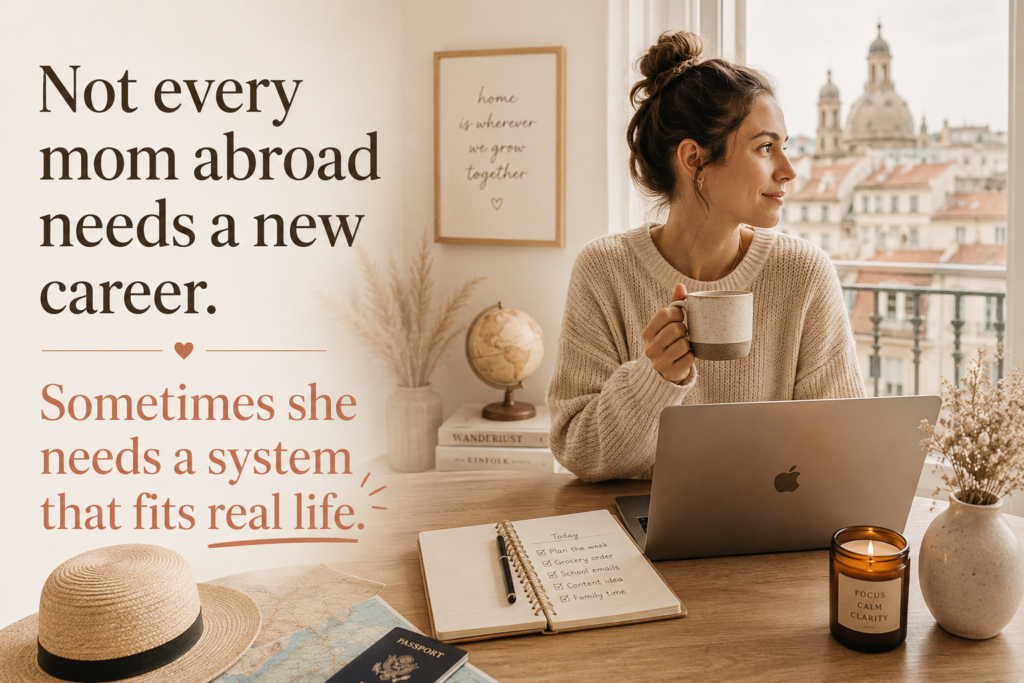
The Real System Behind Sustainable Income Abroad
Most moms don’t fail at building flexible income because they lack ideas or skills. They fail because they lack the organizational infrastructure to make consistent progress inside an inconsistent life.
Building flexible income for moms abroad depends less on motivation and more on:
- Batching tasks so you’re not making content decisions on the fly every day — read more about decision batching here
- Protecting your energy window — the one reliable hour where you can do focused work without interruption
- Reducing decision fatigue in other areas of life so your best thinking goes to your income project, not to what’s for dinner — the Anti-Chaos System was built specifically for this
- Having a crisis-mode plan so that a hard week doesn’t derail weeks of momentum — how to reset your week when things fall apart
- Working in small consistent blocks rather than waiting for a long stretch of time that never arrives
The Sunday Reset I do every week includes a dedicated slot for my personal project — it’s treated as a non-negotiable alongside work deadlines and family commitments. Not because I always have energy for it. Because it’s on the list before the week starts, which means it happens even on the weeks I don’t feel like it.
Organization is not a soft skill when you’re building income abroad. It’s the business strategy.
Realistic Income Timelines for Moms Abroad
One of the most damaging things about online entrepreneurship content is the implication that income happens fast if you just do it right. Most moms building flexible income abroad are working on timelines that look more like this:
Months 1-3: Building foundations. Creating the product or setting up the freelance profile. Writing the first posts. Building the first audience. Zero or near-zero income. This is the phase where most people stop.
Months 3-6: First traction. A few sales. Some organic traffic. The first client. Small numbers but real ones. The proof that the direction is right.
Months 6-12: Momentum building. Compounding content. Repeat customers. A small but growing audience. Income that covers something meaningful — a subscription, a bill, a childcare session.
Year 2+: Real sustainability. Multiple income streams reinforcing each other. Content from year one still working. A product catalogue rather than a single offer.
These timelines assume consistent effort — not full-time effort, not hustle-culture effort, but showing up in your protected window several times a week and doing the work. Even on the weeks when nothing seems to be happening.
The moms who build sustainable flexible income abroad are not the ones with the best ideas. They’re the ones who kept going the longest.
Where to Start This Week
If you’re building flexible income for moms abroad and you don’t know where to begin, here’s the simplest starting point:
Step 1 — Identify your most transferable skill. Not your most impressive skill. Your most transferable one — the thing you can do asynchronously, remotely, without needing to be physically present or fluent in the local language.
Step 2 — Find one person who needs that skill. Not a client list. One person. Solve their problem. Get paid. That’s your proof of concept.
Step 3 — Protect one work window. Name the hour. Guard it. Use it only for this.
Step 4 — Decide on your long-term model. Freelancing builds income now. Digital products build income later. Content builds an audience that supports both. Most sustainable income for moms abroad eventually involves all three — but start with the one that solves your most urgent problem.
Step 5 — Plan it into your week. Not when you have time. Into the week, as a non-negotiable, before the week starts. Use the Sunday Reset Checklist if you need a structure for that.
A Practical Summary
- Flexible income for moms abroad solves a structural problem — not a motivation problem
- Digital products offer the best long-term fit: build once, sell repeatedly, work from anywhere
- Freelancing is the fastest path to first income using skills you already have
- Content creation is the slowest path but builds a compounding asset over time
- Organization is the income strategy — protecting your window and batching your tasks matters more than the perfect business idea
- Slow timelines are normal — the moms who succeed are the ones who kept going past month three
FAQ
What is the best flexible income for moms living abroad?
The best flexible income for moms abroad depends on your existing skills, available time, and financial goals. Digital products offer the most passive model. Freelancing offers the fastest path to first income. Content creation builds the most durable long-term asset. Most sustainable income strategies eventually combine all three.
Can expat moms work remotely without local work authorization?
This depends entirely on your visa status and the laws of your host country. Some visa types permit remote work for foreign employers. Others don’t. Always check the specific regulations for your situation — this is not an area where assumptions are safe. A local immigration lawyer or your country’s official immigration resources are the right starting point.
How long does it take to build income abroad as a mom?
Realistically, three to six months to first meaningful income through freelancing, and six to twelve months before digital products or content generate consistent revenue. The timeline varies by effort, niche, and starting platform — but expecting fast results usually leads to abandoning the project before it gains traction.
Do I need a big audience to sell digital products?
No. A small, specific audience that has the problem your product solves is more valuable than a large general audience. Many moms make consistent digital product sales with audiences of a few hundred people — because those people are exactly the right fit.
What skills translate best to remote freelance work abroad?
Marketing, writing, design, translation, virtual assistance, social media management, and email marketing are consistently in demand remotely and don’t require local presence or language fluency in the host country.
How do I find remote clients as an expat mom?
Platforms like Upwork and Contra are starting points for finding global remote clients. LinkedIn with location set to “worldwide” or “remote” is also effective. Warm outreach to former colleagues and professional contacts is often the fastest path to a first client.
Is blogging still worth it for building income abroad?
Yes — but with realistic expectations. A blog takes six to twelve months of consistent publishing before it generates meaningful organic traffic. The payoff is a compounding asset that works independently of your time. It’s worth starting early, but not as your only income strategy.
How do I balance building income with managing kids and a household?
The honest answer: imperfectly, and with a system. Protecting one dedicated work window, batching decisions to reduce daily cognitive load, and having a crisis-mode plan for hard weeks are the organizational habits that make the difference. The organization system I built was designed specifically for this balance.
If you’re trying to get your week organized enough to protect time for an income project, the free Sunday Reset Checklist is the starting point — a 10-minute weekly reset that helps you find and protect your work window.



One comment on “5 Powerful Ways to Build Flexible Income Abroad as a Mom”
Comments are closed.