
There’s a moment — it happens to almost every mother, though nobody warns you about it — when you catch your reflection and feel a kind of mild shock. What’s my identity after motherhood?
Not because you look different. But because for a split second, you don’t quite recognize the person you’ve become.
You are a mother now. Fully, completely, irrevocably. And somewhere in the process of becoming that, some version of who you were before got very, very quiet.
Table of Contents
The Rocking Chair Moment
I can tell you exactly when it happened for me.
My first son was a few weeks old. I hadn’t slept. It was around noon — not morning, noon — and I was sitting in the rocking chair breastfeeding him, holding a cup of coffee my husband had made because I couldn’t, eating toast he had also made because I couldn’t do that either. I hadn’t showered. I hadn’t been outside. I hadn’t had a thought that wasn’t about the baby’s needs or my own survival since before he was born.
And I started crying.
Not from pain exactly. Not from exhaustion, though I was exhausted. From a sudden, disorienting awareness of a gap — the space where my previous life used to be.
The thought that came was specific: how did I not consciously know when I had my last coffee alone?
Not my last night out. Not my last holiday. My last coffee. Something so ordinary it never warranted attention. And it was gone — replaced, permanently and without warning, by this version of mornings where someone always needed something before I had taken a single sip.
That was the moment I understood, for the first time, that I was grieving something. Not my child — I had wanted him desperately. But the version of myself that had existed before him. The one who drank her coffee in the quiet. The one who knew who she was without having to think about it.
Nobody had told me that was something I would need to grieve.
The Loss Nobody Names
Identity after motherhood is one of the least discussed transitions in public conversation about becoming a parent.
We talk about the baby. We talk about sleep deprivation. We talk about feeding, about milestones, about the practical logistics of a new life. We occasionally talk about postpartum depression — though even that conversation is more sanitized than it should be.
We almost never talk about the ordinary, pervasive, not-quite-depression-but-not-fine feeling of not recognizing yourself. Of looking at your life from the outside and not being able to locate the person who used to inhabit it.
The fury I felt when I first became a mother — and I was furious — was not at my child. It was at the silence that had preceded him. The way nobody had told me. The way the women around me had joked about the sleep and the chaos without ever mentioning that the person you were before simply does not survive the transition intact.
You have to rebuild her. Differently. From the pieces that remain.
Matrescence: The Word You Probably Haven’t Heard
In 1973, anthropologist Dana Raphael coined the term matrescence — the process of becoming a mother. Like adolescence, it describes a developmental transition that reshapes identity at a fundamental level: hormonally, neurologically, socially, and psychologically.
Psychiatrist Alexandra Sacks popularized the concept in a widely-watched TED Talk, describing matrescence as one of the most significant biological and psychological changes a person can go through — one that is largely invisible in the cultural conversation about new motherhood.
We talk about adolescence as a real, significant, socially recognized transition. We give teenagers years of grace for their mood swings, their confusion, their identity instability. We do not talk about matrescence that way. We expect mothers to deliver a baby and continue being who they were — just with a baby attached.
That expectation is a setup for the particular silent suffering that comes from feeling broken by something that was supposed to be joyful.
Research published in Nature Neuroscience found that first-time mothers undergo significant and lasting changes to brain structure — specifically in regions associated with social cognition, self-referential processing, and attachment. Matrescence is not metaphorical. It is neurological.
You are not broken. You are restructured.
What Identity After Motherhood Actually Means
The identity loss of motherhood is not one thing. It’s a series of smaller losses that accumulate before you’ve had time to process any of them individually.
I lost my mornings — that quiet window of being a person before the day started. The coffee, the small rituals, the time between waking and the world making its first demand. All of it gone before I had registered it as something worth protecting.
I lost the professional version of myself. The one who strode into a meeting and knew exactly what she was doing. Not because I stopped being competent — I remained a Marketing Director through both pregnancies and both postpartum periods — but because the certainty that competence produces was harder to access when the rest of my identity was in free fall. You cannot feel like a confident professional while simultaneously crying over cold coffee in a rocking chair at noon.
I lost the social version of myself. The friends who slowly drifted as the gap between our daily realities widened. The conversations that used to sustain me. The version of me who existed in other people’s eyes as more than a mother — as a person with opinions and ambitions and a life that extended beyond the logistics of small children.
I lost the cultural version of myself. I am Dominican, living in Spain. My old identity was rooted in a place, a language as it is actually spoken, a set of references and rhythms and social codes that I carry internally but that have no external reflection where I live. Motherhood abroad compounds identity loss in a specific way: you didn’t just lose your old self to parenting. You lost the geography, the community, and the social context in which your old self existed.
For mothers who have moved countries, this is a double displacement. Naming it as such is the first useful thing.
Postpartum Depression and Identity — Where They Overlap
I had postpartum depression after my first son.
I want to say that clearly because I think the conversation about PPD is still too careful, too hedged, too focused on symptoms checklists and not enough on the lived experience of it — which includes, but is not limited to, a profound disconnection from the person you used to be.
I was treated with medication. It helped. The acute phase lifted. But what remained — what I think most postpartum resources underestimate — is that even after the depression resolves, the identity question doesn’t. The medication addresses the neurochemistry. It doesn’t reconstruct who you are now that everything has changed.
That work is slower. It doesn’t have a prescription. And it requires acknowledging that the loss was real — not a symptom to be managed, but an actual grief that needed to be processed.
According to the American Psychological Association, postpartum depression affects approximately 1 in 7 mothers and is consistently underdiagnosed — partly because the symptoms overlap with the ordinary exhaustion of new motherhood, and partly because mothers are often reluctant to admit difficulty during a period that is culturally framed as joyful. Identity confusion and loss of self are recognized features of postpartum depression that persist even after the acute phase resolves.
If you are currently in the acute phase — if the darkness is not lifting, if you are not okay in a way that feels qualitatively different from tired — please speak to your doctor. The medication helped me. It may help you.
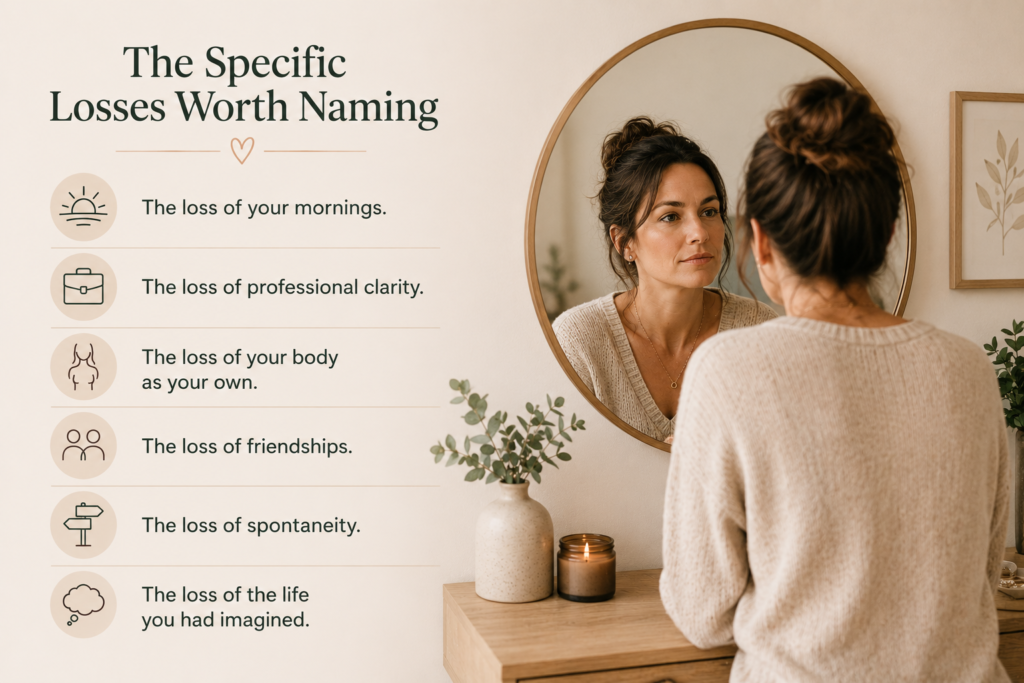
The Specific Losses Worth Naming
Because the generic version of this conversation doesn’t help as much as the specific one:
The loss of your mornings. The quiet that no longer exists. The version of your day that belonged to you before anyone else was awake.
The loss of professional clarity. The certainty about what you’re good at. The professional identity that felt solid before it had to share cognitive space with someone who needs everything from you.
The loss of your body as your own. Pregnancy, then birth, then breastfeeding — your body becomes a resource before it can simply be yours again. This takes longer to process than anyone tells you.
The loss of friendships. The ones that couldn’t survive the gap. The ones that drifted. The ones you let go because maintaining them required more energy than you had.
The loss of spontaneity. The version of yourself who could just go somewhere, do something, decide in real time. That person doesn’t exist in the same way anymore.
The loss of the life you had imagined. This one is the most complicated — grieving not what you had but what you had assumed you would have. The version of motherhood that looked a certain way in your imagination and the version that arrived.
Each of these deserves to be grieved properly, not bypassed in the rush to adapt.
What Rebuilding Identity After Motherhood Actually Looks Like
Here is what I want to be honest about: I am not on the other side of this. I am in it.
My second son is several months old. I am still in the thick of the exhaustion, the depletion, the identity negotiation. The version of me that has fully integrated “mother of two” into a stable, coherent sense of self — she’s coming. She’s not here yet.
What I can tell you is what rebuilding looks like from inside the process, not from the resolution.
It looks like this blog.
Building Mamá Remoto — a project that is mine, that came from something I needed and couldn’t find, that connects to my professional skills and my personal experience simultaneously — has been the most significant thing I’ve done for my identity since becoming a mother. Not because entrepreneurship is the answer for everyone. Because having something that is purely mine, that I made, that exists because I decided it should — gives me something to point to when the question “who am I besides a mother” gets loud.
It looks like the nutritionist appointment.
Going to get blood work done. Taking my own depletion seriously enough to treat it as a medical issue rather than a personality flaw. Treating my body as something worth attending to with the same care I give everyone else’s needs. That is identity work. The decision to prioritize your own recovery is an act of self-recognition.
It looks like the 28-minute pilates session at 9pm.
Not impressive. Not a transformation. Just a Tuesday evening where I did something for my body because my body is mine and it needed movement. Small continuities of self — the version of you that existed before children and still exists underneath everything — are rebuilt through exactly these small, consistent acts of recognition.
It looks like writing the professional bio.
Not for anyone to read. Just for myself — three sentences describing who I am professionally and what I’m good at. Mothers often stop thinking of themselves as professionals the moment they become mothers. Writing it down pushes back against that erasure.
Five Small Things That Help Rebuild Identity After Motherhood
These are not cures. They are practices — small consistent acts of reclaiming parts of yourself that didn’t disappear, just got very quiet.
1. Name one thing that is only yours. Not for the family. Not for work. One thing — a podcast you love, a skill you’re developing, a friendship you maintain, a 20-minute walk you take alone — that exists only because you want it to. Protect it like a work meeting.
2. Answer one question weekly. What did I do this week that had nothing to do with being someone’s mother? If the answer is nothing, that’s data. It doesn’t need to be fixed immediately. But it’s worth knowing.
3. Find your specific community. Not mothers in general. Mothers in your specific situation. Mothers abroad. Working mothers. Mothers who are also building something. The gap between generic motherhood advice and your actual life is wide enough that generic support often misses.
4. Let yourself be angry about what you weren’t told. The fury is appropriate. You were not warned. The women before you either didn’t know how to tell you or didn’t think it would help. It wouldn’t have fully prepared you — nothing fully prepares you — but the anger at the silence is legitimate and worth feeling rather than suppressing.
5. Rebuild slowly and without a deadline. Matrescence is a transition, not a failure state. The reconstructed identity that emerges on the other side is not a lesser version of who you were. It is more complex, more aware of its own limits, more honest about what actually matters. That version is being built right now — in the rocking chair, in the exhausted noon, in every small act of remembering that you exist beyond your children’s needs.
For Mothers Who Moved Abroad
If you are raising children in a country that isn’t yours, identity after motherhood carries an additional weight that most matrescence conversations don’t account for.
Your old self was partially constituted by place — by language as it is actually spoken around you, by the social codes you didn’t have to think about, by the friends who knew you before you were a mother and still reflected that version of you back.
None of that is available where you live now. The version of you that existed at home exists only in your memory and in video calls.
This is not a reason to feel more broken than other mothers. It is a reason to be gentler with yourself about how hard this particular transition is. You are not just becoming a mother. You are becoming a mother in a foreign language, without your village, in a cultural context that wasn’t built around your references.
That is an objectively harder version of an already hard transition. You are allowed to say so.
A Practical Summary
- Identity after motherhood involves real, measurable neurological change — it is not a mindset issue or a failure of adaptation
- Matrescence — the developmental transition of becoming a mother — is as significant as adolescence and almost completely unsupported by culture
- The loss is specific: mornings, professional clarity, body autonomy, friendships, spontaneity, the life you had imagined
- Postpartum depression and identity loss overlap — medication addresses the neurochemistry; the identity work is slower and separate
- Rebuilding is not linear and does not require being on the other side of the transition to begin
- Small consistent acts of self-recognition — a project, a movement practice, a weekly question — rebuild identity from the inside out
- Mothers abroad grieve twice — the displacement of motherhood and the displacement of immigration compound each other
FAQ
Is it normal to lose your identity after becoming a mom?
Yes — it’s so common it has a name. Matrescence, coined by anthropologist Dana Raphael, describes the profound identity shift that accompanies becoming a mother. Research shows that first-time mothers undergo lasting changes to brain structure in regions associated with self-referential processing. Identity confusion in new motherhood is a normal neurological and psychological response.
What is matrescence?
Matrescence is the developmental transition of becoming a mother — encompassing the hormonal, neurological, psychological, and social changes that accompany it. Like adolescence, it is a period of identity reconstruction. Unlike adolescence, it is rarely acknowledged or supported by the culture around it.
How long does identity loss after motherhood last?
There is no fixed timeline. Most mothers report a gradual stabilization of identity over the first two to three years — though this varies significantly based on circumstances, support, and whether subsequent children arrive. Identity after motherhood is not recovered; it is rebuilt differently.
What is the difference between postpartum depression and identity loss?
Postpartum depression is a clinical condition involving neurochemical changes that require medical treatment. Identity loss is a normal feature of matrescence that occurs across the full spectrum of maternal experience — including in mothers who do not have PPD. They overlap and can compound each other, but they are distinct processes requiring different responses.
How do mothers rebuild confidence after having children?
Most mothers find that rebuilding confidence requires reclaiming small, consistent pockets of identity outside of caregiving — professional projects, creative work, physical practice, or community. The specific form matters less than the consistency and the ownership: something that is yours, that you made or maintained, that exists independently of your role as a mother.
Does having a baby change your personality permanently?
Research suggests that motherhood produces lasting changes in brain structure and function — particularly in areas associated with social cognition and attachment. These changes are not losses; they are adaptations. Many mothers report that the reconstructed identity that emerges from matrescence is more self-aware and values-clarified than the one that preceded it.
How do I find myself again after having a baby?
Start small and without a deadline. Name one thing that is yours alone. Answer weekly what you did that had nothing to do with being a mother. Find community with mothers in your specific situation. Build or maintain one thing that exists because you decided it should. Let the reconstruction be slow — it is building something real.
Is it harder to maintain identity after motherhood when you live abroad?
Yes — for specific structural reasons. Your old identity was partially constituted by place, by people who knew you before you were a mother, by cultural references that don’t transfer. Motherhood abroad involves a double displacement: the loss of your pre-mother self and the loss of the social context in which that self existed. Both are real losses and both deserve acknowledgment.
Related: Income Abroad and How It Works


One comment on “Identity After Motherhood: 5 Powerful Ways to Rebuild Yourself After Having Kids”