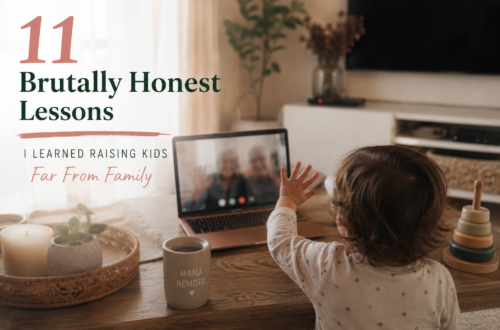
There is a specific kind of loneliness that only a mom abroad understands.
It’s not the loneliness of being in a quiet house. It’s not missing a friend you haven’t called in months. It’s the kind that hits when your toddler has a 39-degree fever at 11pm and the person you’d normally call — your mom, your sister, your best friend from college — is six time zones away, asleep, unreachable in the way that truly matters: physically there.
I’ve lived in Valencia, Spain for several years now. I work remotely as a Marketing Director. I have two kids, a partner who splits the school run with me most mornings, and a life that — from the outside — looks put together. But there were months, especially in the beginning, where I felt the absence of my people in a way I hadn’t anticipated. Not dramatically. Not in a way I could easily explain. Just a low, persistent hum of: who is my village here?
If you’re a mom abroad without family nearby, you know exactly what I mean.
This post is about building the village you need — not finding it, not waiting for it to appear — from scratch. Because that’s what we actually have to do. And it’s more possible than it feels at 11pm with a sick toddler and a silent phone.
Table of Contents
What We Mean When We Say “Village”
The phrase “it takes a village to raise a child” is repeated so often it’s become wallpaper. But what does the village actually do?
Research on social support and parenting consistently shows that caregiving networks — not just partners, but extended community — directly affect parental mental health, parenting quality, and children’s outcomes. A 2023 study in Social Science & Medicine found that mothers with strong social support networks reported significantly lower rates of burnout and anxiety, and greater confidence in their parenting decisions.
The village isn’t about convenience. It’s about:
- Emotional validation from people who get it
- Practical backup when you’re sick, overwhelmed, or traveling for work
- Spontaneous connection that breaks the isolation of being the only adult in the room all day
- Witnessing — someone who sees your effort and reflects it back
When you’re a mom abroad without family, most of these things don’t exist by default. You have to build them on purpose. And that takes a different kind of effort than anything your home country prepared you for.
Why It’s Harder Than Anyone Tells You
Before we get to solutions, let’s be honest about the problem. Because I spent too long thinking the difficulty was a personal failure.
You’re starting from zero, socially. Every relationship you have in your new country — every potential friend, every neighbor, every other mom at the school gate — requires you to re-earn the trust and depth that took you years to build back home. That’s exhausting. It’s not a personality flaw. It’s just math.
The logistics of making friends as a parent abroad are absurd. You’re busy. The other moms are busy. Cultural norms around friendship vary wildly. In Spain, for example, social life often happens late in the evening, which clashes violently with small children’s bedtimes. In other countries, people are warm but rarely invite you into their home. You can’t always read the cues.
Remote work compounds the isolation. If you worked in an office, you’d have colleagues. You’d have water cooler chats, lunch invitations, passive human contact. When your office is your kitchen table, that layer of social scaffolding disappears. Remote working moms abroad often go entire weekdays without a real conversation outside their own household. The professional connection and the community connection are both missing at once.
Guilt gets in the way. There’s an invisible pressure to seem fine — to make the move look like a good decision, to not complain about being lonely because you “chose this.” That silence keeps a lot of expat moms from reaching out for the connection they need.
None of this means you can’t build something real. It means you need a system, and you need to be intentional about it.
The Shift That Changes Everything
Here’s the reframe that helped me most: your village doesn’t have to be local, and it doesn’t have to be deep to count.
We’re often waiting for friendship that resembles what we had at home — effortless, years-old, the kind where you show up unannounced and someone makes you coffee. That kind of relationship takes time to build anywhere. Expecting it to materialize quickly in a new country sets you up to feel perpetually disappointed.
Instead, think in layers.
A functional village for a mom abroad has at least three layers:
- The inner circle — one or two people (could be anywhere in the world) you can call when things fall apart. This layer is about emotional survival.
- The local network — people in your city or neighborhood with whom you have enough trust to exchange favors, share school pickup, grab a coffee on a bad day. This layer is about practical survival.
- The community — a wider group of people, often online, who share your specific experience. Other expat moms, other remote working moms, people who understand what it means to be doing this far from home. This layer is about not feeling invisible.
Building all three is the goal. But you don’t need all three fully formed to start feeling less alone.
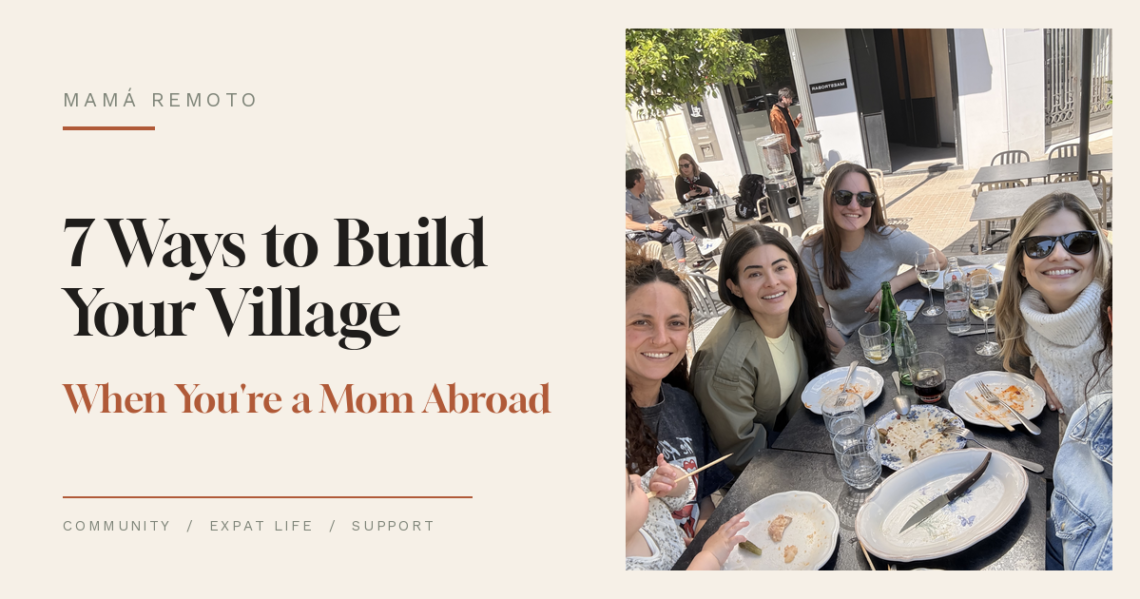
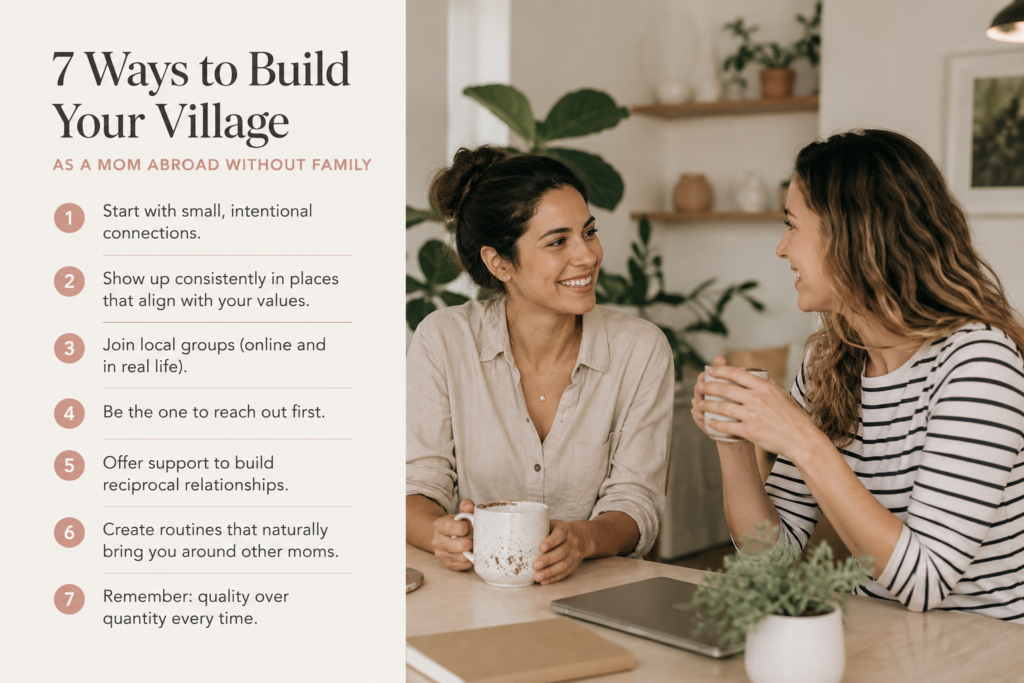
7 Ways to Build Your Village When You’re a Mom Abroad Without Family
1. Start with the people already in your orbit
The first mistake most expat moms make is looking outward before they’ve looked sideways. Before you join any group or download any app, look at who is already around you.
The other parents at your child’s school. The neighbors you’ve greeted but never really talked to. A colleague on your remote team who mentions her kids occasionally. The woman at the playground you see every Tuesday.
These people are potential village. Not because you’re going to become best friends — you might not — but because proximity and repetition are the foundations of trust. Say hello consistently. Ask real questions. Be the one who starts.
Most people, especially in new social environments, are waiting for someone else to go first. Go first.
2. Find your expat mom community online before you find it offline
This sounds counterintuitive — shouldn’t you prioritize local connection? — but online communities of moms in your specific situation can provide something local friendships often can’t in the early stages: immediate recognition.
Facebook groups for expat parents in your city, subreddits like r/expats or r/mommit, Instagram communities for international moms, Discord servers for remote working parents — these spaces are full of people who understand the specific texture of your situation. They won’t need context. They already know.
And practically: online community often converts into offline connection faster than you’d expect. “Anyone else in Valencia want to grab coffee?” is a post that gets responses.
3. Use a weekly system to stay consistent, not just motivated
Connection — like most things that matter — doesn’t happen through motivation. It happens through consistency.
When you’re rebuilding a social life from scratch while also managing a career and raising children, the energy for reaching out is often the first thing to disappear by Wednesday. You’re in survival mode. You’re running on the fuel of your last Sunday reset, and by midweek, sending a “want to grab coffee?” message feels like one more task on an already impossible list.
This is where structure protects you.
One thing that’s helped me is building social outreach into my Sunday planning — the same way I plan the week’s meals and the kids’ activities. One connection per week. One message, one invitation, one response to someone I’ve been meaning to follow up with.
It sounds small. It compounds fast.
If you haven’t already, grab the free Sunday Reset Checklist — it’s the weekly planning template I use to make sure the things that matter (including connection) don’t get swallowed by the urgent.
4. Be honest about what you need
This one is harder than any of the tactical advice, but it matters more.
Most expat moms I know — including me — default to performing fine. We’ve gotten so used to explaining our lives (“yes, we moved abroad, yes on purpose, yes it’s amazing but also…”) that we never get to the but also.
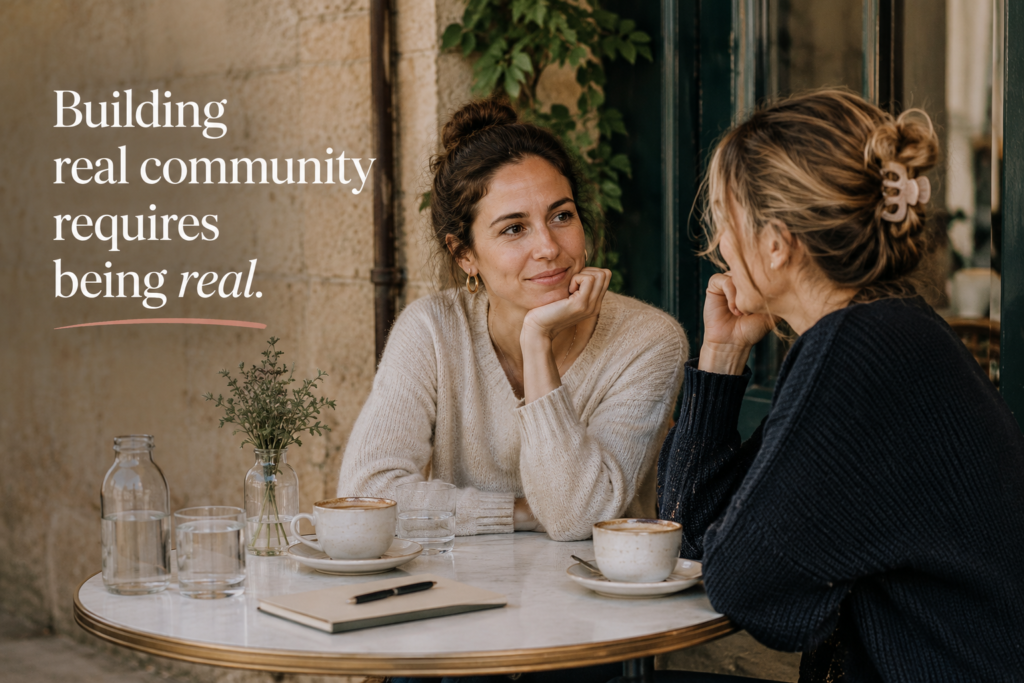
Building real community requires being real. Not performing a highlight reel of expat life. Not pretending the adjustment was seamless.
You don’t have to lead with vulnerability. But when someone asks how you’re settling in and the honest answer is “it’s harder than I expected,” say that. The people who respond with recognition rather than discomfort are the ones worth investing in.
Research from Brené Brown’s work on vulnerability and connection consistently shows that the shortcut to meaningful relationships isn’t time — it’s honesty. You can build depth faster than you think if you’re willing to be real first.
5. Create rituals, not just plans
Plans cancel. Kids get sick. Someone has a work deadline. If your social connection depends entirely on scheduled events, you’ll lose it every time life disrupts the schedule.
Rituals are sturdier. A ritual is a recurring, low-stakes touchpoint that doesn’t require a lot of coordination to maintain.
Some examples that work for expat moms:
- A standing weekly voice note exchange with a friend back home (not a call — voice notes are asynchronous and far easier to keep up)
- A monthly “expat moms dinner” that rotates houses, with a standing date so it never needs to be rescheduled from scratch
- A weekly check-in message to your online community — a question, a response, a “how’s everyone doing?”
- A morning walk with a local mom, same day every week, with the understanding that canceling once doesn’t mean it’s over
Rituals create the feeling of having people without requiring perfect conditions. That’s exactly what you need when your conditions are never perfect.
6. Invest in your kids’ social life strategically
Your children’s friendships are, indirectly, a source of connection for you too.
When your child has a friend at school, you meet that friend’s parents. When your kids play together regularly, you and the other parents start showing up to the same places at the same times. Proximity plus repetition — again.
This isn’t about engineering your children’s friendships for your own social benefit. It’s about recognizing that investing in their integration (playdates, extracurriculars, birthday parties even when you’re exhausted) also builds the infrastructure for your own connection.
Choose one or two activities where you’ll see the same group of families repeatedly. Not for the activity itself, but for the relationship runway it creates.
7. Lower the threshold for what counts as community
One of the most damaging things I did in my early years abroad was discount connection that didn’t look the way I expected.
The neighbor who always waves but never stops to chat — that’s something. The WhatsApp group for school parents that’s mostly logistics — that’s something. The online community where I’ve never met anyone in person but where someone always responds — that’s something.
None of it is the village I had in my head. All of it is real.
A study on loneliness from the Harvard Study of Adult Development — one of the longest-running studies on happiness — found that the quality of relationships matters less about depth and more about regularity and reliability. It’s the consistent small interactions that buffer against isolation, not just the profound ones.
Your village doesn’t have to be dramatic. It just has to be consistent.
When You’re in the Hard Part Right Now
If you’re reading this from the place of acute loneliness — the early months of a move, a period when nothing has clicked yet, a season when your energy for building connection has run out — I want to name something:
This is the hardest part. Not because it stays this hard, but because the early phase of building a life abroad requires output (effort, vulnerability, initiative) before you get significant input back. The return on connection investment is delayed. That gap is genuinely painful.
The thing that helped me most in that period wasn’t finding community. It was reducing friction on the weeks I could show up, and giving myself permission to rest on the weeks I couldn’t. A simple planning practice — knowing what my week looked like, when I had margin and when I didn’t — made it easier to protect the moments where connection was actually possible.
The Sunday Reset Checklist is the template I use every week to make space for what matters — including showing up for my own social life. Download it free here.
What This Actually Looks Like Over Time
Three years in, my village in Valencia is not what I expected when I moved here. It’s not the deep, decades-old web of people I left behind.
But it’s real.
It’s a local mom I met through school pickup who has become genuinely important to me. It’s a group of women I found through an expat community online, some of whom I’ve now had dinner with in three different cities. It’s the friends back home I talk to through voice notes almost every day — imperfect, asynchronous, but present. It’s the online community of moms in situations like mine, where I don’t feel invisible.
None of it was waiting for me. I built it, piece by piece, usually in the ten minutes between finishing work and starting the dinner chaos. Usually imperfectly. Always intentionally.
You can build it too. Not because you’re exceptional — because you’re consistent. Because you lower the threshold for what counts. Because you build it into your week instead of waiting until you feel ready.
Your village is possible. It just looks different than the one you left behind.
Build Your Week Around What Matters
The common thread through every strategy in this post is the same: consistency beats intensity. A small investment, made regularly, compounds into something real.
That’s true for building community. It’s also true for everything else you’re managing as a remote working mom abroad — the home systems, the mental load, the work, the kids. It all runs better when you plan for it, not just react to it.
If you want a place to start, the Sunday Reset is mine. It’s the weekly ritual that gives me 45 minutes of clarity before the week swallows everything whole.
Download the free Sunday Reset Checklist here — and start your next week with intention.
FAQ
How do you make mom friends when you live abroad?
Start with the people already around you — school pickup, neighbors, colleagues. Consistency and repetition build trust faster than big social events. Saying hello to the same people regularly, asking real questions, and being the one to go first are more effective than joining every group at once. One genuine connection a week compounds into something real over time.
Is it normal to feel lonely as a mom abroad?
Completely normal, and more common than expat life on social media suggests. Starting a social life from zero as an adult — while raising children and often working remotely — is genuinely hard. The isolation isn’t a personal failure. It’s a predictable consequence of the situation, and it responds to intentional effort.
Can you build a real support network as an expat mom without family nearby?
Yes, but it looks different from the one you left behind. A functional village abroad has three layers: an inner circle (one or two people you call in a crisis, anywhere in the world), a local network (people nearby for practical backup), and a community (others who share your experience, often online). You don’t need all three fully formed to feel less alone — building any one layer is worth starting.
How do online expat communities help with the loneliness of living abroad?
Online communities provide immediate recognition — you don’t have to explain your situation from scratch. They also convert into local connections faster than expected. Many real friendships between expat moms start in a Facebook group or subreddit and become in-person relationships. They’re not a substitute for local connection, but they’re a legitimate and often underestimated layer of village.
What’s the fastest way to meet other moms when you move abroad?
Your children’s activities. School pickup, extracurriculars, and playdates create repeated proximity with the same families — the exact conditions that build trust over time. Choosing one or two consistent activities rather than many different ones gives you the relationship runway to actually get to know people.