
Nobody warns you. They hand you this tiny human, and somewhere deep down you assume that your mom, your sisters, your cousins will be around the corner when things get hard. And then you move — and suddenly you’re raising kids far from family in a way that no one prepared you for.
I’ve been doing this for almost three years — basically since my oldest was born. I live in a country that isn’t mine, building a life that is genuinely good, but also shaped by a specific kind of loneliness that only another mom living away from family truly understands. It hits when I watch my sisters casually drop their kids at my parents’ house on a Saturday morning. It hits when I want to sleep in and there’s no one to call. It hits every single time we say goodbye at the airport.
Here are 11 things I’ve learned while raising kids far from family. I’m not sugarcoating any of them — because the moms who need this post deserve honesty more than comfort.
Table of Contents
1. Raising Kids Far From Family Is a Logistical Problem, Not Just an Emotional One
When your child has a fever at 2am, you don’t need a hug. You need someone to stay with the baby while you run to the pharmacy. You need a backup plan. You need infrastructure.
The loneliness of parenting without family nearby isn’t something you can push through with the right mindset. It’s a structural gap. My sisters can leave their kids at my parents’ house on a Friday night and have a weekend. I cannot. My mom can’t come over and stay with the baby so I can sleep in. I figure it out — every single time — but it costs something. Time, energy, flexibility that other moms take for granted.
Research consistently backs this up: a study published in PMC on social and cultural factors in parental stress found that both grandparents and peer support networks have independent, measurable effects on parenting stress — meaning the absence of either one matters. Extended family isn’t a bonus. It’s infrastructure.
My oldest is almost always playing with me. His little brother is still a baby, so they’re not really playmates yet. There are no cousins nearby. No neighbor kids he knows well enough to run to. When he’s bored and needs stimulation and human connection, I am it. That’s beautiful, and it’s also a weight that doesn’t let up.
What helped me: Stop treating this as a feelings problem and start treating it as a planning problem. Build the local backup — the neighbor you can call, the family nearby who helps, the rhythm that keeps things functioning. It won’t look like what you had at home. Build it anyway.
2. You Will Grieve the Ordinary Things the Most
People expect you to grieve the big moments — the milestones, the birthdays, the holidays. And yes, those hurt. But when you’re raising kids far from family, it’s the ordinary things that blindside you.
Back home, going to a family member’s house for lunch on a Sunday was just something that happened. Not an event. Not a plan. Just life. When we visit the Dominican Republic, we eat at someone’s house almost every single day — my mom’s, my sister’s, a cousin’s. It’s loud and spontaneous and exactly what I grew up with. And then I come back and I realize my kids’ default will be different. That’s not a crisis. But it’s a loss I didn’t know to anticipate.
I grieve the cousin sleepovers. The spontaneous “we’re just passing by.” The grandparents who are just around on a Tuesday. I grieve the version of my kids that would have grown up with that as normal — not as a special trip twice a year, but as the fabric of their everyday life.
That grief is real. And it doesn’t help to minimize it. Acknowledging it, naming it, is actually what keeps it from taking over.
3. Video Calls Are a Gift — and Not Enough
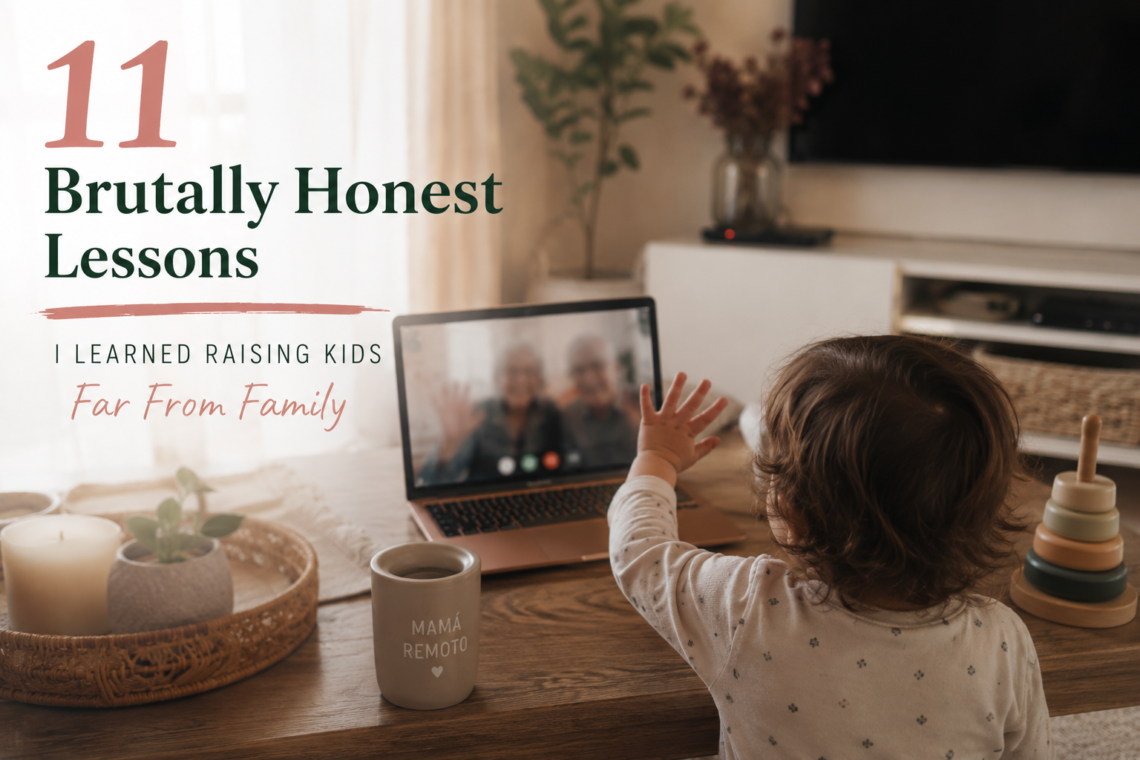
We live in an era of FaceTime and WhatsApp, and I’m genuinely grateful for it. My family group has everyone — my siblings, brothers-in-law, all of them. I send videos constantly: first words, funny moments, milestones as they happen. My oldest knows his grandparents well. He asks to call them. Every time he sees an airplane, he mentions them. That connection is real, and I worked for it.
But a screen cannot come over when I need an hour of rest. It cannot take my son to the park so I can breathe. The love is fully there over video. The logistics are not.
A 2022 study on virtual grandparenting published in Human Behavior and Emerging Technologies found that video chat frequency is a strong predictor of grandparent-grandchild closeness — but that it works best when grandparents focus on the child’s interests rather than adult conversation. Worth sharing with your own parents next time they’re not sure what to do on a call.
One of the hardest parts of raising children without extended family is that you can maintain closeness emotionally while still carrying every single practical thing alone. Those are two separate gaps, and technology only closes one of them.
Lower your expectations for what video calls can do practically. Raise your investment in what visits can do.
4. You Become the Bridge — But the Connection Goes Both Ways
There’s a version of this lesson that’s all burden: you’re the one who plans the trips, coordinates the visits, sends the updates, keeps the relationship alive. And yes — I plan our visits home. That’s on me.
But here’s what’s also true: my family calls. A lot. They call because they know I’m busy, they know time zones are complicated, and they don’t want the connection to fade because I forgot to reach out. They send voice notes. They are in that family group sending reactions to every video I post of the kids. They show up.
Parenting far from family does require you to be the initiator more often than not. But if your family loves you, they will meet you halfway. And if the effort is entirely one-sided, that’s important information about the relationship, not about the distance.
Give yourself grace when you can’t keep up perfectly. The relationship needs two sides to work.
5. Your Kids Will Grow Up Between Two Worlds — and It’s Kind of Wonderful
My son mixes languages. His accent right now is a blend of both places, both versions of who he is. When we go back to the Dominican Republic, he slides in and out of both languages without thinking about it. It’s funny. It’s a little strange. It’s completely his.
He doesn’t fully belong to one world or the other, and there was a time I worried about that. Now I think he’s building something richer. He’s young enough that the blend still feels seamless. I watch it happen and try to let it be fascinating rather than unsettling.
The Encyclopedia on Early Childhood Development notes that bilingualism at an early age interacts positively with cognitive, social, and language development — and that the earlier children are exposed to two languages, the better the outcomes. The mixing you’re seeing isn’t confusion. It’s competence forming.
Your children will carry a cultural identity that didn’t exist before them. It won’t look like yours, and it won’t look like what your family back home expected. That’s not a failure of raising children away from home. That’s the story they’re writing for themselves.
Help them own it.

6. The Mom Guilt of Living Away From Family Never Fully Goes Away
This is one of the most searched things about expat motherhood, and I understand why: mom guilt living away from family is its own category of heavy.
At first it’s guilt for leaving. Then it’s guilt every time your sisters casually drop their kids at your parents while you’re managing everything alone. Then it’s guilt for not visiting more. For not calling enough. For being tired of being the one who always calls. For resenting the distance when you chose it.
Here’s what I’ve learned: the guilt doesn’t disappear. But it changes shape. In the beginning it’s sharp and loud. Over time, it becomes background noise — present, but not controlling. The shift happens when you stop using guilt as a measuring stick for how much you love your family.
Research from the British Psychological Society found that mothers feel significantly higher levels of guilt than fathers, driven largely by internalized gender norms about who is responsible for family proximity and caregiving. In other words: the guilt isn’t just about distance. It’s layered on top of everything else society already expects from us. Knowing that doesn’t make it go away — but it does make it easier to stop taking it as personal evidence of failure.
You left. You’re still a good daughter, a good sister, a good mother. Those things are not in conflict.
7. Milestones Hurt in a Specific Way When You’re Raising Kids Far From Family
First steps. First words. First day of school. Losing a tooth. My family group sees all of it — I send the video the second it happens, and my whole family, brothers-in-law included, is watching within minutes. They are genuinely up to date with my kids’ lives in a way a lot of long-distance families aren’t.
And I still feel the hollow. Not because they missed it — they see the video. Because the people who raised me, who remember my first steps, aren’t in the room. There’s a specific thing that happens when the people who knew you as a child witness your child. I’ve felt it on our trips back. I’ve felt the absence of it at home.
Take the video. Send it immediately. Let them be there the best way they can. And let yourself feel the rest.
8. Distance Forces an Intentionality That Changes You
Here’s the flip side of all that hard: when you’re raising kids far from family, you cannot coast. You have to be deliberate about connection in a way that people with proximity can spend a lifetime avoiding.
We visit about twice a year. Those trips take planning, money, and real sacrifice. When we go, we go to be with family — we eat at someone’s house almost every day, we make every hour count. We are more present during those visits than we would ever be if we lived five minutes away.
My oldest recognizes his grandparents immediately. He asks to call them. He mentions them when he sees an airplane. That doesn’t happen by accident. It happens because I built it — consistently, intentionally, over almost three years of video calls and shared videos and “call abuela” before bedtime.
People who live around the corner can let months slip by without a real conversation. I can’t afford that. Neither can you. Use it.
9. Your Partner’s Family Becomes Your Entire Village — and That’s Both a Rescue and a Different Kind of Hard
My husband’s parents have become a huge part of how I manage this. His mom helps a lot. Without them, I genuinely don’t know how I would have gotten through some stretches of these three years. They are my village in the most practical sense — and I’m grateful for them in a way that’s hard to fully articulate.
A Frontiers in Psychology review of expatriate family adjustment found that social support within the host country is one of the strongest predictors of how well families adapt to life abroad. Partner support and local networks matter enormously — which is why investing in both is not optional. It’s survival.
But it’s different. It’s not my mom. It’s not my sister’s couch I can collapse onto when I need to fall apart about something that involves my husband. When I’m going through something difficult with him, there’s no one from my side I can go to — no one who knew me before all of this, who is fully in my corner by default.
That specific gap — your people, on your side — is one of the hardest things about parenting without family nearby that almost no one talks about. In-law love is real love. It doesn’t fill every shape.
Protect your relationship with your partner fiercely. And be honest about the fact that you need support that isn’t filtered through his family’s loyalty.
10. The Visits Are Never Long Enough — and the Logistics Make It Harder
Even a month goes fast. And the complicated part of raising kids far from family isn’t just the goodbye. It’s the trip itself.
We travel when we can — which usually isn’t during school holidays, because flights to the Dominican Republic during peak season cost a fortune and coinciding schedules are nearly impossible. So we go when we can go, which means family is not always on holiday either. If we want real time with them, we stay in the city. Which means the Dominican Republic — the beaches, the food, the everything — becomes something we walk past on the way to someone’s living room.
Last trip we made it to the beach one weekend. One. Because the point of the trip was family, not vacation. The money spent on that flight is money we didn’t spend going somewhere new with the kids. We haven’t traveled anywhere else with them — nowhere that isn’t home — because every trip has to make a choice between visiting family and exploring the world. And every time, home wins.
That trade-off is love. It’s also real, and exhausting, and something the “expat life is an adventure” narrative rarely mentions.
The goodbyes don’t get easier with repetition. My kids have cried on the way home from the airport. I have cried driving back alone. You make peace with it. You let yourself feel it every time rather than becoming numb, because the grief that stays alive means the love is still there.
11. You Are Building Something That Didn’t Exist Before
Your family — the one you’re raising right now — is its own thing. It has its own rhythms, its own language, its own inside jokes. My boys are growing up with two worlds in them, a dad whose family shows up, a mom who makes sure they never forget where they come from.
That’s not a lesser version of something. That’s something entirely new.
Some days it feels like a loss. On the hard days — the ones where I see my sisters living five minutes from my parents and I feel the weight of everything I’ve chosen to carry — it genuinely hurts. I won’t pretend otherwise.
But on the good days, it feels like exactly what it is: a family built from scratch, on purpose, in a place we chose. A family that works harder for its connections than most families ever have to. A family where love is not assumed — it’s demonstrated, consistently, across distance and time zones and airplane windows.
Raising kids far from family is not the easy path. But it is yours. And there is something that gets built in that difficulty — in your children, and in you — that proximity alone can’t teach.
That’s not a consolation prize. That’s the whole point.
Before You Go: Plan Your Week Around What Matters
The hardest part of parenting without family nearby isn’t any single moment — it’s the cumulative weight of doing it all without backup. What makes that manageable is structure: knowing what your week looks like, where the margins are, and how to protect the things that matter before the week swallows them.
The Sunday Reset is the weekly planning ritual I use to do exactly that — 45 minutes on Sunday that gives me clarity on the week ahead, including when I have capacity for connection and when I genuinely don’t.
Download the free Sunday Reset Checklist here — and start your next week with intention, not just survival.
FAQ
Is it normal to struggle when raising kids far from family?
Completely normal, and far more common than the expat highlight reel on social media suggests. Parenting without family nearby means carrying things — logistically and emotionally — that most parents around you have built-in help for. The difficulty isn’t a character flaw. It’s a predictable consequence of a real structural gap, and it responds to honest acknowledgment and intentional strategy.
How do you cope with mom guilt when you live away from your family?
Mom guilt when living away from family tends to come in waves — when you see siblings who have the support you don’t, when you miss a big moment, or when the distance feels like a choice you’re still paying for. The thing that helps most isn’t eliminating the guilt but changing your relationship with it: it’s information that you love your family, not a verdict on the quality of your parenting. Over time, it becomes quieter. It rarely disappears entirely.
How do grandparents stay connected to grandchildren who live far away?
Consistency matters more than frequency. Regular video calls, even short ones, build familiarity over time. Sending videos — milestones, funny moments, ordinary Tuesday afternoons — keeps grandparents genuinely part of a child’s daily life. When visits do happen, invest fully in them rather than trying to optimize for vacation activities. And include grandparents in family group chats so they receive updates in real time without it requiring effort from either side.
What are the biggest challenges of raising children without extended family?
The three hardest things in practice: the logistical gap (no built-in backup for sick days, exhausted days, or moments you just need to hand off), the social isolation for the child (fewer organic playmates, no cousins, limited options for connection that don’t involve you), and the emotional support gap for the parent (no one on your side, close by, who knew you before all of this). All three are real and all three can be partially addressed — but they don’t fully disappear with distance.
How do you maintain your children’s cultural identity when raising kids far from home?
Start early and don’t overthink it. Language at home, food that connects, video calls that keep the relationship with grandparents warm — these matter more than any formal cultural program. When your child is young, they absorb more than you realize. My son mixes languages, has a blended accent, and feels genuinely comfortable in both worlds. That happened because we kept the connection alive, not because we followed a curriculum. Let the culture be present in the everyday rather than saved for special occasions.
How often should you visit family when raising kids abroad?
There’s no right answer, but twice a year is a realistic and meaningful frequency for many families. What matters more than frequency is intentionality: when you visit, be present for the relationship rather than trying to also take a vacation. The trips that build connection are the ones where you eat at someone’s house every day, not the ones where you split time between family and beach. Plan for both eventually — but in the early years, the relationship is the investment.




Great content! Keep up the good work!