By 5pm most days, I have zero decisions left in me.
Not because I’m lazy. Not because I’m disorganized. But because by the time I’ve gotten through a full remote workday, handled two kids, made food appear three times, and kept the basic operations of our home running — my brain is done.
And yet, somewhere in the background of all of that, there is always a quiet mental list running.
The bathroom needs attention. The sheets haven’t been changed in longer than I’d like to admit. There’s something in the back of the fridge that probably needs to go. The living room floor was fine this morning but won’t be by dinner.
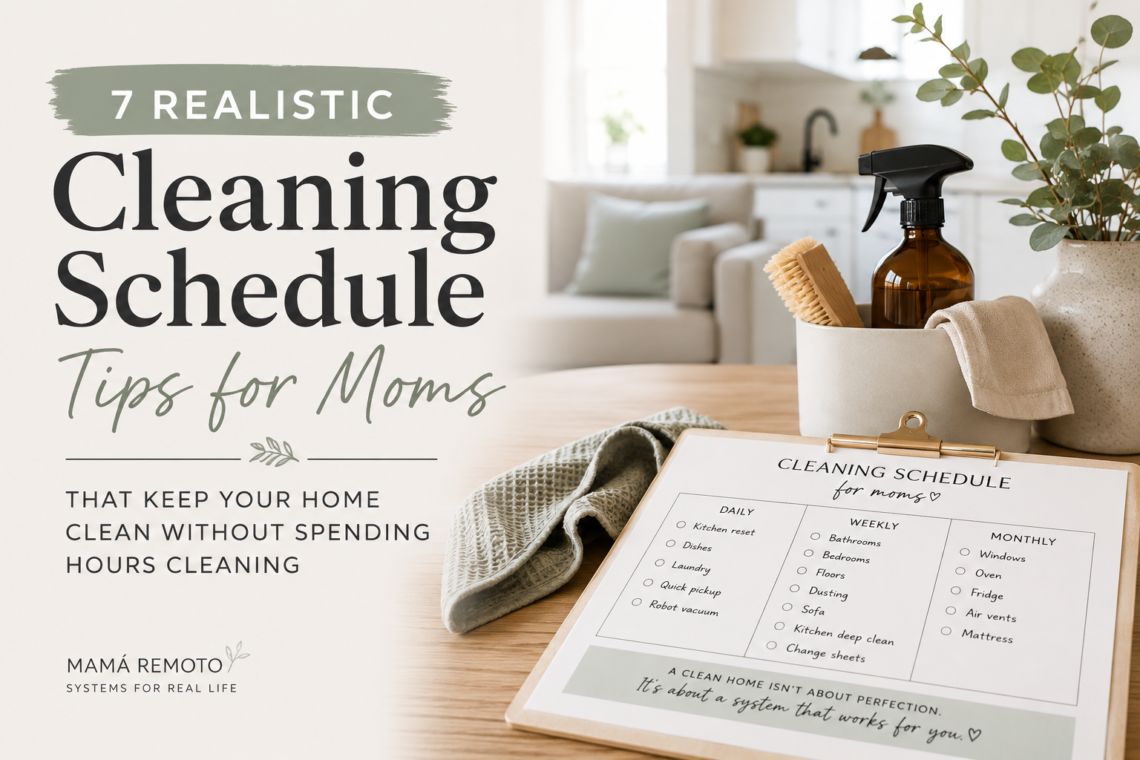
I used to think the problem was that I needed a better cleaning schedule for moms like me. Something more detailed. More color-coded. More complete.
It took me longer than it should have to realize the problem wasn’t the schedule.
The problem was that I was carrying the schedule inside my head — and it was taking up space I needed for everything else.
What I’m sharing in this post isn’t a perfect cleaning routine. It’s the system I built to get the cleaning out of my head and into something that runs without me having to think about it constantly. It works for a working week that doesn’t have a predictable shape. It works when the kids are sick and the week falls apart. And it’s designed around the reality that a working mom’s most limited resource isn’t time — it’s cognitive bandwidth.
Table of Contents
Why Most Cleaning Schedules for Moms Fail
Before we get to the tips, it’s worth naming why the schedules you’ve tried before probably didn’t stick — because it’s almost certainly not a discipline problem.
Most cleaning schedules are built for households where someone is available during the day to execute them. They assume a predictable week. They assign the same tasks to the same days, which works beautifully until Tuesday becomes a sick day, Wednesday runs long with a work deadline, and suddenly the whole structure collapses.
When the schedule fails, most moms do one of two things: they try harder (more detailed schedule, stricter commitment) or they give up entirely and return to cleaning reactively, whenever things get bad enough.
Neither solves the actual problem.
The actual problem is that most cleaning schedules for moms are task systems, not cognitive systems. They tell you what to clean. They don’t address the mental work of remembering, deciding, and monitoring — the part that runs in the background all week and quietly drains you.
A realistic cleaning schedule for moms doesn’t just distribute tasks across days. It offloads the thinking.
That’s what these seven tips are designed to do.
Tip #1: Stop Trying to Clean Everything Every Day
This one sounds obvious but it runs counter to how most of us were taught to think about housekeeping. And yet it’s one of the most common reasons a cleaning schedule for moms breaks down within the first two weeks.
The idea that a clean home requires daily attention to every area is one of the most exhausting myths in domestic life. It’s also not how most things actually work. Your bathroom doesn’t need to be scrubbed every day. Your floors don’t need vacuuming every 24 hours. Your kitchen surfaces need a quick wipe after cooking — but a deep clean of the oven can wait weeks.
The first shift is separating maintenance from cleaning. Mayo Clinic research on stress and household routines consistently points to predictable, low-effort systems — not intensive cleaning sessions — as the habits that actually reduce household anxiety over time.
Maintenance is the daily stuff: wiping the counter after dinner, a quick floor sweep in high-traffic areas, keeping laundry from piling into a week’s worth of work. These things take minutes and prevent things from deteriorating.
Cleaning is deeper: scrubbing bathrooms, mopping properly, vacuuming the whole house, cleaning appliances. These need to happen regularly, but not daily.
When you stop trying to do everything every day, you create a schedule that’s actually sustainable. You stop feeling like you’re failing every day you don’t get through the whole list — because the whole list was never meant to be daily.
Tip #2: Create a Daily Cleaning Schedule for Moms That Takes Under 20 Minutes
The goal of your daily cleaning schedule is not a clean house. The goal is a house that doesn’t deteriorate while you’re busy living in it.
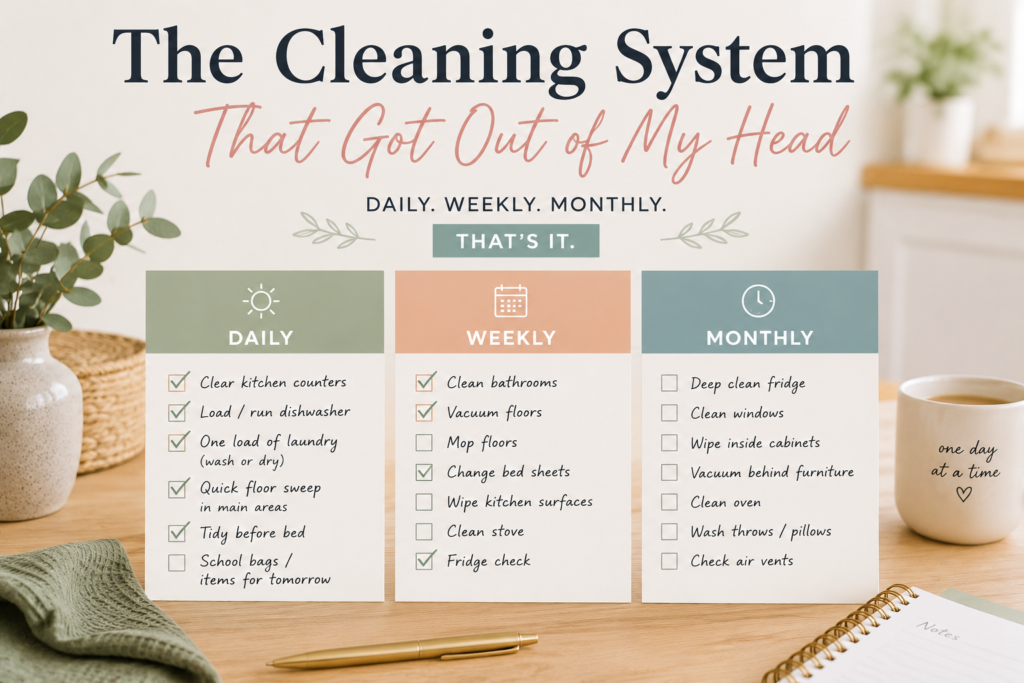
This means identifying your non-negotiables — the three to five things that, if left undone, make the rest of the week harder. For most working moms, the daily list looks something like this:
- Kitchen counter and sink cleared before bed
- One load of laundry through (wash or dry — not both, not folded, just through)
- Kids’ school bags or next-day items sorted the night before
- A 5-minute floor sweep in the main living area
That’s it. Everything else is maintenance that happens when you have capacity, not daily obligation.
The reason this works is because it creates a reliable baseline. Even on a hard day — sick kid, long work call, everyone-went-to-bed-late kind of day — you can do these five things in under 20 minutes. You wake up the next morning to a kitchen that isn’t yesterday’s disaster. The week doesn’t compound.
The daily schedule exists not to clean the house, but to prevent it from getting away from you.
Tip #3: Separate Daily, Weekly, and Monthly Tasks
This is the structural core of any cleaning schedule for moms who work full-time — and the piece most printable systems get wrong by making it too complicated.
The three-level system works like this:
Daily — the non-negotiables from Tip #2. Fast, consistent, non-negotiable. These run on autopilot.
Weekly — the tasks that need to happen once a week to keep the home functional. Bathroom surfaces. Vacuuming. Mopping if needed. Changing one set of sheets. Wiping down the stove. These take one to two hours total and are best batched into one or two sessions rather than spread across every day.
Monthly — the tasks that matter but don’t need weekly attention. Cleaning the fridge. Washing windows. Vacuuming behind furniture. Wiping inside cabinets. These go on a rotating list and come up when they come up — not as weekly obligations.
The shift this creates is significant. Instead of a long task list that you’re measuring yourself against every day, you have three clear levels with different frequencies. You always know which level you’re operating on and what “done enough for today” actually means.
This is also what makes the system resilient. If the weekly tasks slip one week, the daily baseline is still holding. If a monthly task gets delayed by three weeks, nothing has actually gone wrong.
A house running on three levels is much easier to manage than a house where every task feels equally urgent and overdue.
Tip #4: Build Your Weekly Cleaning Schedule Around Your Life — Not the Other Way Around
Here’s where most cleaning schedule templates fail working moms specifically: they’re built around a generic week.
Monday: clean bathrooms. Tuesday: vacuum. Wednesday: laundry.
But your week doesn’t have a generic shape. Some weeks your Monday is a full day of back-to-back calls. Some Wednesdays the kids have activities until 7pm. Some Fridays you’re done early and have an actual hour to spare.
A realistic cleaning routine for moms adapts to the week you actually have, not the week the template imagined.
The way to do this is to anchor your weekly cleaning to one reset day instead of distributing tasks across fixed days.
Sunday works well for this — which is exactly why the Sunday Reset is built around it. You take 20–30 minutes on Sunday morning or afternoon to look at the week ahead, identify what genuinely needs attention, and do a focused reset. Not a full clean — a reset. The starting line for the week is clear.
Everything else in the week is your daily maintenance list. If you have capacity on a Wednesday evening to vacuum, great. If not, it waits until Sunday without consequence.
The anchor day removes the daily decision-making about what needs cleaning and when. That decision has already been made, once, in a calm moment — not at 8pm when you’re running on empty.
Tip #5: Use Checklists Instead of Memory
This is the tip that has the most direct impact on mental fatigue, and it’s the one most moms skip because it feels like extra work to set up.
It isn’t.
The cognitive load of keeping a cleaning schedule for moms in your head — of being the person who remembers when the sheets were last changed, when the bathroom was properly scrubbed, when the fridge needs attention — is real and cumulative. Research from Harvard Health Publishing confirms that holding multiple open loops in working memory consumes the same mental resources as active problem-solving. You’re not resting when you’re just remembering — you’re working.
Externalizing your cleaning system into a checklist closes those loops.
It doesn’t need to be elaborate. A note on your phone with three columns (daily, weekly, monthly). A whiteboard on the inside of a cabinet door. A simple section in whatever planner you already use. The format doesn’t matter — what matters is that the information lives outside your head.
Once it does, you stop monitoring. You stop doing the background scan every morning. You stop waking up at night thinking about whether you cleaned the bathroom this week.
The checklist holds the information. You just consult it.
This is one of the core principles behind the Anti-Chaos Weekly Kit — the idea that a working mom’s week shouldn’t require constant mental management. When the system is external and reliable, you get to think about other things.
Tip #6: Aim for Functional, Not Perfect
This one is less a practical tip and more a mindset reset — but it might be the most important shift in building a cleaning schedule for moms that actually sticks long-term.
A functional home is one where you can cook without stress, sleep in clean sheets, and let people in without panic. That’s the actual goal. Not a home that looks like a lifestyle blog. Not a home where every surface is clean at all times.
Chasing perfection in a home with young children and a demanding job is not a productivity failure — it’s an impossible standard. And the problem with impossible standards isn’t just that you can’t reach them. It’s that the gap between where you are and where you think you should be generates constant low-level guilt, which in turn depletes the motivation you need to maintain even the basics.
When you aim for functional, the bar becomes achievable. The daily list feels manageable. The weekly reset feels like enough.
One specific reframe that helps: instead of asking “is the house clean?”, ask “is the house under control?” These are different questions. Under control means the daily maintenance is running, the weekly reset is happening, nothing has deteriorated to the point of requiring emergency intervention. That’s the goal.
A home that’s consistently functional is better — and more realistic — than a home that’s briefly perfect and then collapses.
Tip #7: Build a Cleaning Schedule the Entire Family Can Follow
The most sustainable cleaning schedule for moms is one that doesn’t rely entirely on mom.
This is easier said than done, especially when children are young. But the system you build now — even if you’re implementing most of it yourself initially — should be designed with eventual family participation in mind. The American Academy of Pediatrics notes that consistent household routines — including age-appropriate contributions from children — support both family organization and children’s development of responsibility.
A few things that make this practical:
Age-appropriate daily tasks for kids. Even young children can put their own things away, bring their plates to the sink, and pick up toys before bed. These aren’t chores — they’re daily non-negotiables that kids are capable of maintaining when the expectation is consistent and the system is clear.
A visible system. When the cleaning list exists only in the primary caregiver’s head, no one else can participate in it. When it’s visible — on the fridge, on a family board, in a shared notes app — it becomes a shared system rather than a personal burden.
Language that normalizes contribution. “We all live here, we all maintain it” is a principle that takes years to establish but starts from the first conversation. Not assigning tasks as punishments, not treating cleaning as primarily a mom’s domain, not doing everything yourself when asking for help would take 90 seconds.
The goal isn’t a perfectly distributed household. The goal is a system where the cognitive and physical load of maintaining the home is genuinely shared — even if that sharing is imperfect and gradual.
My Realistic Cleaning Schedule for Moms — What Actually Works for Us
I want to share what this looks like in practice — a real cleaning schedule for moms with full-time work, kids, and an irregular week. Not as a template to copy but as proof that the system doesn’t have to be complicated to work.
Daily (15–20 minutes, split between morning and evening): Kitchen counter and sink cleared. One laundry load started or moved. School bags sorted. A 5-minute tidy in the living room before bed.
Weekly (Sunday, 25–30 minutes): I look at the whole house and identify what’s most out of order. Bathroom surfaces get wiped. I vacuum whatever needs it. I change the sheets I notice need changing. I do a fridge check. I don’t do all of this perfectly every week — I do what the week needs.
Monthly (rotating, whenever it comes up): Fridge deep clean. Windows. Behind furniture. Inside cabinets. This list lives in my notes app. I check it during the Sunday reset and address whatever is due — or overdue, without guilt.
That’s the whole system. It doesn’t require a detailed schedule with tasks assigned to every day of the week. It doesn’t require perfect execution. It requires a daily baseline, a weekly anchor, and a place where the longer-term tasks are tracked so I don’t have to carry them in my head.
If you want the exact Sunday Reset checklist I use to set up my week, it’s free at mamaremoto.com/free-resources.
Free Cleaning Planner for Moms
A system only works if it lives somewhere. So I turned the exact three-level system from this post into two free tools: a printable cleaning checklist (in English and Spanish) you can stick on the fridge, and a free interactive cleaning system at clean.mamaremoto.com — it remembers your tasks, resets the daily list every morning and the weekly list every week, and tracks when each monthly task was last done. Nothing lives in your head.
Enter your email below and everything arrives instantly — the printable checklists and your link to the interactive system. No spam, no complicated signup. Just the system.
And if you’re finding that cleaning is just one piece of a week that feels like it’s running you — decisions piling up, routines collapsing, the whole week feeling like an unsolvable logistics problem — the Anti-Chaos Weekly Kit is built for that.
What is the best cleaning schedule for moms?
The best cleaning schedule for moms is one that works with your actual week, not against it. Rather than assigning fixed tasks to each day (which breaks down when life intervenes), the most effective approach uses a three-level system: a short daily maintenance list (15–20 minutes), a weekly reset session (20–30 minutes, ideally on Sunday), and a rotating monthly task list that lives outside your head. The goal is a home that stays functional without requiring constant mental monitoring.
How do working moms keep their house clean?
Working moms who manage their homes well have usually stopped trying to keep everything clean all the time — and started focusing on keeping things under control. This means maintaining a consistent daily baseline (clearing the kitchen, moving laundry through, a quick evening tidy), doing a focused weekly reset rather than cleaning a little bit every day, and using a checklist system so the cognitive load of tracking what needs cleaning lives outside their head, not inside it.
How often should moms deep clean their home?
Deep cleaning tasks (fridge, windows, behind furniture, inside cabinets) don’t need to happen weekly. Monthly is sufficient for most of them, and some can go longer. The key is having these tasks written down in a rotating list so you don’t have to track them mentally — you consult the list during your weekly reset and address whatever is due.
What should be included in a weekly cleaning schedule?
A realistic weekly cleaning schedule for moms should include: bathroom surfaces (sink, toilet, mirror), vacuuming main living areas, mopping if needed, changing at least one set of sheets, and a quick check of the fridge. This typically takes one to two hours and is most effective when batched into a single Sunday reset rather than spread across the week.
How can I clean my house when I have young children?
With young children, the goal shifts from “clean house” to “house that doesn’t compound.” Focus on a short daily maintenance list that you can complete in under 20 minutes — even on hard days. Build a weekly reset on a day when you have slightly more time or energy. Involve children in age-appropriate daily tasks (putting toys away, bringing plates to the sink) from early on, and keep expectations anchored in functional rather than perfect.