
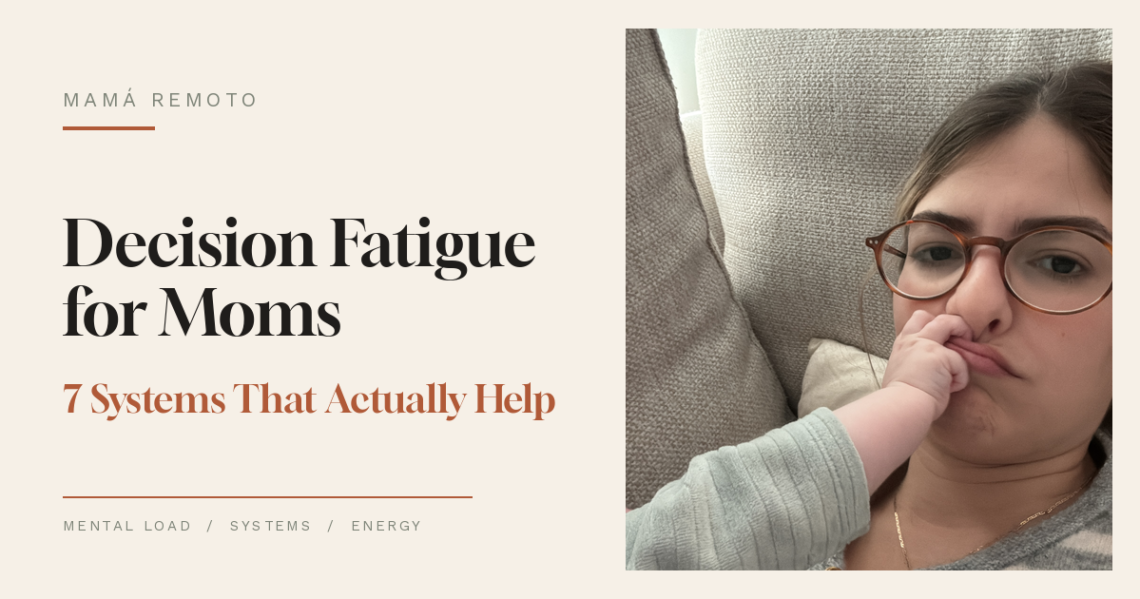
Decision fatigue for moms is not a buzzword. It is what happens when you have made 200 small decisions before 9am and your brain has nothing left for the ones that actually matter.
Before I became a mother, I was genuinely good at this. Not just functional — strategically organized. Over ten years of managing marketing across regions, coordinating teams, juggling budgets, campaigns, and competing priorities — I had built systems for everything. Organization wasn’t something I had to work at. It regulated my brain. It was part of my identity.
Then I had children. And then I lost it — not the desire to be organized, but the cognitive capacity to maintain the systems I had always relied on.
That was the discovery that changed everything for me: I wasn’t bad at organization. I was depleted by decisions. And those are completely different problems with completely different solutions.
Table of Contents
What Decision Fatigue for Moms Actually Feels Like
Decision fatigue for moms is not the same as being tired. It is a specific kind of cognitive depletion that happens when the brain has processed too many choices — and it accumulates long before most moms recognize it.
Research published by the American Psychological Association shows that repeated decision-making depletes mental resources over time, reducing the quality of subsequent choices. For mothers managing remote work, childcare, household logistics, and emotional labor simultaneously, this depletion happens faster and deeper than most productivity content acknowledges.
Here is what decision fatigue for moms looks like in real life:
- Snapping at your kids at 5pm and feeling terrible about it afterward — not because you’re a bad mother, but because you had zero cognitive reserves left by then
- Standing at the fridge for ten minutes and still ordering delivery
- Saying yes to things you should have said no to because evaluating the request felt too hard
- Going to bed anxious about tomorrow without having planned anything — because planning required decisions you couldn’t make
- Feeling productive but like nothing important actually got done
- Losing your train of thought mid-sentence, mid-task, mid-meeting
The average adult makes approximately 35,000 decisions per day. For mothers — especially those managing remote work, a household, and life in a country that isn’t their home — that number doesn’t just feel high. It feels like a physical weight that sits in your chest from morning to night.
Why “Just Leave the Mess” Never Worked for Me
There is a particular strand of motherhood advice that tells you to relax your standards. Let the dishes sit. Accept the chaos. Lower the bar.
I understand the intention. But for me, it has never worked — and I’ve spent a long time understanding why.
Visual clutter raises cortisol. This is not a preference or a personality quirk — it is physiological. A study published in Personality and Social Psychology Bulletin found that women who described their homes as cluttered or full of unfinished projects had higher levels of the stress hormone cortisol throughout the day compared to women who described their homes as restful.
For mothers already operating at the edge of their nervous system’s capacity, adding visual chaos to the environment is not neutral. It is one more thing the brain has to process — one more low-level decision running in the background, draining cognitive energy that has nowhere to spare.
What I do instead is what I call “keeping the house tight.” Not perfect. Not deep-cleaned. Tight — meaning the surfaces are clear, the toys are in a box, the laundry is folded even if it’s not put away. Visual calm, even if everything underneath is still in progress.
This is not perfectionism. It is nervous system management. And the distinction matters, because it changes why you’re doing it — from performing standards for someone else to protecting your own cognitive capacity for the things that actually require it.

Why Most Organization Systems Don’t Solve Decision Fatigue for Moms
Most productivity systems are built around time management. Block your calendar. Batch your tasks. Schedule everything. The premise is that if you plan your hours correctly, you will feel in control.
This works when your main variable is time.
Mothers don’t have a time problem. They have an energy problem — and specifically a decision-volume problem. And the two require completely different solutions.
The energy is unpredictable — and the system has to know that
Before I built anything that actually held, I had to accept something uncomfortable: I cannot schedule my week around an idealized version of my energy. Bad sleep changes everything. A health flare changes everything. A baby in a growth spurt changes everything. The system that worked last Tuesday may be completely irrelevant this Tuesday.
I stopped organizing around ideal weeks. I started organizing around variable capacity.
That single shift — from planning for the week I wished I had to planning for the week I actually have — is the foundation of everything else. It is also why rigid systems keep failing most moms. They plan for consistency in conditions that are structurally inconsistent.
Remote work adds fragmentation, not just flexibility
Working from home with children is frequently described as a privilege — and it is. But it also creates a specific kind of cognitive fragmentation that office work doesn’t.
When you work from home, the household is always visible. The pile of laundry is in your line of sight during a video call. The sound of the kids in the next room is never fully absent. The physical proximity to everything that needs doing means your brain is running two parallel tracks simultaneously — the work track and the home track — even when you’re supposed to be fully on one of them.
This fragmentation is not laziness or poor boundaries. It is a structural feature of working from home with children. And it means the decision load is higher, not lower, than it would be in an office — because the home track never fully switches off.
Motherhood abroad adds an invisible extra layer
If you’re raising children in a country that isn’t your home, your decision load carries an additional weight that most organizational frameworks never account for.
Navigating systems that aren’t intuitive — healthcare, school enrollment, banking, bureaucracy — in a language that may not be your first. Maintaining connection with family across time zones while functioning inside a culture that has different rhythms and different expectations. Managing a household without the village that would have been automatic back home.
I moved from the Dominican Republic to Madrid, and then from Madrid to Valencia. I have built a career and a life in a country that isn’t mine. I have done it without my family nearby — without the sisters I would have called, without the mother who would have helped with the kids on a hard week.
That absence is not just emotional. It is logistical. Every task that a nearby family member would have absorbed becomes a decision you carry alone. And it adds up in ways that are invisible until you’re standing in the kitchen at 7pm, depleted, wondering how everyone else seems to be managing this.
They are not managing it better. They are managing it with more support. That is not the same thing.
The 7 Systems That Actually Reduce Decision Fatigue for Moms
These are not hacks. They are structural changes that reduce the volume of decisions your brain has to process in real time — so that your cognitive energy goes to the things that actually require it.
System 1 — Batch your decisions
The most effective way to reduce decision fatigue for moms is to stop making the same decisions repeatedly. Meal planning is the clearest example: deciding what you’ll eat seven times in one sitting instead of seven separate times throughout the week.
The same principle applies to outfits (a loose weekly capsule for the kids means no morning argument about what to wear), errands (one trip, one list, not three trips because you remembered different things each time), and work tasks (grouping similar tasks together so you’re not context-switching constantly).
Batching is not about being a certain kind of organized person. It is about recognizing that each repeated decision costs cognitive energy — and paying that cost once instead of seven times.
System 2 — Define your weekly non-negotiables
Decision fatigue for moms is worst when everything feels equally urgent. The solution is to pre-decide, in advance, what is actually most important.
Every Sunday — or Monday morning if Sunday collapses — I identify three to five non-negotiables for the week. Not aspirational goals. Actual commitments that, if they happen, make the week feel functional regardless of what else falls apart.
One work deliverable that closes something important. One family commitment I will not cancel. One thing for myself — a pilates session, an hour on this project, a morning where I sleep in while my husband takes the kids — that I protect as fiercely as a work meeting.
When everything feels urgent, your non-negotiables tell you what’s actually important. They are the decision you make on Sunday so you don’t have to make it again on Wednesday when the week is on fire.
System 3 — Build time blocks around energy, not tasks
Your peak cognitive window is probably two to three hours. Don’t fill it with emails. Fill it with the one thing that requires your best thinking.
For me, that window is late morning — after the baby goes to my mother-in-law’s and before my afternoon meetings start. Everything that requires sustained focus goes there. Everything else — emails, logistics, household admin, the tasks that can happen in fragmented attention — goes in lower-energy windows.
This is not time management. It is energy management. And the distinction matters because time management assumes your hours are interchangeable. They are not. A depleted hour and a sharp hour are not the same resource.
System 4 — Pre-decide your crisis protocol
Decision fatigue for moms is worst during the weeks that fall apart. And the cruelest part of a hard week is that it demands good decisions from a brain that has the least capacity to make them.
The solution is to make those decisions before you need them.
My crisis protocol is written down. When a week collapses — bad nights with the baby, a sick toddler, a work deadline that landed at the wrong moment — I don’t figure out my minimum viable week in real time. I already know it.
Sleep first. If my husband can take the baby in the morning, that happens before any other decision gets made. At work, I protect deliverables with real deadlines only — everything else waits without apology. The house gets the absolute minimum: fed, functional, not clean. And my personal project gets whatever is left, even if that’s twenty minutes at 9pm.
Past me made those decisions so present me doesn’t have to. That is the most practical thing I have ever done for my own functioning.
[FREE DOWNLOAD — Crisis Mode Card]
Decide your minimum viable week before you need it. The Crisis Mode Card is a one-page tool that helps you pre-build your crisis protocol — your two work non-negotiables, your household minimum, the one person you can call, and what you’ll cancel first. Free download below.
[MailerLite form — Crisis Mode Card]
System 5 — Reduce visual decisions in your environment
As discussed above — visual clutter is not neutral. Every object in your visual field that is out of place is a micro-decision your brain registers: should I deal with this? Should I move it? Is this the priority?
Multiply that by a full home environment and the cognitive load becomes significant before you’ve even sat down to work.
Keeping surfaces clear, having a place for everything (even if it’s a basket that hides the chaos), and ending each day with a ten-minute reset so the morning starts calm — these are not perfectionistic standards. They are cognitive load reduction strategies.
The goal is not a beautiful home. The goal is an environment where your brain can rest instead of continuously scanning for things that need attention.
System 6 — Automate the recurring decisions
Subscriptions for things you buy regularly. A recurring grocery list that covers the basics so you’re only deciding the extras. A standing family dinner rotation for the nights when creativity is not available. A weekly schedule that has the same shape every week even if the specific tasks change.
Automation is not laziness. It is protecting your decision budget for the choices that actually require human judgment — the ones at work, the ones about your kids, the ones that actually matter.
Every decision you automate is cognitive energy you get to spend somewhere else.
System 7 — Build a weekly reset that closes the loop
Decision fatigue for moms accumulates partly because nothing ever feels finished. The week ends with a pile of undone tasks, unresolved questions, and unprocessed thoughts that carry forward into the next week and the next and the next.
A ten-minute weekly reset — a Sunday evening brain dump where everything in your head goes onto paper, three non-negotiables get set, and the week gets assessed honestly — does something specific: it closes the loop.
It gives your brain permission to stop holding things. Because they’re written down now. They’re not going to be lost. The next week has a plan. And your nervous system can actually rest over the weekend instead of running background anxiety about Monday.
The free Sunday Reset Checklist on the Free Resources page walks through this exact process — ten minutes, one page, the whole week set up.
The Bigger Shift — From Surviving to Designing
The moms who seem to have it together are not doing more than you. They are deciding less — because they built a structure that does the deciding for them.
They are not waking up and figuring out their priorities in real time. They already know. They are not standing in the kitchen at 6:45am wondering what the kids are eating. That was decided on Sunday. They are not asking themselves whether to check email now or later. There is a block for that.
This is what an anti-chaos system actually does. Not a morning ritual that requires 45 minutes of silence you don’t have. Not a 12-step productivity method. Just a structure you build once a week that carries you through the chaos instead of leaving you inside it.
The decision fatigue for moms problem is not solved by doing more. It is solved by deciding less — by moving as many decisions as possible out of real time and into a structured, pre-decided system that runs even on the days you have nothing left.
That is the end of decision fatigue. Not the absence of hard days. Just a structure that holds on them.
A Practical Summary
- Decision fatigue for moms is cognitive depletion from decision volume — not laziness, not lack of discipline
- Visual clutter raises cortisol — keeping the environment tight is nervous system management, not perfectionism
- Rigid systems fail because they plan for consistent conditions that motherhood doesn’t provide
- Energy is variable — the system has to adapt to your capacity, not demand the same performance every day
- Remote work adds fragmentation — the home track never fully switches off, increasing cognitive load
- Motherhood abroad adds invisible load — tasks a nearby village would absorb become decisions you carry alone
- The 7 systems work by moving decisions out of real time and into a pre-decided structure
- The goal is not a perfect week — it is a recoverable one, built on a structure that holds even on hard days
What is decision fatigue for moms?
Decision fatigue for moms is the cognitive exhaustion that comes from making too many decisions across too many domains — work, childcare, household, logistics, emotional labor — without adequate recovery time or structural support. Research shows repeated decision-making depletes mental resources, reducing the quality of subsequent choices.
Why do mothers experience more decision fatigue than other adults?
Because the mental load of motherhood adds a significant volume of invisible decisions — anticipating needs, managing logistics, emotional regulation for children — on top of existing work and personal responsibilities. For moms living abroad or working remotely, the load is often higher still.
Does clutter actually cause stress?
Yes. Research has found a measurable relationship between cluttered home environments and elevated cortisol levels in women. Visual clutter creates ongoing background cognitive load — the brain continuously registers and processes out-of-place objects — which contributes to mental fatigue even when you’re not actively dealing with it.
What are the most effective ways to reduce decision fatigue for moms?
The highest-impact strategies are: batching recurring decisions (especially meals), defining weekly non-negotiables in advance, building a pre-written crisis protocol, automating recurring choices, and doing a weekly reset that closes the cognitive loop before the new week starts.
How is energy-first organization different from standard time management?
Time management assumes your hours are interchangeable and focuses on scheduling tasks into available time. Energy-first organization recognizes that a depleted hour and a sharp hour are completely different resources, and schedules cognitively demanding work around your real energy — not an idealized version of it.
What should a crisis protocol include?
At minimum: the two work tasks that cannot slip this week, the household minimum that keeps the family functioning, one person you can ask for help without guilt, and explicit permission to let everything else wait. The goal is to make these decisions before the crisis hits, so you’re not making them with depleted cognitive resources in the middle of a hard week.
What is the fastest way to start reducing decision fatigue?
Pick one recurring decision and remove it from your daily real-time decision load this week. Meal planning for three dinners. A standard grocery list for the basics. A set time for email instead of checking it continuously. One decision removed is cognitive energy recovered — and it compounds from there.
Is decision fatigue worse for moms living abroad?
Structurally, yes. Navigating unfamiliar systems, maintaining cross-time-zone connections, and functioning without a nearby support network all add to the decision volume. Tasks that a nearby family or community would absorb become individual decisions that accumulate in ways that are invisible until the depletion becomes undeniable.
The Anti-Chaos Weekly System was built specifically for decision fatigue for moms — a personalized weekly planning tool that moves as many decisions as possible out of real time and into a pre-built structure. One-time purchase, €4.99. Yours to use every week.
The Sunday Reset Checklist is the free starting point — ten minutes that closes last week and sets up the next one.





3 Comments on “Decision Fatigue for Moms: 7 Powerful Systems That Actually Help”