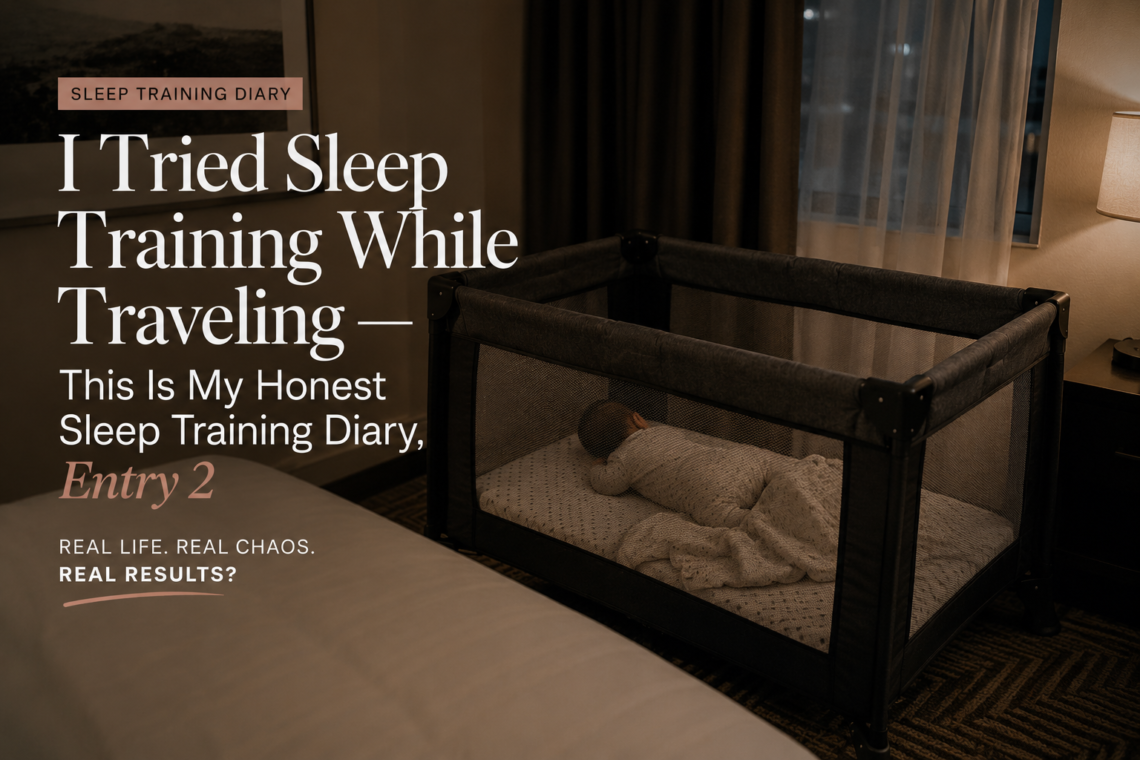
Last time I wrote here, I was one day into working with a baby sleep coach and slightly stunned by how well it had gone. Six hours uninterrupted. A nap that took fifteen minutes instead of an hour. I ended that post saying we were about to leave for a hotel with both kids, and that I’d tell you honestly what sleep training while traveling actually looks like.
So. Here’s how it went.
Short version: the hotel didn’t break the sleep training, but it showed me exactly how fragile a brand-new routine is — and the setback didn’t actually start at the hotel. It started when we came back and then left again. I’m writing this from my husband’s family’s summer town, where my baby has spent the last few nights crying in a way he’d already stopped crying, and where I’m re-learning the same lesson for the third time.
I’m not going to tidy this up. It’s a diary, not a case study.
Table of Contents
Key takeaways
- Sleep training while traveling won’t erase your progress — it moves you back a stage, not back to zero.
- The setback usually isn’t the trip itself. It’s the number of environment changes in a row. Three houses in one week is what got us.
- Blackout curtains and a pre-assembled crib matter more than any other booking decision when you’re sleep training while traveling.
- The single most valuable thing wasn’t the method. It was having a sleep coach answer within minutes when the plan broke.
- Even on our worst nights, we now get six hours instead of two and a half.
Sleep training while traveling: what we actually walked into
We went to Benidorm, about an hour and fifteen minutes from us. Four nights, both kids, one room.
Two things went right before we even arrived, and I want to name them because they’re the only part of sleep training while traveling that I actually controlled.
The room had proper blackout curtains. Not the polite hotel version that still lets a stripe of light across the floor — full, real, can’t-see-your-hand darkness. If you’re choosing accommodation mid-sleep-training, ask about this before anything else. Not the pool. Not the breakfast buffet. The curtains.
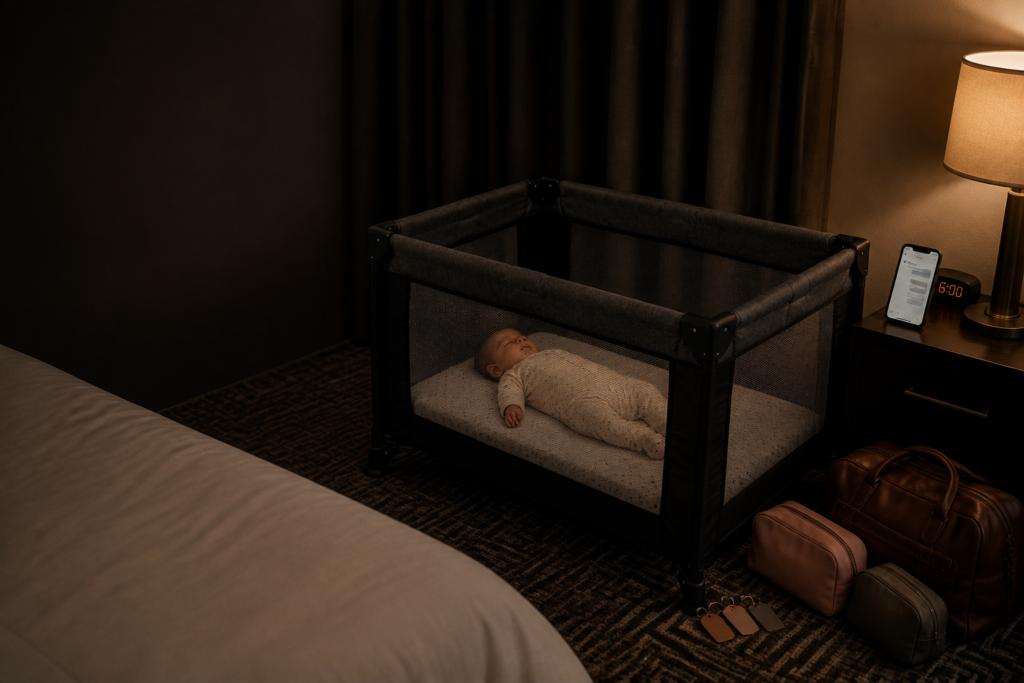
I requested the crib in advance, and it was already set up when we walked in. A big wooden one, solid and properly sized — not the flimsy folding kind I was bracing for. No assembling anything with a tired baby on my hip, no negotiating at reception while my toddler dismantled the lobby.
So the environment was about as good as I could have hoped for. Which is useful information — because it means what went wrong wasn’t the room.
Day 1: the drive that broke the whole schedule
I’d like to say I didn’t plan carefully. I did plan carefully. It still fell apart, because the maths of a travel day and the maths of a nap schedule don’t reconcile.
His first nap is at 9:30am. He wakes between 10:30 and 11. Check-in was at 2pm. The drive was an hour and fifteen.
The plan: feed him at 12:30, leave straight after, arrive right at check-in. Clean. Sensible.
We arrived exactly on time. And he had, of course, fallen asleep in the car.
Which meant the 2:30pm nap — the one that holds the whole afternoon together — was gone. Not shifted. Gone.
Nobody accounts for this when they say “we’ll just keep the routine on holiday.” You can’t. A car is a moving, humming, dim little sleep machine, and a slightly overtired baby will use it. There’s no version of a two-hour travel day that doesn’t cost you a nap.
We went straight to the hotel restaurant for lunch — me, my husband, my toddler. The baby sat in the high chair playing, perfectly content, having had his nap in the car and no idea he’d just cost me the afternoon. Then we set the room up and took both kids to the kids’ pool.
And genuinely? The afternoon was lovely. That’s worth saying too. Sleep training while traveling wasn’t four days of grim damage control. Most of it was a good holiday.
The 6pm stroller nap that derailed sleep training while traveling
Then I made the mistake.
I needed the supermarket. I took the baby in the stroller. It was 6pm.
He fell asleep. Obviously he fell asleep. He’d lost his afternoon nap, he was in a moving stroller, it was the end of the day. If I hadn’t been so tired I’d have seen it coming from the lift.
A 6pm nap is a bedtime problem, and I knew it while it was happening.
This is the moment where, before I had a sleep coach, I’d have spiralled — woken him up, felt guilty about waking him up, forced the original 7:30 bedtime, failed, and gone to bed at midnight convinced I’d undone everything.
Instead I messaged her. She answered.
Her instruction was immediate and specific: let him sleep forty minutes, and move bedtime from 7:30 to 9:30.
That’s it. Not “you’ve ruined it.” A recalculation.
And it had a second-order effect I hadn’t even asked for: we got to have dinner as a family. All four of us, at a table, at a normal hour, on holiday — instead of me disappearing upstairs at 7 with a baby while everyone else ate.
That’s the thing I most want other moms to hear about sleep training while traveling: a good coach isn’t there to hand you a schedule. She’s there for the moment the schedule breaks, which — if you have children — is most moments.
Night 1: the first real test of sleep training while traveling
At 9:30 we were all in bed. One room, two kids, blackout curtains, unfamiliar everything.
He fell asleep crying.
I need to explain why that landed the way it did. Before the trip, he had started falling asleep alone, and without crying. That was the whole win. That was the thing I wrote about last time with something close to disbelief.
So the crying wasn’t just crying. It was the sound of the thing I’d just gained, slipping.
I comforted him. I patted him, and he fell asleep holding onto my hand. It took about twenty minutes.
Was that breaking the method? By a strict reading, yes. But he was in a new room, in a new town, in a new crib, after a broken day, at a bedtime two hours later than his body expected. There’s a version of consistency that’s really just cruelty with good branding, and I’m not interested in it. He needed a hand. He got a hand.
If there’s one permission I’d give anyone sleep training while traveling, it’s that one. Comfort in an unfamiliar room isn’t a failure of the plan. It’s the plan meeting reality.
And then all four of us slept until 7:30am.
7:30am. In a hotel room. With a toddler. By any measure I care about, that’s a hit.
Day 2: sleep training while traveling done exactly right — then 2am
Day 2 we followed the coach’s plan exactly. No car naps, no improvising, no supermarket.
- 8am: breakfast
- 8am–9:30: playing. Our room had a terrace, which turned out to be the single most useful feature of the whole hotel — somewhere for the kids to be that wasn’t the bed
- 9:30: my husband took the toddler to the pool, I stayed with the baby for nap one
- He fought it. He’s fought every nap since the trip started. But he was asleep by about 10, and slept 40 minutes
- 2:30pm: nap two. Asleep by around 3. We all napped together — genuinely one of my favourite hours of the trip. He woke at 4
- 7:30pm: bedtime, back at the proper time. Asleep by 7:45, and he fought noticeably less
A good day. A day where sleep training while traveling visibly worked in a hotel room, which is exactly what I’d wanted to find out.
And then 2am.
He woke up soaked. His nappy had leaked through completely — him, the sheet, the whole crib. Underneath it he had a significant nappy rash, so he was wet, cold and genuinely sore all at once.
He was, understandably, wide awake.
Then the second problem: the spare sheets I’d packed didn’t fit that crib. I’d brought extras. I’d been proud of myself for bringing extras. They were the wrong size for a hotel cot I’d never seen.
So I tried the only thing left, which was getting him to sleep on top of me. He was not remotely interested. In hindsight that was a good sign — he wanted his crib, he just wanted his crib to not be wet.
In the end I made the crib up with a normal, non-fitted sheet. Not ideal. Not what I’d planned. Fine.
He complained for about five minutes and then fell asleep. It was around 4am. He woke at 6:45.
Days 3 and 4: the sleep training while traveling pattern I couldn’t fix
By this point a shape had emerged.
Naps were consistent and mediocre: a fight to go down, then 40 to 45 minutes. Every time. Not a disaster, not a win — just the tax on being somewhere new.
Night 3 was perfect. Asleep around 8pm, woke at 7am, straight through. The kind of night that makes you think you’ve cracked sleep training while traveling for good.
Night 4 he leaked again — and this time it took roughly two hours to get him back to sleep. He fell asleep holding my hand, exactly like the first night. Full circle, at 4am, in a hotel in Benidorm.
Two soaked nights out of four is not a sleep training problem. It’s a nappy problem that became a sleep problem, and no method solves for it. If I could change one thing about sleep training while traveling with him, it wouldn’t be the schedule. It would be the nappies.
Coming home from sleep training while traveling — and leaving again
Here’s the part I didn’t expect, and the reason this entry isn’t just “we survived a hotel.”
Back home, something new appeared: he hated watching us leave the room. That wasn’t a thing before. He’d started going down alone and fine. Now the door closing was the trigger.
Still, he slept through the night. He just started waking at 5:30am. We’ve had a few of those mornings since, and we leave him until 6 with one of us there so he isn’t alone. It works, but it’s a shift, and it appeared right after the trip.
Then we slept exactly one night in our own house before packing again — because he’s spending August at my husband’s family’s summer town.
Hotel, home for one night, new house for a month.
Where we are right now, honestly: he won’t fall asleep alone anymore. He cries. Not a whimper — properly furious, angry crying. Last night I went in and comforted him several times before he finally collapsed. It took about an hour. He was asleep around 8:30.
That’s the real cost of sleep training while traveling for us, and it didn’t show up until we got home.
8 things I’d do differently when sleep training while traveling
Not advice from someone who’s figured it out. Just what I got wrong about sleep training while traveling, written down so I don’t repeat it.
- Don’t schedule the drive across a nap window. If arrival time and nap collide, the nap loses and you pay at bedtime. I’d now either drive during a nap on purpose and write it off, or leave much earlier and wait.
- Never put the stroller in play after 5pm on a travel day. Movement plus an overtired baby is a nap, whether you wanted one or not.
- Measure the crib before you go. Ask the hotel what size cot sheet it takes. Bringing spare sheets that don’t fit is exactly as useless as bringing none, and you find out at 2am.
- Overhaul the nappy plan, not just the sleep plan. Bigger size for nights, doubled up, barrier cream properly applied before bed. Two of my four bad hours came from this alone.
- Request blackout curtains and a pre-assembled crib in writing. Both went right, both because I asked in advance, and both saved me more than anything I did once I was there.
- Book a room with a terrace or a second space. Somewhere the kids can be that isn’t the bed is worth more than any other amenity when you’re sleep training while traveling.
- Decide in advance which nap you’re willing to lose. Choosing it beforehand is far less destabilising than losing it by accident.
- Keep one non-negotiable. For us it was the bedtime routine order. Everything else moved; that didn’t.
The bigger lesson though: it isn’t the trip that causes the setback, it’s the number of changes in a row. One hotel would have been absorbed. Hotel, then home, then a different house for a month, is three environments in under a week for a baby who’d had a stable routine for about ten days. Of course it slipped.
If he had stayed in one environment the whole time, I genuinely believe it would have worked like a charm. He was falling asleep alone, quickly, without crying. That happened. I saw it. The changes are the setback — not the method, and not him.
The part that matters more than any of the nights
I could write this entry as a failure. Bad naps, two soaked nights, a crying baby who used to settle alone, an hour-long bedtime last night.
Here’s the number that reframes all of it.
Before we started, I was sleeping two and a half to three hours a night. Not in a stretch. In fragments.
Now, on our worst nights — leaked nappy, two hours awake, three houses in a week — I get around six.
We are sleeping. After all this time, I can actually say that sentence.
And what made the difference isn’t a method. Methods are free; you can find the fading method or PUPD in fifteen minutes online, and I’d already written a full guide to the 21-night version before I ever hired anyone. Knowing what to do was never my problem.
The difference is having an expert on the other end of a message when it falls apart. Mine is @theyellowfamily_, the coach I wrote about in Entry 1 — and no, I get nothing for naming her. Every time I’ve hit something — the 6pm stroller nap, the 2am flood, the new-house crying, the 5:30 wake-ups — I’ve told her exactly what’s happening and she’s adapted the routine. It has worked every single time.
That’s the actual product. Not the schedule. The recalculation. And it’s the entire reason sleep training while traveling didn’t end with me giving up.
I said in Entry 1 that hiring a sleep coach was something I swore I’d never do. Four hotel nights, two soaked cribs and one house move later, I’ll go further than I did then: it’s the best decision we’ve made for our family.
What’s next in this diary
We’re here for the rest of August. So the next entry picks up where sleep training while traveling left us: rebuilding independent sleep in a new house after a setback — whether it comes back quickly, whether we have to restart, and what the coach has us doing about it.
If you’re still at the beginning of all this and your baby has never slept well anywhere, not just while travelling, I’ve written about the real reasons behind that here.
I’ll write the next entry whether it goes well or not. That’s the deal I made with this diary.
Sleep Training While Traveling FAQs
Should you sleep train while traveling, or wait until you’re home?
If you can wait, wait. Sleep training works on consistency, and a trip removes the one variable the whole thing depends on. That said, we didn’t have the option — the trip was booked — and it wasn’t a disaster. If the travel is already happening, aim to protect the routine rather than progress it.
Will traveling undo baby sleep training?
Partly, and less than you fear. My baby went from falling asleep alone without crying to needing comfort again — a real setback. But he kept sleeping through most nights, and the underlying gain didn’t vanish. Setbacks are a return to a previous stage, not a return to zero.
How do you keep a sleep routine on a travel day?
You mostly don’t, and planning for that is more useful than pretending otherwise. Assume the car or plane will take a nap you were counting on, decide in advance which nap you’re willing to lose, and have a plan for what bedtime becomes as a result. Our fix was letting the accidental late nap run 40 minutes and pushing bedtime by two hours.
What should you pack for sleep training in a hotel?
Blackout backup if you can’t confirm the curtains, white noise, the sleep sack or bag they already use, and — the one I got wrong — cot sheets that actually fit the crib the hotel will provide. Ask for the crib dimensions before you travel. Also pack a nappy setup one step more absorbent than your normal night one.
My baby fell asleep alone before the trip and now cries. What do I do?
This is exactly where we are. What our coach has us doing is going back a step rather than pushing through — offering comfort where he needs it, then fading it again, rather than treating the setback as a discipline problem. It’s the same gradual approach, restarted from where he actually is instead of where he was.
Was a baby sleep coach worth it for travel specifically?
For us, this trip is the clearest argument for it. A method can’t tell you what to do about a 6pm stroller nap in a supermarket, or a soaked crib at 2am with wrong-sized sheets. A person can, and mine answered within minutes both times. That responsiveness is what I’m actually paying for.
If you’re in the middle of your own version of this — the leaked nappies, the 5:30am wake-ups, the setback you can’t explain — the thing that helped me most was writing it down instead of holding it in my head at 3am. That’s what the Baby Sleep Tracker is for: seeing the pattern instead of just feeling it. It’s free, and it works on your phone. It’s also the easiest way to spot what’s actually happening when you’re sleep training while traveling and every day looks different.
And if sleep isn’t the only thing that’s slipped — if the whole week feels like something you’re absorbing instead of running — that’s what the Anti-Chaos System is for.
Sleep training while traveling cost us something. It also proved the thing underneath it held. Six hours isn’t eight — but it isn’t two and a half either.
We’re sleeping. We’ll get the rest of it back.