
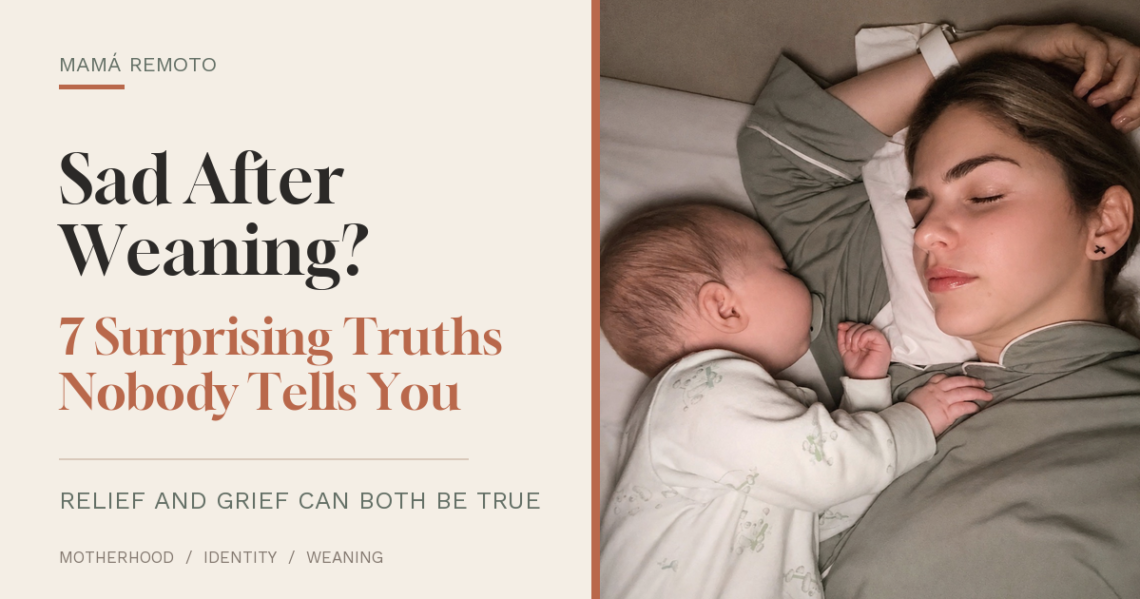
Six weeks ago I weaned my baby. He was nine months old, almost ten.
Here’s what nobody told me: I would feel relief and profound grief at the exact same time, and both would be equally true.
If you’re googling why you feel sad after weaning at eleven at night, phone in hand, with something sitting in your chest you can’t name — and a little bit of shame on top, because you wanted this — stay. I’m writing this from inside it, not from a safe distance.
Table of Contents
How my weaning actually happened: I wanted it, just not like this
I’d been thinking about it for a while. It wasn’t a new idea or an impulsive decision — I’d been circling weaning for weeks, quietly craving the freedom a bottle gives you. Being able to leave. Being able to let someone else do a feed. Getting my body back a little.
But it didn’t happen the way I pictured. It happened all at once.
He got sick. His little mouth filled with sores. And overnight, with no warning, he wanted nothing to do with nursing. I had to switch to a bottle because there was no other option — and he never went back.
That’s what’s called sudden weaning: the kind you don’t choose, or the kind you half-choose before your baby, your body, or an illness decides for you. And even though I’d wanted to get here for months, arriving here like that was something else entirely.
Because there’s an enormous difference between closing a chapter and having it slam shut on you.
Relief and grief together: why both are true
The hardest part at the beginning wasn’t the sadness. It was the contradiction.
On one side: relief. Real, physical relief, the kind you feel in your shoulders. My body was mine again. I could leave the house for two hours without doing math. I could sleep without being one entire person’s sole food supply.
On the other side: a grief I absolutely did not see coming.
And it didn’t arrive when I made the decision. It arrived when I watched him refuse me.
I tried to get him to latch again. He turned his face away. And standing there, holding him while he turned away, I thought something I haven’t been able to shake: is that it — is that thing that was only ours actually over?
Nobody warns you about that. Nobody tells you the last feed already happened and you didn’t know it was the last one. That there was no goodbye. That one day you’re breastfeeding and the next you’re a woman holding a bottle, and there was no ceremony in between.
If you feel both things at once, you are not ungrateful and you are not inconsistent. The relief belongs to your body. The grief belongs to the bond. They’re two separate things and they can live in the same chest without a problem.
What’s actually happening in your body when you feel sad after weaning
I wish someone had explained this to me first, so here it is.
When you breastfeed, your body runs on high levels of two hormones:
- Prolactin — the milk-production hormone, which also brings a background feeling of calm and wellbeing.
- Oxytocin — the “love hormone”, responsible for letdown, which spikes every single time your baby latches.
When you wean, both drop. And the faster the weaning, the steeper the drop. This is exactly why lactation professionals recommend dropping no more than one feed per week: so the hormonal descent is a slope, not a cliff.
With sudden weaning, you don’t get that option. The slope is a cliff.
This is why so many women describe what’s commonly called post-weaning depression — a mood crash in the weeks after stopping breastfeeding. Let’s be honest about one thing: it isn’t a formal diagnosis, and it isn’t well documented in the scientific literature. But it’s described by an enormous number of mothers, and organisations like La Leche League International and Postpartum Support International know the pattern well.
The fact that it doesn’t have a medical label does not mean it isn’t happening to you.
The first two weeks: the strange body
Two weeks in, I started getting aches around my ovaries, my uterus, somewhere in there. I say “somewhere in there” because I genuinely couldn’t identify it: my body changed after two pregnancies and I don’t read its signals the way I used to.
It makes sense. As prolactin withdraws, your cycle reboots. Your body restarts machinery that’s been paused for the better part of a year. And that machinery makes noise.
Weeks four to six: the wave
Then last week arrived. Six weeks out.
Hormonal in a way I hadn’t felt in a very long time. Sensitive to things I’d stopped being sensitive to years ago. With a need for affection and for being taken care of that I was almost embarrassed to say out loud.
This is where most of us panic, because it’s been six weeks and we’re supposed to be “over it” by now. But weaning doesn’t run on the timeline we’d like. The emotional peak can land well after the last feed.
Gradual vs. sudden weaning: why they hurt differently
Not everyone who feels sad after weaning experiences it the same way, and the difference isn’t how much you loved nursing. It’s speed.
With gradual weaning, you drop one feed every week or ten days. Your body gets time to recalibrate: prolactin steps down instead of falling, your breasts adjust without engorging, and you get to experience each dropped feed knowing it’s the last one at that time of day. There’s a goodbye. There’s still sadness — but it’s sadness spread across weeks.
With sudden weaning, all of that happens in three days. And it adds two things gradual weaning doesn’t have:
- The hormonal cliff. No steps. Prolactin and oxytocin collapse, and your nervous system finds out at the same moment you do.
- The loss of control. You didn’t decide, or you only half-decided. And grief for something you didn’t choose always weighs more than grief for something you did — even when the outcome is identical.
On top of that comes the guilt: if I’d pushed a bit harder, if I’d waited for his mouth to heal, if… I tried. He turned his face away. There was no amount of pushing that would have changed it, and I suspect the same is true in your case.
If your weaning was sudden and you’re wondering why you’re taking it harder than expected: you aren’t taking it harder. You got the abrupt version, and the abrupt version is harder. That’s not a failure of attitude.
The part nobody writes about: weaning hands you back to yourself
Here’s what genuinely blindsided me.
When the hormonal wave hit, it didn’t come alone. It came with nostalgia. I found myself thinking about the past — about who I used to be, how I used to be. Why I’m the way I am. What got left behind somewhere along the way.
I think I understand why now. While you’re breastfeeding, your body has an unmistakable job. You feed. That’s the work, and it’s enormous and all-consuming. There isn’t much mental room left for wondering who you are, because you are, very literally, keeping another person alive.
When that ends, a gap opens. And into that gap walks the question that’s been waiting outside the door for months: so who am I now?
Weaning doesn’t create the identity crisis. It uncovers it.
If you’ve also started going through old photos, remembering who you were at twenty-five, thinking about friends you don’t see anymore — you’re not losing it. Your mental space came back, and mental space hurts at first, the way your arm hurts when the cast comes off.
Weaning and your relationship: the roommate phase
One more thing that got stirred up, and I’m saying it out loud because I know I’m not the only one.
When the sensitivity came back, so did the awareness of how much I’d been missing being shown affection. And of how long we’d been in that phase where you’re roommates with your partner: kids in the bed, broken nights, no time, no energy, no intimacy. You function beautifully as a logistics team. Not so much as a couple.
While you’re breastfeeding, that lands differently, because your body is already giving and receiving contact all day long. You are saturated with skin. You don’t miss being touched, because you’re being touched constantly.
When you wean, that contact vanishes overnight — and that’s when you realise you’ve gone a very long time without receiving affection from an adult. It wasn’t that you didn’t need it. It was that it was covered up.
I don’t have a packaged solution for this. What I do know is that naming it changes things: “something broke between us” is a very different thought from “we’re in the small-children phase and my hormones have been upside down for six weeks.”
7 things that have helped me feel less sad after weaning
None of this makes it disappear. All of it makes it more livable.
1. Naming it. “I’m in the post-weaning dip” is infinitely more manageable than “I don’t know what’s wrong with me and I don’t even have a reason.”
2. Marking the date. I count from the day he stopped nursing. Knowing I’m in week six gives me context: this isn’t my life, it’s my week six.
3. Finding the contact elsewhere. Bath time, massage, skin to skin, napping with him against me. The bond never lived in the breast — it lived in the contact, and the contact is still available.
4. Saying it out loud to my partner. Literally: “I’m hormonal, I’m sensitive, I need more affection this week.” Not so he can fix it. So he knows.
5. Dropping the demand for consistency. I can be relieved I weaned and sad that I weaned. I don’t have to pick a side.
6. Lowering the bar for the week. Mid-hormonal-reshuffle is not the moment to reorganise your entire life. It’s the moment for your week to run on the bare minimum. That’s what I use the Mental Load Reset for: everything spinning in my head goes into four columns and the week is built in ten minutes. It has a crisis mode — the bare-minimum plan for days when you’ve got nothing left — and these six weeks have been exactly that.
7. Writing it down. This post is, quite literally, number seven.
When feeling sad after weaning is something more
This part matters, and I’m not going to soften it.
Feeling sad after weaning is usually temporary: a few weeks, up and down, gradually easing. But if any of this is true for you:
- The sadness isn’t easing after two or three weeks, or it’s getting worse
- You can’t enjoy anything, including things you used to love
- Day-to-day functioning is genuinely hard
- You’re having thoughts that frighten you
…that isn’t “just weaning.” Talk to your doctor, your midwife, or a mental health professional. A hormonal explanation doesn’t mean you have to white-knuckle it alone, and asking for help here isn’t being dramatic — it’s exactly the right move.
Women with a history of depression, and women who wean abruptly or against their will, are at higher risk. If that’s you, look at it early rather than late.
Frequently asked questions about feeling sad after weaning
How long does sadness after weaning last?
For most women, a few weeks, with ups and downs that gradually ease. What almost nobody warns you about is that the peak can arrive late — mine hit in week six, when I assumed I was already through it. If it hasn’t eased after two or three weeks, or it’s getting worse, that’s the moment to talk to a professional.
Is it normal to feel relieved and sad at the same time?
Completely normal, and almost nobody says it out loud. The relief belongs to your body, which is getting its autonomy back. The sadness belongs to the bond, which is losing its most physical form. Two different systems, under no obligation to agree.
Why do I have ovary or uterus pain after weaning?
As prolactin withdraws, your hormonal cycle restarts after months on pause. Many women notice pelvic aches, the return of their period, or sensations they don’t recognise, usually between weeks two and six. If the pain is severe, persistent, or comes with unusual bleeding, get it checked — a hormonal explanation is not a substitute for an examination.
Is feeling sad after weaning the same as postpartum depression?
They aren’t the same, though they share a hormonal mechanism. Postpartum depression appears in the months after birth; the post-weaning dip appears after breastfeeding ends, which can be much later. What they do share is this: if it’s stopping you from functioning, it isn’t something to white-knuckle alone.
Is feeling sad after weaning the same as postpartum depression?
They aren’t the same, though they share a hormonal mechanism. Postpartum depression appears in the months after birth; the post-weaning dip appears after breastfeeding ends, which can be much later. What they do share is this: if it’s stopping you from functioning, it isn’t something to white-knuckle alone.
Can I relactate if I regret weaning?
Often yes, especially if weaning was recent. Relactation is real and it works, but it needs support from a lactation consultant or midwife. Before deciding, give yourself a few weeks — part of what you’re feeling right now is chemistry, and chemistry stabilises.
Will weaning damage my bond with my baby?
No. The bond never lived in the breast, it lived in the contact — and the contact is entirely intact: bath time, babywearing, napping together, giving the bottle in your arms while looking at each other. The channel changes, not the connection.
If you’re in it right now
Something that was yours and nobody else’s has ended. Even if you wanted it to end. Even if you were desperate for your body back. Even if it’s better for everyone.
You can want something to be over and still miss it. That isn’t inconsistency. That’s grief — and grief doesn’t ask permission or check whether now is convenient.
What’s working for me, six weeks out, is this: not trying to feel one thing. Letting the relief and the sadness sit in the same room without forcing them to agree.
And if you’re doing all this far from your family, like me — no mother nearby, no lifelong friends around the corner, nobody to say “I cried when I weaned too” — this is what I write for us:
👉 How I survive motherhood far from family
And if what you need right now isn’t more feelings but less chaos — because you’re raw and your week is a disaster — the Mental Load Reset was built for weeks like this one. You’re not disorganised: you’re carrying too much at once, and right now your hormones are upside down on top of it. Emptying your head and having the week planned takes ten minutes.
It also includes something that matters more than usual in this particular season: micro oases. Two to fifteen minute blocks for you, built into the plan from the start rather than earned as a reward. Which is precisely what’s missing when you’ve spent six weeks noticing how much you need someone to take care of you.
You’re not broken. You’re in week six.


One comment on “Sad After Weaning? 7 Surprising Truths Nobody Tells You”