
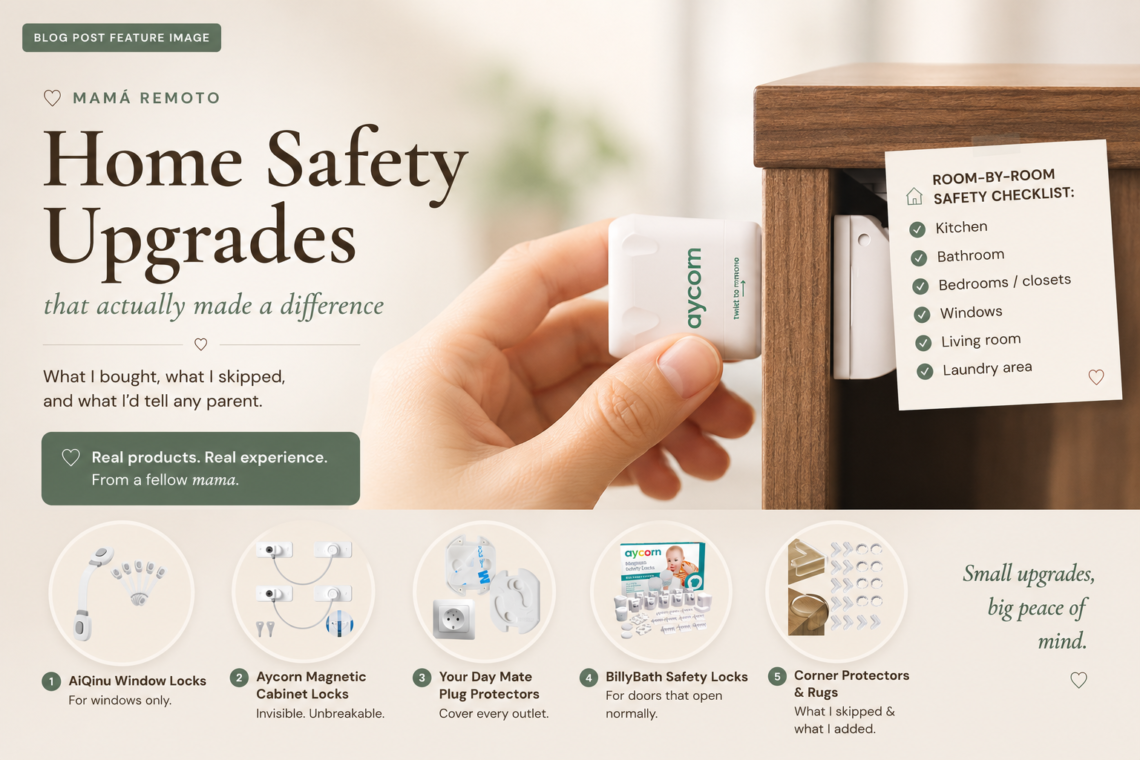
This post contains Amazon affiliate links. If you buy through one, I earn a small commission at no extra cost to you — thank you for supporting Mama Remoto.
There’s a specific kind of panic that only hits you once your baby starts crawling. One day they’re a happy little lump on a blanket, and the next they’re barreling toward the kitchen like they’ve got a personal vendetta against your cabinets. That’s exactly what happened with my older son. He’s always been strong for his age, and by 10 months old he’d figured out how to pull open our lower kitchen drawers — the ones with a pull-out system that isn’t supposed to be easy for little hands. He couldn’t get into the fridge (ours is panelled into the kitchen cabinetry, so it’s genuinely hard even for adults to spot at a glance), but the drawers were fair game. Not long after, he moved on to his closet doors, and I’d walk in to find every single pair of his shoes pulled out and lined up across the floor like he was running inventory. That combination — strong, fast, and endlessly curious — is what finally pushed me to stop putting off the home safety upgrades I’d been meaning to make for months.
I live in Valencia with my husband and our two boys, and between working remotely and running my own small business, “childproof the entire apartment this weekend” was never going to happen as one big project. So I did it the way I do most things now — a little at a time, testing products as I went, keeping what worked and returning or skipping what didn’t. This post is the result of that process: the home safety upgrades that actually made a difference, the ones I didn’t end up needing, and the honest reasoning behind each decision.
If you’re a parent who’s had that same jolt of “wait, they can open that now?” — this list is for you.
Table of Contents
Why Home Safety Upgrades Matter More Than You Think
It’s easy to assume that a few cabinet locks are overkill until you actually watch a ten-month-old figure out a drawer mechanism faster than you figured out your own oven settings. Kids under three are especially fast learners of exactly the things you don’t want them to learn — how to open doors, how to reach outlets, how to pull themselves up on furniture. Home safety upgrades aren’t about being paranoid. They’re about closing the small gaps between “this seems fine” and “this is actually fine,” so you’re not spending your entire day hovering over a toddler like a human motion sensor.
What changed my mind wasn’t a scary statistic, honestly — it was just exhaustion. I couldn’t keep saying “no, don’t touch that” fifty times a day and also get anything done. It’s the same reasoning behind how I approach meal planning when I’m exhausted: the goal isn’t perfection, it’s removing enough daily friction that you get some mental space back. Once I started treating home safety upgrades the same way — not just a box to tick for the baby, but a way to give myself back that space — it stopped feeling like a chore and started feeling like relief.
Here’s exactly what I bought, what I skipped, and what I’d tell any parent starting this same list today.
1. AiQInu Window Locks — For Windows Only
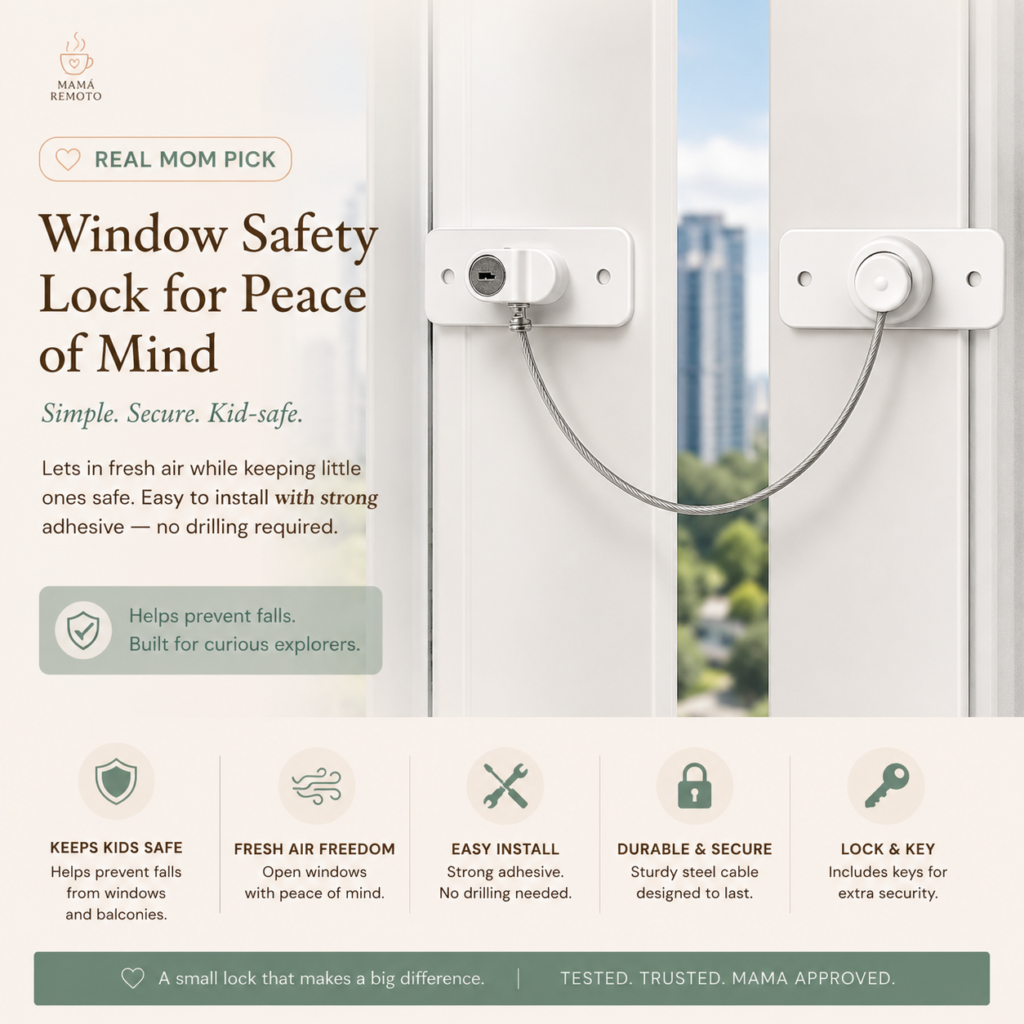
This is the one product on this list that’s genuinely simple, so I’ll keep it simple too: it’s a window lock, and it’s for windows. It comes packaged with adhesive or screw-in mounting, and with keys instead of a code or push-button, which is handy when you need to open a window quickly. It’s sold as both a 4-piece set (€15.99) and a 2-piece set (€8.99) — it’s the exact same lock either way, just a different quantity, so there’s no need to overthink which one to buy. Count your low, reachable windows first, then pick whichever pack actually covers that number instead of buying the bigger one “just in case.”
We used ours on the two windows in our apartment that open low enough for a curious toddler to reach, and that’s genuinely all it’s meant for. I mention this mostly because the product listing implies it can double as a fridge or cabinet lock, and in our experience, it’s really built and best suited for windows specifically.
Where I used it: the two low, reachable windows in our apartment.
2. Aycorn Magnetic Cabinet Locks — The One That Changed Everything in the Kitchen
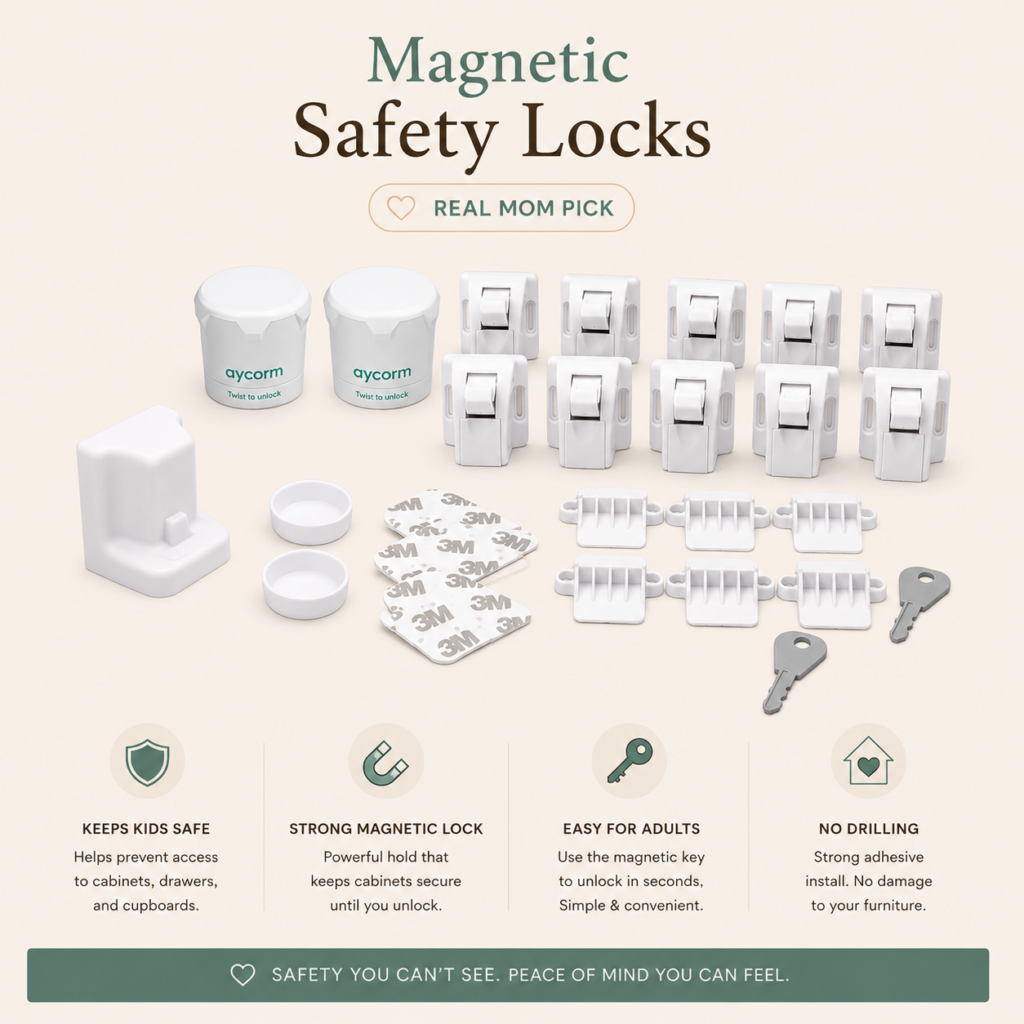
If I had to pick a single favorite out of everything on this list, it’s this one. The AYCORN Safety Proof Magnetic Cabinet Locks (€19.99) come with 10 locks and 2 magnetic keys, and they install completely inside the cabinet or drawer, out of sight. There’s no visible latch, lever, or button for a child to study and eventually figure out — the only way to open it is with the magnetic key held against the outside of the door. My son can pull on the handle all he wants; there’s simply nothing external for him to manipulate.
We used these on the entire kitchen — every drawer and cabinet with something genuinely dangerous inside: knives, glass, cleaning products, anything heavy or sharp. But I intentionally left one low drawer unlocked — the one with plastic tupperware and lids. Having one “safe” drawer he’s allowed to dig through and dump on the floor turned out to be genuinely useful, not just harmless. It keeps him entertained for a solid ten minutes while I’m cooking, and it means he’s not constantly testing every other drawer in frustration.
It does take more patience to install than the adhesive options — I’d budget 15–20 minutes per cabinet the first time you do it, faster after that — but for a kitchen you look at and use every single day, it’s worth it for how invisible and genuinely unbreakable the whole system is.
Where I used it: every kitchen drawer and cabinet with anything dangerous inside — knives, glass, cleaning products — leaving one tupperware drawer unlocked on purpose.
3. Your Day Mate Plug Protectors — For Every Outlet in the House
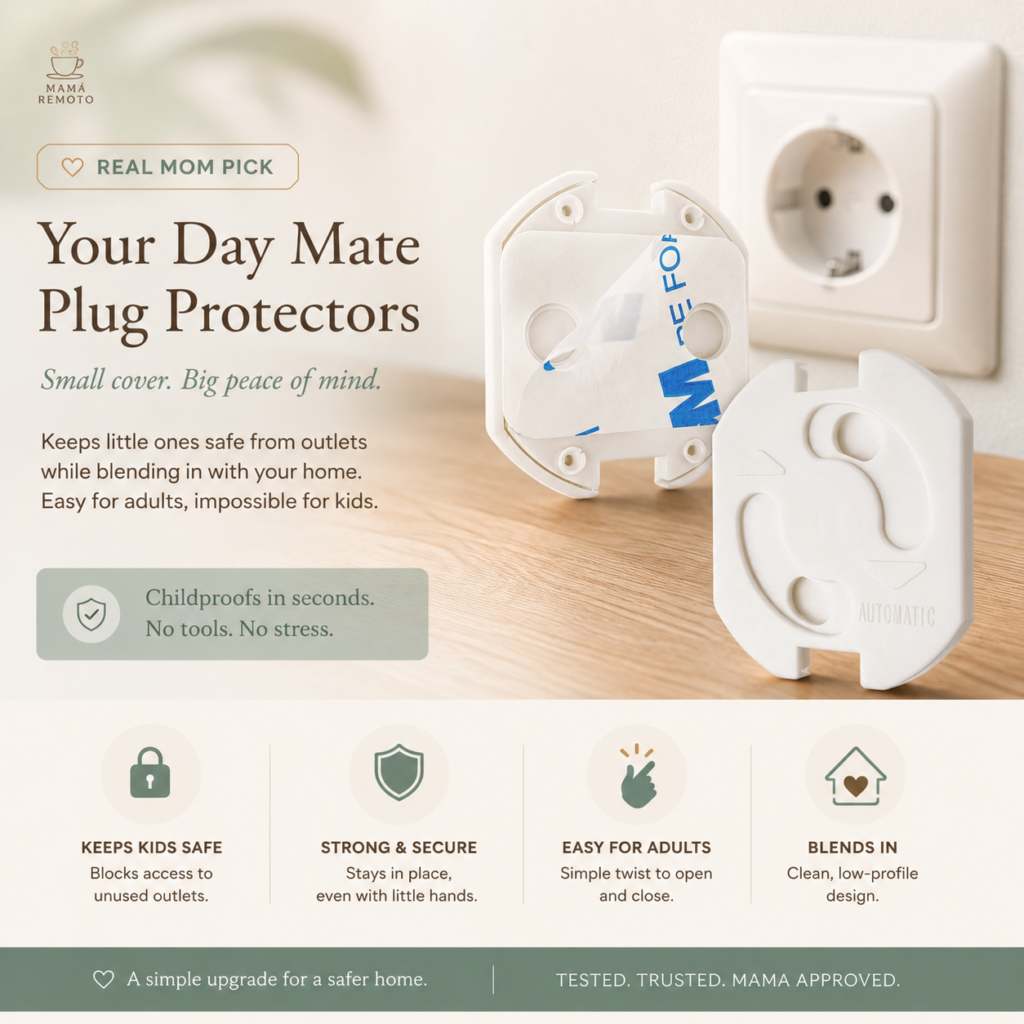
Outlets are the one home safety upgrade that people underestimate the most, in my experience, because they’re low to the ground and easy to forget about once you’ve done the “obvious” stuff like cabinets and drawers. I bought two packs of the Your Day Mate Plug Protector, 10 Pieces, which are made for the Schuko/Type F sockets standard in Spain and most of continental Europe — 20 covers in total, which was exactly enough to cover every outlet within reach across our entire apartment.
They’re simple, snap-in covers — nothing fancy, no keys or codes, just enough resistance that a toddler’s fingers can’t easily pry them out, but an adult can remove them in about two seconds when you actually need to plug something in.
If I’m being fully honest, these are the least “exciting” upgrade on this list, but they’re also the fastest and cheapest to install, and outlet covers are one of those home safety upgrades that pays for itself the very first time your kid tries to stick a toy fork somewhere it doesn’t belong.
Where I used it: every unused outlet within reach, in every room — two packs covered the whole apartment.
4. BillyBath Safety Locks — For Doors That Open Normally, Like Closets
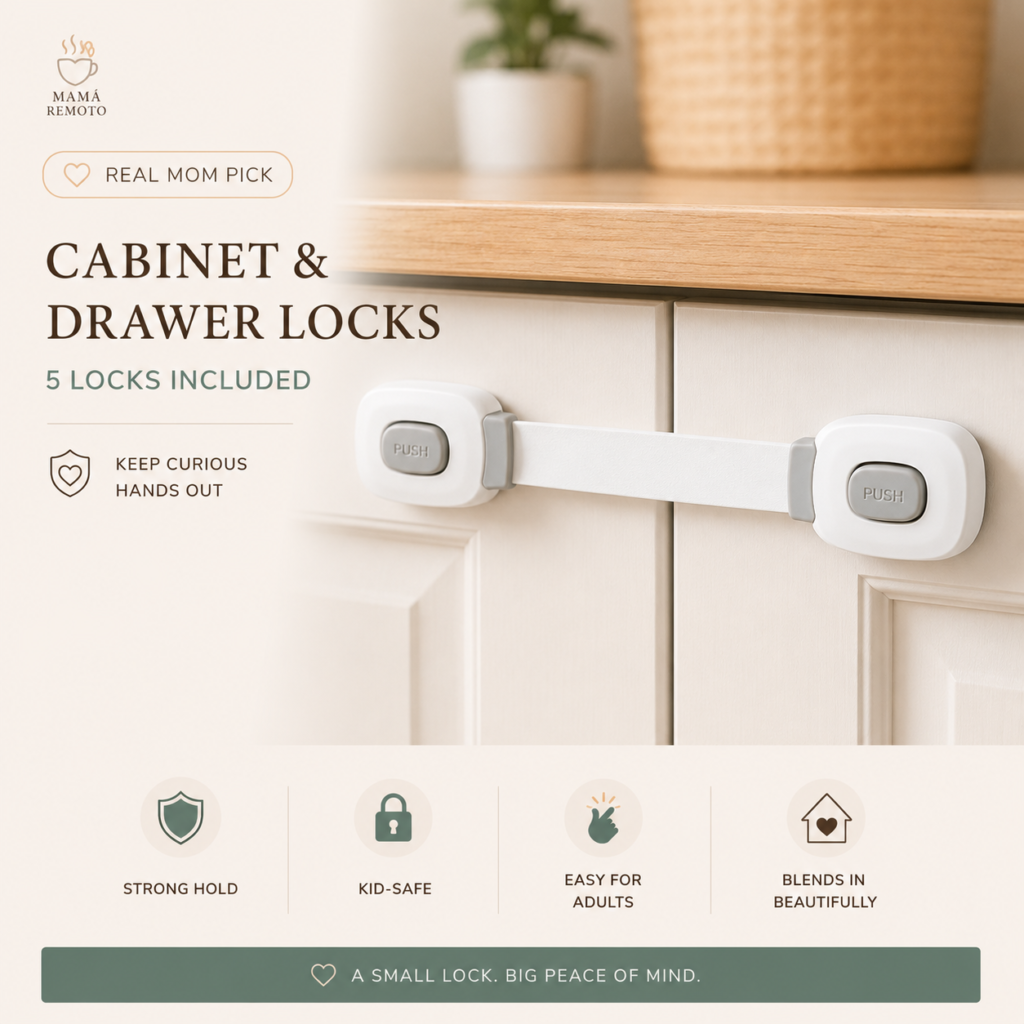
This one is specifically for doors that swing or hinge open the regular way — think closets, cabinets with standard doors, the toilet lid. We used the BillyBath Safety Doors Children, 10 Pieces set mainly on my son’s closet doors, which is exactly what put a stop to his daily shoe-emptying ritual.
These use a transparent U-shaped design that’s genuinely easy for adults to operate one-handed (a real requirement when you’ve got a baby on your hip) but requires a squeeze-and-pull motion that’s much harder for small hands to figure out. I also tried using a couple of these on windows at one point, since the packaging suggests it’s an option — but in our case they broke fairly quickly under the different kind of pressure a window puts on the mechanism. My honest recommendation: keep these for doors that open and close the normal way, and use a dedicated window lock (like the AiQInu one above) for anything that slides or cranks open.
Where I used it: my son’s closet doors and the toilet lid — not on windows.
5. Corner Protectors and Rugs — What I Skipped, and What I’d Add
Not everything on my childproofing list ended up being necessary, and I think that’s worth mentioning too. I bought a set of foam corner protectors early on, fully expecting to need them on every table and counter edge in the apartment — and then realized almost all of our furniture already has rounded corners. They’re sitting unused in a drawer. The lesson here isn’t “skip corner protectors,” it’s “actually look at your furniture before you buy for it.” If you’ve got sharp, square edges at head height for a toddler, they’re worth adding. If your furniture is already rounded, you can likely skip this one entirely.
The one thing I didn’t buy early enough, and wish I had, is a proper rug or carpet in the rooms where my son plays. Between about 7 and 10 months, babies spend a lot of time sitting up before their balance is fully reliable, and a backward tumble onto a hard floor is a completely normal, everyday thing that happens more than once. A rug doesn’t prevent the fall, but it makes a real difference in how hard the landing is.
Room-by-Room Home Safety Checklist
If you want to tackle your own home safety upgrades in a sensible order, here’s roughly how I’d break it down by room, based on what actually mattered in ours:
Kitchen: magnetic locks on any drawer or cabinet with something genuinely dangerous inside — knives, glass, cleaning products — and consider leaving one low, harmless drawer unlocked on purpose so your child has somewhere “allowed” to explore. Outlet covers on anything unused and reachable.
Bathroom: a lock on the cabinet under the sink for cleaning supplies and medication, a lock on the toilet lid, and an outlet cover near the sink.
Bedrooms / closets: a door lock on any closet your child can reach, especially if shoes, belts, or anything small enough to be a choking hazard live down low. Outlet covers throughout.
Windows (any room): a dedicated window lock on anything low enough to reach — don’t rely on a door-and-drawer style lock here, since it’s not built for that kind of pressure.
Living room: outlet covers throughout, a genuine check of table and furniture corners at head height, and a rug or carpet in the main play area if your floors are hard.
Laundry area: a lock on the washing machine door if it’s front-loading and within reach.
You don’t need to buy every product on this list on day one. Start with outlets and whatever your child has already shown the most interest in — for us, that was the kitchen drawers — and build out from there.
How I Installed Everything (Spread Over a Few Weeks)
I’ll be honest — I didn’t do all of this in one go. It happened gradually, a product or two at a time, whenever something arrived or whenever my son found a new “project” to investigate. But if you wanted to knock most of it out efficiently, here’s roughly the order I’d suggest, based on install time and impact:
- Outlet covers first — fastest win, no tools required, and it covers your most common everyday hazard immediately.
- Window locks next, on anything low enough to reach — clean the surface first if you’re using the adhesive version, and let it set for a few minutes before testing it.
- Closet and normal-opening door locks — these go fast once you get the hang of the squeeze mechanism.
- Magnetic cabinet locks last, since they take the most patience to align inside each drawer or cabinet. Do these when you’re not also trying to keep an eye on a toddler at the same time.
- Take one honest look around at furniture corners and rugs before deciding whether you actually need to buy anything for them.
Total cost for the products we actually kept came to well under €70 for the whole apartment — a pretty small price for the amount of “wait, are they okay in there?” anxiety it removed from my daily life.
Mistakes I Made While Childproofing (So You Don’t Have To)
I wish I could say this whole process went perfectly on the first try, but a few things tripped me up, and they’re worth mentioning so you can skip straight past them.
The first mistake was assuming a “hard to open” mechanism was the same thing as a childproof one. Our kitchen drawers run on a genuinely stiff pull-out system, and I figured that alone would keep a baby out. My son proved me wrong within about a week — strength and persistence beat a stiff mechanism every time. If something is only hard to open, not actually locked, treat it like it’s already open, because eventually, for a determined toddler, it will be.
The second mistake was buying a product for the wrong job — trying door-style locks on windows because the packaging suggested it might work. It didn’t hold up, and I ended up buying a dedicated window lock anyway. Matching the product to the exact type of opening it’s designed for saves you money and a second trip through the return process.
The third mistake was buying corner protectors before actually checking whether I needed them. A five-minute walk through the apartment looking specifically at furniture edges would have saved me from an unnecessary purchase entirely.
Signs You Might Be Overdue for Home Safety Upgrades
Sometimes it’s hard to know if you’re being appropriately cautious or genuinely behind on childproofing. A few signs it might be time to prioritize this: your child has recently started crawling, cruising, or climbing in the last few weeks; you’ve caught them reaching for an outlet, cord, or drawer handle more than once; you have cleaning products, medications, or sharp objects stored anywhere below waist height; or you’ve simply never done a room-by-room safety pass since bringing them home. None of these are cause for panic — they’re just useful nudges to move a few of these upgrades higher up your to-do list.
FREQUENTLY ASKED QUESTIONS
What are the most important home safety upgrades for a new crawler?
Start with outlet covers and a lock on whatever drawer or cabinet your child has already shown interest in. Those two cover the most common early hazards and take under 30 minutes total to install.
Are magnetic cabinet locks worth the extra cost?
In our experience, yes, easily. Because there’s no visible latch or lever, a child genuinely can’t learn to open it through trial and error the way they can with a standard clip-on lock — they need the external magnetic key every time. It’s also the cleanest-looking option if you care about how your kitchen looks day-to-day.
Should I put a door lock or a window lock on my windows?
Use a lock designed specifically for windows. We tried a door-style lock on a window as a shortcut, and it broke under the different kind of pressure a window puts on the mechanism. It’s worth buying the right product for the job.
How many outlet covers do I actually need?
Count every unused outlet within about a meter of the floor in every room your child has access to. We needed two 10-packs (20 covers total) to cover our entire apartment — one pack is rarely enough for a full home.
Do I really need corner protectors?
Not necessarily — check your actual furniture first. If your tables and counters already have rounded edges, you can likely skip this one. If you’ve got sharp, square corners at head height, they’re worth adding.
Can I use these home safety upgrades in a rented apartment?
Yes — that’s actually why I chose products with adhesive-or-screw options in the first place. The adhesive versions come off cleanly enough for a rental, and none of the products on this list require permanent drilling if you go the adhesive route.
At what age should I start childproofing?
Most parents start once a baby begins crawling, usually between 6 and 10 months, but it’s worth doing outlet covers and a rug in the play area even earlier, since babies can tumble backward from sitting well before they’re mobile.
Keep Reading
- Baby Products I Still Use at 9 Months — the gear that earned a permanent spot in our house past the newborn stage.
- Meal Planning for Exhausted Moms — the same “remove the friction, not chase perfection” approach, applied to dinner.
Final Thoughts
These days, if my son slips out of my sight for thirty seconds while I’m in the bathroom, my mind doesn’t go straight into panic mode. I run through the list almost without thinking: anything dangerous is out of his reach, every outlet is covered, there’s nothing at head height he could run into, and if he trips, he’s landing on a rug instead of tile. That’s the actual peace of mind these home safety upgrades bought me — not a spotless safety record, just enough time to actually finish washing my hands.
If you’re standing at the start of your own childproofing list feeling overwhelmed, start small: one drawer lock, one pack of outlet covers, and an honest look around your own furniture before you buy anything else. You’ll feel the difference faster than you’d expect.
You can find these products together in my Casa Segura list on Amazon if you’d rather shop them as a set.
Disclosure: As an Amazon Associate, I earn from qualifying purchases made through the links in this post.




We went through the same process when our youngest started pulling himself up, and the kitchen was the biggest job of all. The magnetic cabinet locks were worth every penny here too, especially on the cupboard with the cleaning products. One thing we added on top of the outlet covers was a simple latch on the toilet lid, which took five minutes to fit. It is reassuring how much calmer the house feels once those little hazards are dealt with.