
I want to be honest with you before we start.
I created the Anti-Chaos System — a weekly planning tool for moms — and I am not consistently using it right now.
I know how that sounds. But stay with me, because that contradiction is exactly the point of this article. And understanding it might be the most useful thing you read this week.
Table of Contents
The organization system I thought I needed
Before I became a mother I was good at this. Really good.
Over ten years of managing marketing across regions, coordinating teams, juggling budgets and campaigns and stakeholders — I had systems for everything. I time-blocked my calendar. I ran weekly reviews. I had a planning method that worked reliably, week after week.
Then I had children.
And then everything I knew about organization stopped working.
Not because I got lazy. Not because I stopped caring. But because every productivity system I had ever used was built on an assumption I had never noticed before: that you start the week with a baseline of functional energy.
I no longer had that baseline.
What nobody tells you about organization after motherhood
Here is what my mornings look like right now.
I have a baby and a two-and-a-half year old. My baby is in that stage where everything changes constantly — his sleep, his needs, his schedule — nothing is fixed yet. My toddler has a solid routine, which helps, but he also has the emotional volume of a small hurricane before 8am.
I have ankylosing spondylitis — a chronic inflammatory condition that affects my spine and joints. I have diastasis recti after two pregnancies. I am breastfeeding. I have chronic sleep deprivation that is not occasional tiredness — it is structural, months-long, accumulated exhaustion that sits in my body and affects every decision I make.
When both kids wake up I lie on the couch. I delegate to my husband around seven. I go back to sleep until eight thirty. Then I wake up, feed the baby, get myself ready, and take the baby to my mother-in-law’s house until five.
Most days I work in my pyjamas. I hate it. But I cannot find the energy to change that right now.
This is not a failure of discipline. This is what it looks like to be a remote-working mother with two small children, a chronic illness, no family nearby, and a body that is still recovering from two pregnancies.
And this is also what makes traditional organization systems completely useless for me — and probably for you too.
Why Most Organization Systems for Moms Fail
Most organization systems are built on time management.
The logic goes: if you plan your hours correctly, block your calendar intelligently, batch your tasks efficiently — you will be productive. You will feel in control. You will have a good week.
This works beautifully when your main variable is time.
Mothers do not have a time problem. We have an energy problem.
The energy problem nobody is solving for
Think about what depletes a mother’s energy before she even opens a planner:
- Broken sleep — not one bad night, but months of accumulated fragmented sleep that changes brain function, emotional regulation, and decision-making capacity
- Physical recovery — pregnancy, birth, breastfeeding, chronic conditions that are often worsened by postpartum hormonal shifts
- Mental load — the invisible cognitive work of running a household, anticipating everyone’s needs, managing logistics that no one else tracks
- Emotional labor — being the emotional regulator for small children who cannot regulate themselves yet
- Identity renegotiation — figuring out who you are now, what you want, and how your old self fits into this new life phase
None of this is in your calendar. None of it shows up as a time block. But all of it affects how much you have available when you sit down to work, to plan, to do anything that requires sustained focus.
A productivity system that does not account for energy is not a system for mothers. It is a system built for someone else’s life.
What happens when you try to force it anyway
Here is what happens when you try to implement a standard productivity system on top of a depleted body and an unpredictable life:
It works for two or three days — maybe a week if things align — and then the baby has a bad night, or you have a flare-up, or your toddler gets sick, or a work deadline lands on the same day as a pediatrician appointment, and the whole system collapses.
And then you feel like the problem is you. That you are not disciplined enough. Not organized enough. Not trying hard enough.
You are not the problem. The system is not built for your conditions.
The shift that changes everything: energy-first organization
The approach I am building — the one that actually holds up across the chaotic weeks, the sick weeks, the exhausted weeks — starts from a completely different question.
Instead of asking: how do I plan my time?
I ask: what is my capacity this week — and how do I build a plan that works within that capacity, not against it?
What energy-first organization actually means
Energy-first organization is not about optimizing your schedule around your energy peaks. That is still the same framework with a small tweak.
It means starting every week by honestly assessing your actual capacity before you plan anything. Not your ideal capacity. Not what you wish you had available. What you actually have.
That means asking:
- How are you sleeping right now — not generally, but this week?
- What is your physical state? Are you dealing with illness, recovery, a flare-up, pain?
- What is your emotional load? What is sitting on you that is not on any to-do list?
- What is your childcare situation this week? What are the hard stops — school pickup, pediatrician, the days the cleaning help comes?
- What are your non-negotiables at work this week — the meetings, the deadlines, the things that cannot move?
- What is the minimum viable version of your home functioning this week — not the ideal, the minimum?
Only after you have answered those questions do you start planning. Because now you are planning around reality, not around an imaginary week where everything is available.
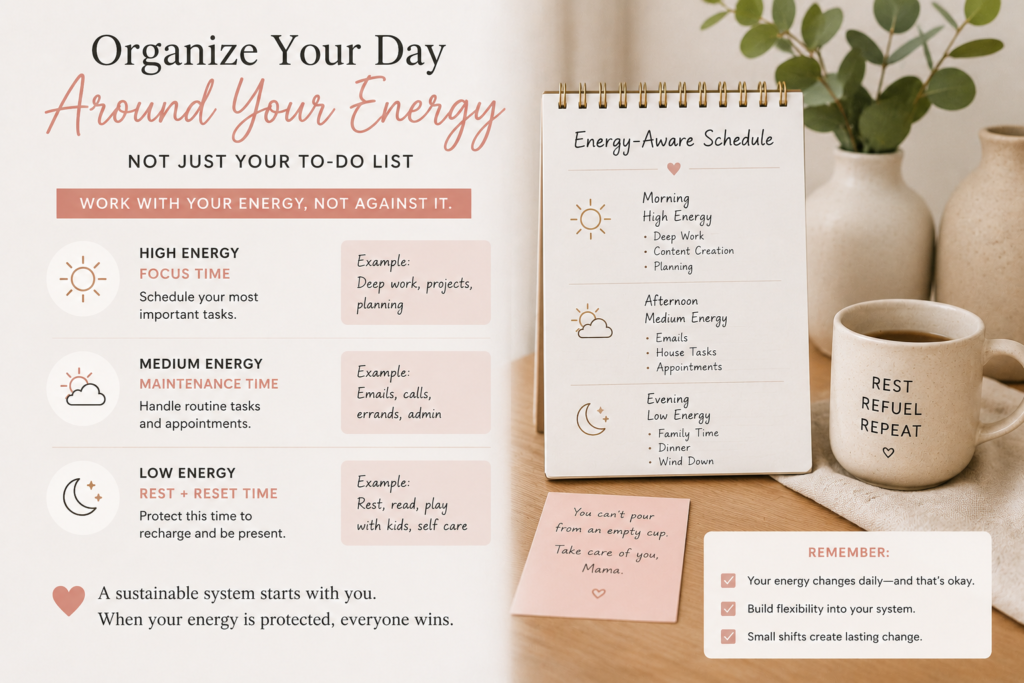
The three energy levels
I organize my capacity into three levels. This has been the most practical thing I have implemented — not because it is sophisticated, but because it is honest.
- Low energy days These happen. Chronic sleep deprivation, health flare-ups, emotionally heavy days, the mornings after bad nights with the baby. On these days the plan is survival mode: three non-negotiables only. The most critical work task, the most critical home task, and one thing for yourself — even if that is just a shower.
- Medium energy days This is most days for most mothers in the thick of it. You are functional. You are not thriving, but you are moving. On these days I plan for a realistic version of what I need to get done — not everything, not my aspirational list, but the things that matter most and are possible.
- High energy days These exist, even in the hardest seasons. The baby slept. The toddler is at nursery. You feel, for once, like a human being with agency. On these days you do the harder things — the project that needs sustained focus, the deep work, the tasks you have been deferring.
The system does not require every day to be high energy. It is built to function across all three — and to not collapse when the low energy days outnumber the others.
What my actual system looks like right now
I want to show you the real version, not the aspirational one.
The Sunday Reset
On Sunday evening — or sometimes Monday morning if Sunday collapses — I spend ten minutes doing a brain dump. Everything that is in my head: work tasks, home tasks, things I am worried about, things I keep forgetting. All of it onto paper or a notes app.
Then I look at the week ahead. I identify:
- The hard stops I cannot move
- The three work things that absolutely must happen
- The three home things that absolutely must happen
- What my energy is likely to look like based on how the weekend went
That is the whole reset. It takes ten minutes. On the weeks I skip it I feel the difference immediately — I spend Monday reactive instead of directed.
If you want to try this, the Sunday Reset Checklist on the Free Resources page walks you through it step by step. It is free.
The weekly structure I am building toward
My goal — not my current reality, my goal — is a week with three types of blocks:
- Deep work blocks: two to three hours of focused, uninterrupted work. For me this is ideally the mid-morning window when the baby is at my mother-in-law’s and before my afternoon meetings start.
- Maintenance blocks: the tasks that keep life running. Cooking, household management, emails, administrative work. These can happen in shorter, fragmented windows because they do not require sustained focus.
- Recovery blocks: this is the one most mothers eliminate first and should protect most fiercely. Rest. A short nap. Movement that is gentle rather than punishing. The things that replenish rather than deplete.
The reason I am not fully living this yet is that the recovery block keeps getting cut — by work, by the kids, by the feeling that I should be doing something more productive. I am working on it.
The Anti-Chaos System
The Anti-Chaos System is the tool I built to make this process repeatable.
It starts with a questionnaire about your real life — your kids’ schedules, your work blocks, your energy patterns, your household responsibilities. From there it helps you build a weekly structure that is specific to your actual constraints, not a generic template.
What makes it different from a standard planner is that it includes a crisis-mode version — a simplified plan for the weeks that fall apart. Because those weeks exist. And having a plan for them means the whole system does not collapse when they arrive.
The thing I am still figuring out
I want to be direct about this because I think it matters.
The biggest gap in my system right now is not organizational. It is physical.
My nutritionist gave me a meal plan weeks ago. I have not started it. I did 28 minutes of pilates last night at 9pm and it felt like a triumph. I am trying to figure out how to train consistently with a body that is dealing with ankylosing spondylitis, diastasis recti, and chronic sleep deprivation simultaneously.
I am sharing this because I think the honest version of a working mother’s organization journey includes the reality that you cannot organize your way out of physical depletion. At some point the system has to include taking care of your body — not as a wellness aspiration, but as infrastructure. Because nothing else works when the physical foundation is broken.
I have not solved this yet. I am working on it. And I will write about it here as I figure it out.
That is what this blog is. Not a finished guide. A working document.
What actually helps — a practical summary
If you are in the thick of it right now and need something actionable, here is the distilled version:
Stop planning your ideal week. Plan the week you actually have — with your actual energy, your actual childcare, your actual physical capacity.
Identify your three non-negotiables. Not ten. Three. The work task, the home task, and the one thing for yourself that you will protect even on the worst days.
Build a crisis-mode plan. Decide in advance what the minimum viable week looks like — what has to happen, what can wait, and what you will let go of completely when things fall apart.
Protect recovery. Not as a luxury. As infrastructure. You cannot give what you do not have, and no planning system works when the person running it is running on empty.
Start with the Sunday Reset. Ten minutes on Sunday buys you a clearer, more directed week. It is the smallest intervention with the largest return. Grab the free checklist here.
FAQ
Is this only for remote-working moms?
No. The energy-first approach applies to any working mother — remote, in-office, freelance, part-time. The specifics will look different, but the core problem is the same: most organization systems are not built for the interrupted, depleted, high-stakes reality of working motherhood.
Do I need to buy the Anti-Chaos System to do any of this?
No. Start with the free Sunday Reset Checklist. It walks you through the weekly reset process at no cost. The Anti-Chaos System goes further — it helps you build your full weekly structure — but the reset alone is worth starting with.
What if I try this and it doesn’t work for me?
Then you adjust. The point of energy-first organization is not to find the one perfect system — it is to stop using systems that require conditions you don’t have. If something isn’t working, the question is not “what’s wrong with me?” It’s “what does this system require that I don’t currently have, and how do I adjust for that?”
How long does the Sunday Reset take?
About ten minutes when you know what you’re doing. Longer the first few times. It is not meant to be a long planning session — it is meant to be a short, honest check-in that gets you clear before the week starts.




2 Comments on “7 Powerful Organization Systems for Moms: An Energy-First Approach That Actually Works”