
Let me guess how your last morning routine attempt went.
You read something inspiring — a blog post, an Instagram caption, a book about how successful people wake at 5am and meditate before the rest of the world is awake. You got motivated. You set the alarm. Maybe it even worked for two or three days.
Then the baby had a bad night. Or the toddler climbed into your bed at 4am. Or you were just, simply, exhausted in the way that only parents of young children understand — not tired in a way that sleep fully fixes, but tired in a way that lives in your bones.
And the routine collapsed. And you felt like you failed.
You didn’t fail. The routine failed you.
“A morning routine designed by someone without kids is not a morning routine for someone with kids. It’s a different document entirely.”
Table of Contents
Why Most Morning Routine Advice Doesn’t Work for Moms
Most morning routine advice assumes your mornings belong to you.
That you wake up peacefully. That nobody needs anything from you before sunrise. That your energy is consistent. That your schedule is predictable.
Motherhood destroys all four.
And yet most advice online still treats mothers as if they’re simply “less disciplined” versions of people without children. That if you just committed harder, woke up earlier, or found the right journal, you’d finally crack the morning routine code.
That’s why so many moms feel like failures every time another routine collapses after three days.
The problem usually isn’t motivation. It’s that the system was never built for your reality.

The Real Reasons Mom Morning Routines Fail
If you’ve ever tried to create a consistent morning routine as a mother and failed within a week, you’re not alone. Most routines fail because they depend on conditions most mothers simply don’t have.
Here are the three biggest reasons.
1. They assume you control your mornings
Most morning routine advice is built on a single assumption: that the morning is yours. That you decide when it starts, how it unfolds, and when the rest of the world gets access to you.
When you have kids, your morning starts when they decide it does.
A baby who wakes hourly overnight changes your physical capacity before the day even begins. A toddler changes your timeline. A sick child changes the entire day before 6am. And none of that is predictable, schedulable, or something you can optimize your way out of.
This is why rigid morning routines create guilt instead of support. You built a plan for a morning that belongs to you — and then your two-year-old decided otherwise at 5:47am.
A realistic morning routine for moms must work after broken sleep, during chaotic mornings, with constant interruptions, and across the low-energy seasons that early motherhood brings. Not only during ideal days that may come once a month, if that.
2. They have no Plan B
Standard morning routines are brittle. They only work when conditions are right. The moment one variable changes — sick kid, bad night, partner’s schedule shifts, baby decides 4am is morning — the whole thing collapses.
And because there’s no fallback plan built in, you’re left with two options: force the full routine on a day it doesn’t fit, or abandon it entirely and feel terrible about it.
A good system for mothers has a minimum version built in from the start. What does morning look like on the hardest day? What are the two things that must happen no matter what — the non-negotiables that keep you functional even when everything else is falling apart? That stripped-back version is your real routine. Everything else is bonus when circumstances allow.
3. They’re measuring the wrong thing
Most morning routine advice measures success by completion. Did you do all the things? Yes? Good morning. No? Failed morning.
This is the wrong metric entirely.
A better question: did the morning move you in the direction you needed to go? Did you start the day feeling even slightly more grounded than you would have without any intention at all? Did you do the one thing that makes you feel like a person before the chaos fully arrives?
That’s a successful morning. Even if it was 8 minutes instead of 45. Even if it looked nothing like what you planned. Even if the only thing you managed was coffee before the first demand hit.
Small and real beats perfect and theoretical. Every single time.
What I Actually Do in the Morning
I want to be honest here because I think the real version is more useful than the aspirational one.
I have a baby and a two-and-a-half year old. My baby is in that stage where everything changes constantly — sleep, needs, schedule — nothing is predictable yet. My toddler has a solid routine, which helps, but he also has the emotional intensity of a small hurricane before 8am.
I have ankylosing spondylitis — a chronic inflammatory condition affecting my spine and joints. I have diastasis recti after two pregnancies. I am breastfeeding. I have the kind of chronic sleep deprivation that isn’t occasional tiredness — it’s structural, accumulated exhaustion that sits in your body and affects every decision you make.
So what does my morning look like? When both kids wake up, I lie on the couch. I hand them off to my husband around 7am and go back to sleep until 8:30. Then I wake up, feed the baby, and start the day.
When I have to leave the house — when there’s a reason to actually get ready — I go to the bathroom, wash my face, brush my teeth, do my skincare routine. Then I make coffee. And I drink it while getting the kids ready, walking around the kitchen, usually holding something or someone. Sometimes I pour it into a thermos and drink it cold an hour later.
That’s my morning. Coffee is the only anchor I can honestly claim right now.
And here’s what I’ve learned from that: the coffee isn’t just coffee. It’s the five-second decision I make every morning to do one thing for myself before I do everything for everyone else. It’s small. It’s almost laughably small. But it’s mine. And on the mornings I skip it entirely — when I go straight from waking up to responding to everyone else’s needs — I feel the difference immediately.
One small thing. That’s the whole system, on the hardest days.
What Actually Works Instead: Morning Anchors
Stop trying to build a perfect morning routine.
Build a morning anchor instead.
A morning anchor is one small action — just one — that helps you feel intentional before the day fully accelerates. It doesn’t have to be impressive. It doesn’t have to signal anything to anyone. It just has to be yours, and it has to happen before you’re fully in reactive mode.
The best part about anchors is that they work during hard seasons. They survive interruptions. They don’t require perfection or a quiet house or a baby who slept through the night.
Examples of morning anchors:
- Coffee before checking your phone
- Washing your face before picking up the baby
- Three deep breaths before getting out of bed
- Reviewing your top priority for the day
- Opening the curtains and standing in natural light for two minutes
- A specific song that signals the day is starting on your terms
- Sitting outside with your drink for five minutes before the noise begins
None of these are impressive. None of them require waking up at 5am. All of them work because they’re a small act of intention in a morning that otherwise happens to you instead of for you.
Start with one. Just one. Make it something so small it’s almost embarrassing. That’s the version that will actually stick.
The 3-Level Morning System
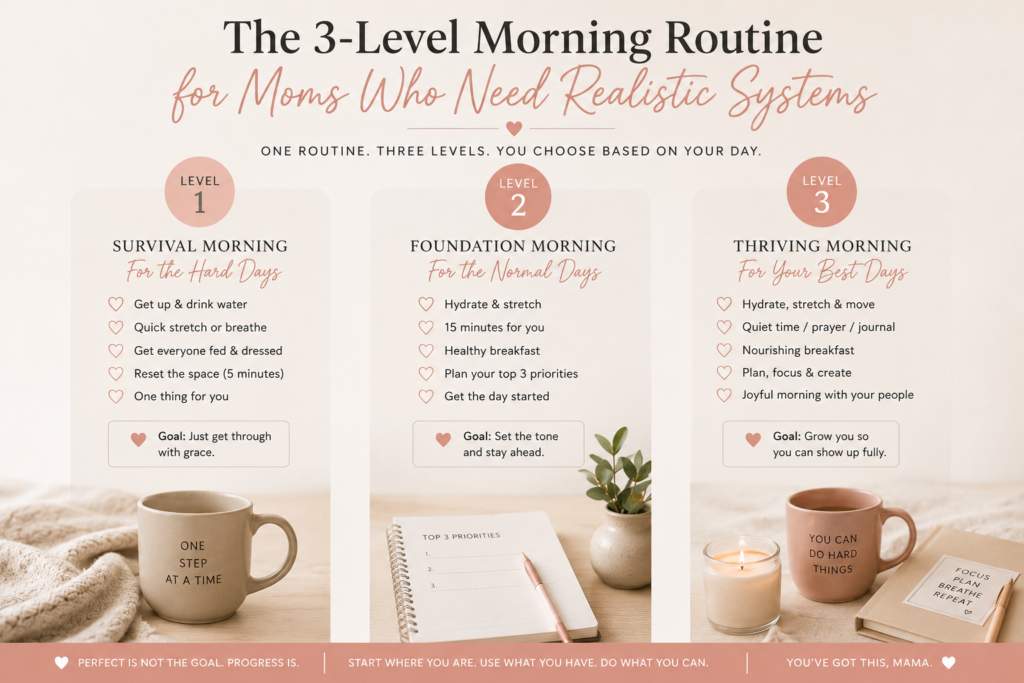
Instead of building one perfect morning routine that collapses the first time conditions aren’t ideal, build three versions. One for the worst days. One for the normal days. One for the rare days when things align.
This is the 3-Level Morning System — and having all three defined in advance means you never have to decide which version of the routine applies in the moment. You just assess where you are and run the corresponding version.
Level 1 — Survival Morning
When to use it: After a terrible night. Sick kids. A baby who didn’t sleep. A health flare-up. Any morning where functioning is the entire goal.
The only rule: Do the one thing that makes you feel like a person. Just one.
What it looks like:
- Drink something — water, coffee, anything
- Wash your face or brush your teeth — one small hygiene act that signals the day has started
- Identify the single most important thing that needs to happen today — just one, not a list
That’s it. That’s the whole Level 1 morning. You don’t owe anyone more than this on a survival day. Getting through it is the achievement. Not optimizing it.
What to let go of: Everything else. The workout. The journaling. The elaborate breakfast. The inbox. All of it can wait. Survival mode is not failure mode — it’s an appropriate response to genuinely hard conditions.
Level 2 — Standard Morning
When to use it: Most days. The baseline. You’re tired but functional. The kids are managing. The night was broken but not catastrophic. This is the routine you can actually count on most of the time.
What it looks like:
- Your anchor — the one non-negotiable thing (coffee, face wash, whatever yours is)
- Get dressed — even into something comfortable, but dressed. It changes how the day feels.
- Do a 5-minute priority check — what are the two or three things that actually need to happen today?
- Prep one thing for the day ahead — lunch, bag, laptop, whatever reduces friction for future you
- Eat something, even if it’s small, before the demands start
What makes this level work: It’s short enough to be realistic but intentional enough to feel different from complete chaos. Most moms can reliably do a Level 2 morning even on the hard weeks. It becomes the foundation everything else is built on.
Time required: 20–30 minutes, including getting dressed. Less if you need it to be.
Level 3 — Ideal Morning
Let me be completely honest about this level: for most mothers of young children, it doesn’t exist yet. And that’s okay.
Before I became a mom, I had Level 3 mornings. I’d wake up without an alarm, make coffee, sit quietly for a few minutes, exercise, eat a real breakfast. The morning felt like mine.
That version of morning is currently not available in my life. And if you have a baby or a toddler or both, it’s probably not available in yours either.
But here’s why Level 3 still matters: it gives you something to aim toward as the season changes. Babies grow. Sleep improves — not always linearly, but eventually. The conditions that make Level 3 impossible right now are temporary.
What Level 3 looks like when it becomes possible:
- Waking up before or at the same time as the kids, with enough sleep behind you that it doesn’t feel punishing
- A longer anchor — not just coffee but coffee and something else that’s yours. A walk. Ten minutes of reading. Movement that feels good rather than obligatory.
- A real breakfast, eaten sitting down, not walking around the kitchen holding a baby
- A proper priority review — not just the day’s tasks but the week’s direction
- Some form of movement — not as punishment but as maintenance. Even 20 minutes.
- Getting fully dressed, in clothes you actually feel good in, before the day starts
The important caveat: Don’t try to force Level 3 during a Level 1 season. The mistake most productivity advice makes is assuming everyone is operating at Level 3 capacity all the time. You’re not. And chasing Level 3 mornings when you’re in a Level 1 reality creates a specific kind of exhaustion — the exhaustion of constantly falling short of an aspiration that isn’t appropriate to your current conditions.
Know which level you’re in. Operate accordingly. And let Level 3 be something you’re moving toward, not something you’re failing to reach right now.
Should Moms Wake Up Before Their Kids?
The short answer: sometimes yes, sometimes absolutely not.
The longer answer: it depends entirely on whether you have enough sleep to absorb the earlier wake-up without making everything worse.
If waking up 30 minutes before your kids gives you quiet, peace, a moment that’s yours before the noise starts — and you can do it without falling into a sleep debt hole — it can be genuinely valuable. Many moms find that 20 minutes of silence before anyone needs anything from them changes the entire texture of the day.
But if you’re already chronically sleep-deprived because of a baby who wakes multiple times a night, a toddler who ends up in your bed, or simply the accumulated exhaustion of early parenthood — waking up earlier is not the answer. It is, in fact, the opposite of the answer.
Sleep deprivation at the level many mothers experience it affects brain function, emotional regulation, decision-making capacity, and physical health in measurable ways. Cutting more of it to gain a quiet morning is a trade most bodies can’t sustain.
The 5am routine advice was written for people who are sleeping through the night. If that’s not you right now, it doesn’t apply to you right now.
Protect your sleep. Build your anchor. That’s enough.
Why Traditional Productivity Advice Often Fails Mothers
A large amount of productivity advice online is built around optimization, consistency, and strict habit formation. It assumes a stable baseline — stable energy, stable schedule, stable sleep — and then offers systems for making the most of that baseline.
Mothers, especially those with young children, often don’t have a stable baseline. The baseline itself keeps changing. Research from the American Psychological Association has repeatedly shown that chronic stress, sleep disruption, and cognitive overload affect focus, emotional regulation, and decision-making — all things many mothers experience daily, not occasionally.
That’s part of why routines that look simple on paper can feel impossible in real life after multiple night wakings, childcare interruptions, or the particular mental load of running a household while also running a career.
This is also why many experts now recommend flexible systems over perfection-based productivity models. A sustainable routine should adapt to your current season of life instead of demanding the same performance every single day regardless of conditions.
For mothers especially, consistency often looks less like discipline and more like recovery, adaptation, and reducing friction wherever possible. The goal is not a perfect morning. The goal is a morning that moves you forward — even slightly — on the days when forward is all you’ve got.
How to Start This Week
Don’t design a full morning routine. Don’t download a template. Don’t set five new alarms.
Do this instead:
Step 1: Decide which level you’re in right now. Be honest. If you’re in a sleep regression, you’re in Level 1. If things are hard but manageable, you’re in Level 2. Act accordingly.
Step 2: Identify your one anchor. The single thing that makes you feel like a person before the day takes over. Coffee, face wash, two minutes outside — whatever it is, name it.
Step 3: Do that anchor tomorrow morning before you respond to anything else. Before you check your phone. Before you answer anyone’s request. Do your anchor first.
Step 4: Keep a minimum version ready. Know what Level 1 looks like for you so that on the bad days, you’re not improvising — you’re just running the minimum version.
Step 5: Let that be enough for now.
The more elaborate system — the one with movement and journaling and a real breakfast eaten in peace — that comes later. It comes when the sleep improves, when the kids get a little older, when the season shifts. It is not gone forever. It is just not available right now.
What is available right now is your anchor. Start there.
A Practical Summary
- Rigid morning routines fail mothers because they depend on conditions — uninterrupted sleep, predictable mornings, consistent energy — that motherhood removes.
- Morning anchors work because they’re small enough to survive the hard days. One thing, done consistently, is more sustainable than ten things done perfectly twice.
- The 3-Level System removes the all-or-nothing trap. Level 1 for survival days. Level 2 for normal days. Level 3 for when the season allows.
- Waking up early is not the answer if you’re already sleep-deprived. Protecting sleep matters more than gaining a quiet morning at the cost of the sleep you already don’t have enough of.
- The goal is not a perfect morning. The goal is one small act of intention before the day happens to you.
Frequently Asked Questions
Why do morning routines fail for moms?
Most morning routines fail because they rely on uninterrupted sleep, predictable schedules, and consistent energy — conditions many mothers don’t have. They also tend to be brittle — one bad night and the whole system collapses because there’s no minimum version built in.
What is the best morning routine for overwhelmed moms?
The best routine is a flexible one with three versions: a survival version for the hardest days, a standard version for most days, and an ideal version for when conditions allow. Starting with one anchor — one small non-negotiable act that’s yours — is more sustainable than any elaborate system.
How can working moms create realistic morning routines?
Start by assessing your current season honestly — not what you wish were possible, but what actually is. Then identify one anchor, build a minimum version of your morning, and only add complexity when the simpler version is genuinely holding.
Do moms need to wake up early to be productive?
Not necessarily. Sleep deprivation reduces cognitive function, emotional regulation, and decision-making capacity in measurable ways. For many mothers, protecting the sleep they have matters more than waking earlier to gain a quiet morning.
What is a morning anchor?
A morning anchor is one small intentional act done before the day fully takes over — coffee before checking your phone, washing your face before picking up the baby, two minutes outside before the noise starts. It doesn’t need to be impressive. It needs to be consistent and yours.
What if I have a baby and my mornings are completely unpredictable?
Then you’re in Level 1 season. Your morning routine right now is survival mode — and survival mode is a legitimate, appropriate response to genuinely hard conditions. Find your one anchor and let that be enough. The more structured version comes later when the season changes.
Is the 5am routine realistic for new moms?
For most mothers with babies or toddlers who are not sleeping through the night, a 5am wake-up creates more problems than it solves. It was designed for people with adequate sleep. If that’s not your situation, it doesn’t apply to your situation.
How long should a realistic mom morning routine take?
Level 1 can be done in 5 minutes. Level 2 in 20–30 minutes. Level 3 varies. The goal is not a long routine — it’s an intentional one. Short and real beats long and aspirational.
Free Download for Overwhelmed Moms
Use this before opt-in:
If your mornings feel reactive before they even begin, my free Sunday Reset Checklist helps reduce mental load before Monday starts.
It’s designed specifically for overwhelmed working moms trying to manage home, work, kids, and exhaustion without rigid perfectionism.